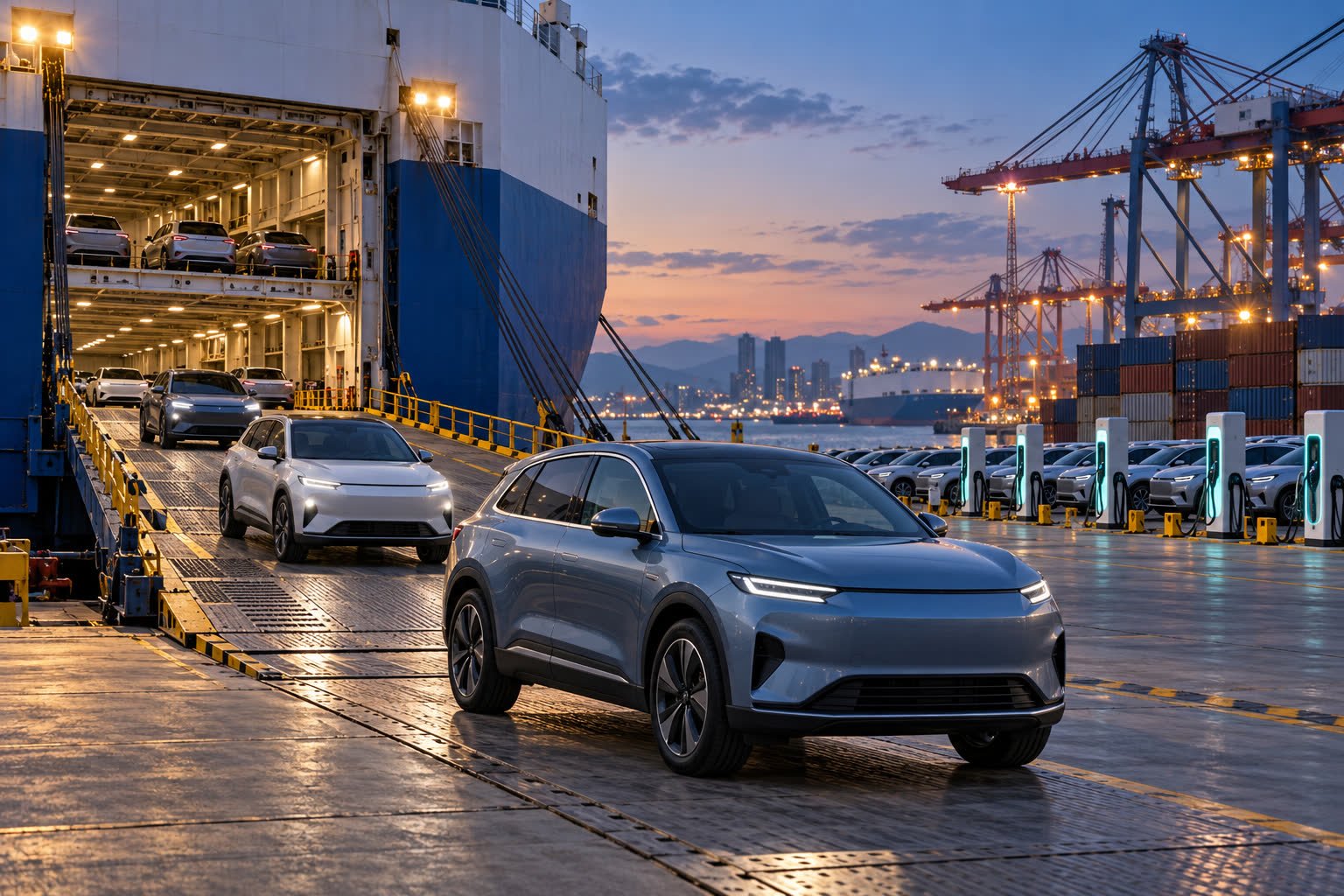
BYD reported a 28.1% year-on-year rise in third-quarter 2026 net profit to RMB10.02 billion, while its overseas vehicle shipments more than doubled. The result matters beyond one automaker: it shows that the global electric-vehicle race is shifting from China’s home-market price war to export logistics, local production and trade rules.
The quarter was stronger than the first half, but it was not a clean breakout. BYD’s unaudited filing and same-day Reuters coverage show a return to revenue growth, while the nine-month figures still show profit below last year’s level. That leaves global buyers, dealers and suppliers watching whether overseas expansion can keep growing without putting too much pressure on inventory, cash and margins.
Key takeaways
- BYD’s Q3 net profit reached RMB10.02 billion, up 28.1% year on year; revenue rose 13.6% to RMB221.49 billion.
- Company sales disclosures show 550,704 vehicles exported in Q3, up 137% from the year-earlier quarter.
- For the first nine months, net profit fell 4.2% to RMB22.34 billion, while revenue was essentially flat at RMB566.30 billion.
- Inventory reached RMB221.58 billion, up 60.1% from 31 December 2025; trade receivables rose 52.6% to RMB56.47 billion.
- The next test is whether export growth can absorb China’s intense price competition while European trade scrutiny and local-production requirements increase.
What BYD reported
BYD’s 29 October 2026 third-quarter report gives the clearest measure of the rebound. Net profit attributable to shareholders was RMB10.02 billion,. Revenue was RMB221.49 billion, up 13.59% year on year. Reuters separately reported the same headline figures, rounding the profit increase to 28% and revenue to RMB221.5 billion.
The improvement is meaningful because revenue had contracted for four consecutive quarters, according to Reuters’ review of the company’s results. It still needs to be read in context. Across the first nine months, BYD reported revenue of RMB566.30 billion, almost unchanged from a year earlier, and attributable net profit of RMB22.34 billion, down 4.2%. One better quarter has improved the trend, but it has not erased the pressure built up earlier in 2026.
Exports are carrying the global story
BYD’s vehicle disclosures show why the quarter is globally important. The company sold 1,323,065 vehicles in the third quarter, up about 18.7% from 1,114,192 a year earlier. It exported 550,704 vehicles, compared with 232,806 in Q3 2025, a 137% increase. That means roughly two-fifths of the quarter’s vehicle sales were exported, according to calculations based on the company’s disclosures reviewed by Reuters and Electrek.
For the international auto market, this changes the question being asked of Chinese EV makers. The issue is no longer only whether they can build large volumes at competitive prices in China. They also have to move vehicles through ports, provide service and parts in unfamiliar markets, meet different safety and software requirements, and decide when overseas assembly makes more sense than shipping finished vehicles.
That expansion can give buyers more choice. A larger export pipeline can bring more electric body styles and battery options to markets that previously had limited EV supply. But availability is not the same as affordability. Final prices still depend on shipping, duties, taxes, exchange rates, local incentives, dealer costs and charging access. BYD’s earnings report does not set the retail price of any specific model in any country.
Why the balance sheet matters
The most important warning sign is not a single profit number; it is the amount of working capital tied up as BYD expands overseas. The filing shows inventory of RMB221.58 billion at 30 September 2026, up 60.1% from RMB138.42 billion at the end of 2025. Trade receivables reached RMB56.47 billion, up 52.6% from RMB37.00 billion over the same period. Reuters said both increases were primarily connected with the growth of the overseas automotive business.
Those figures do not prove that vehicles are unsold or that the expansion is failing. Cars in transit, port compounds and dealer networks can remain on a company’s books for longer than vehicles sold through a more established domestic channel. The reasonable inference is that a global push requires more cash and credit before revenue is collected. That creates more exposure to currency moves, shipping delays, local demand and discounting.
For the global EV industry, this is a useful distinction. Export growth can be strategically valuable while still being financially demanding. The companies that win the next phase will need not just low-cost batteries and high factory output, but also a disciplined way to match production with demand market by market.
Trade policy is part of the next test
BYD’s overseas growth is arriving as trade barriers become more important. Reuters reported that Chinese automakers face the prospect of tighter European scrutiny, with the European Union already applying additional duties to China-made battery-electric vehicles and considering limits on fast-growing hybrid imports. Bloomberg coverage published by The Edge Singapore also said European policy and local-production plans would be central to how investors judge BYD’s expansion.
That means the company’s international strategy is likely to become more local over time. Building or assembling vehicles closer to customers can reduce exposure to some border costs and shorten supply chains, but it also requires capital, suppliers, labour and regulatory approvals. For drivers, the result could be more locally tailored EVs, yet not necessarily a simple fall in sticker prices.
What this means for EV and fuel decisions
A quarterly result cannot tell a buyer whether a particular EV is cheaper to own. It does, however, show why the global vehicle market may offer more electric choices in the years ahead, while petrol and diesel vehicles face a stronger technology and pricing challenge. The running-cost comparison still depends on the vehicle, distance, electricity tariff, fuel price and charging access.
Readers comparing a petrol or diesel trip with an EV can use the fuel cost calculator to model the conventional-fuel side of the equation. For current pump rates, the live fuel prices section provides a starting point. Drivers planning around public charging can check the EV charging-station directory, while the latest news archive tracks related fuel and mobility developments.
The practical point is to separate the market signal from the household decision. BYD’s export growth may increase choice and competition, but a real ownership comparison still needs the local purchase price, financing terms, insurance, taxes, charging availability and expected annual distance. Those inputs vary by market and by driver profile.
What to watch next
Three indicators will show whether this quarter marks a durable change. First, watch whether BYD’s overseas volumes keep rising without a further sharp build-up in inventory and receivables. Second, watch how quickly production in overseas facilities develops relative to finished-vehicle exports. Third, watch European and other market rules, because tariffs, quotas and local-content requirements can change the economics of an export-led strategy.
The reader takeaway is balanced. BYD’s Q3 report confirms that overseas EV demand has become a major growth engine, with export shipments up 137% year on year. It also shows that global expansion carries real working-capital and policy risks. For buyers, the likely result is more electric-car choice and tougher competition, but the final cost and ownership experience will still be decided locally.
Sources
- BYD Company Limited, 2026 Third Quarterly Report, 29 Oct 2026
- Reuters, BYD’s third-quarter profit growth slows, misses forecasts, 29 Oct 2026
- Electrek, BYD Q3 profit jumps 28% on exports, but inventory balloons 60%, 29 Oct 2026
- Bloomberg via The Edge Singapore, BYD earnings dampen hopes Chinese car stocks will reverse rout, 30 Oct 2026
This article is for general information only and is not financial, insurance or legal advice.