MoRTH’s E85/E100 flex-fuel rule has brought a practical insurance question into focus: current insurer views reported by Mint say E100 compatibility alone is not an automatic premium-loading trigger, but the vehicle’s fuel specification and policy wording still matter. The rule does not make an ordinary E20 petrol car safe to run on E100, and it does not make every fuel-system or engine loss payable under a comprehensive policy.
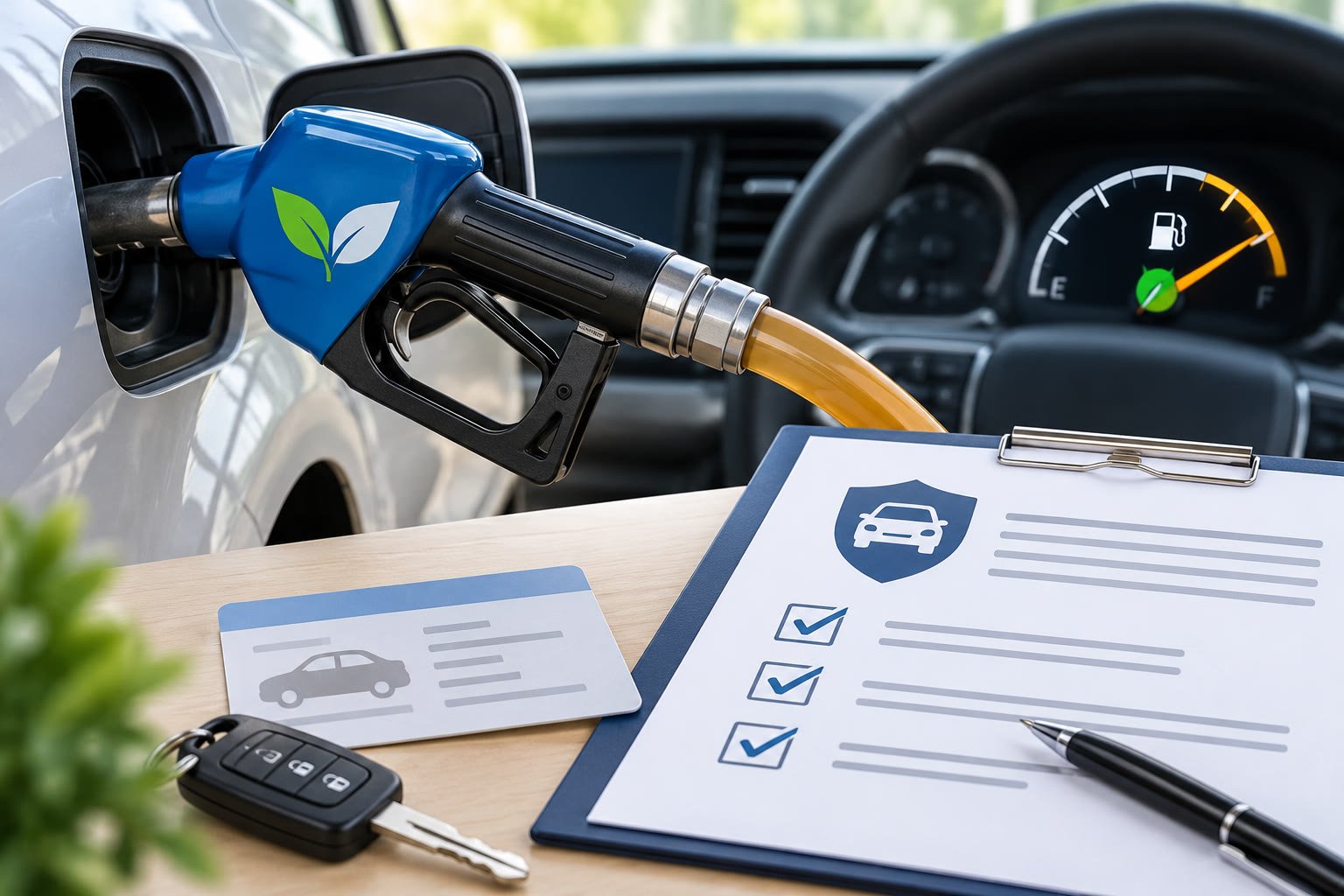
For a buyer or owner, the useful takeaway is to cross-check three records—fuel compatibility sticker, registration certificate (RC) and insurance schedule—before selecting fuel or renewing cover. Once the approved fuel is clear, the fuel cost calculator can help compare running-cost assumptions without treating an unapproved fuel as an option.
Key takeaways
- MoRTH notified Central Motor Vehicles Rules changes on 26 Oct 2026 to expressly recognise E100 alongside E85 for vehicles designed and certified as flex-fuel vehicles.
- An E20-compatible petrol car is not automatically compatible with E85 or E100, and existing owners are not being asked to modify their vehicles.
- Mint reported on 1 Nov 2026 that insurers do not expect E100 compatibility alone to create an automatic premium loading; actual pricing can still reflect the model, value, repairs, location and claims experience.
- Engine protection is an add-on with its own terms. A comprehensive policy does not automatically cover every mechanical, fuel-related or consequential loss.
- There is no nationwide E100 retail-rollout date in the rule change, so fuel availability and vehicle certification remain separate checks.
What MoRTH changed on 26 Oct
The Ministry of Road Transport and Highways said in its 26 Oct 2026 Press Information Bureau release that it had notified amendments to the Central Motor Vehicles Rules, 1989. The change expressly includes E100 alongside E85 in the emission-certification provisions for suitable flex-fuel vehicles. The ministry said the amended rules take effect from publication in the Official Gazette.
E85 is a petrol-ethanol blend containing up to 85% ethanol by volume. E100 is the higher-ethanol category covered by the amendment and is described as fuel containing 100% ethanol in an Economic Times explainer published on 27 Oct 2026. The labels are not permission for every petrol vehicle to use either fuel: the official release says the vehicle must be specifically designed and certified for the approved blend.
That distinction is central for Indian drivers. A car that is compatible with E20 is not automatically suitable for E85 or E100. The ministry also said the notification does not require owners of existing vehicles to switch fuel or retrofit their cars. Drivers are expected to check the vehicle’s fuel-compatibility sticker and follow the manufacturer’s owner-manual guidance.
The Economic Times separately reported that the amendment was notified through G.S.R. 911(E) and does not announce a nationwide E100 availability date. In practice, the legal ability to certify a vehicle and the physical availability of the fuel at a petrol pump are different questions. Drivers can use the live fuel-price pages for conventional fuels, but an E100 price or station should not be assumed where no verified local listing exists.
Why insurance is part of the check
Vehicle insurance normally follows the risk and specification of the insured vehicle, not just a broad fuel label. In its 1 Nov 2026 report, Mint quoted insurer representatives who said a factory-built, regulator-recognised E100 vehicle would not inherently require a separate policy or a premium loading solely because of its compatibility. The same report said own-damage pricing can reflect the vehicle’s make, model, value, repair and replacement cost, safety features, location and claims experience.
This is reported industry commentary, not a new tariff notification from MoRTH or IRDAI. It should not be read as a promise that every E100-compatible car will cost the same to insure as a comparable petrol model. A newer or more expensive vehicle, costlier components or a different claims record can still change the quote. Third-party and own-damage sections also have different pricing and coverage logic, so the policy schedule matters more than a general assumption about flex fuel.
The information recorded by the manufacturer and registration authority also matters at claim time. A factory-fitted flex-fuel vehicle with the correct fuel type and variant in the RC is different from an aftermarket conversion or an undisclosed modification. Mint reported that modifications should be disclosed to the insurer and approved where required; a mismatch can create questions about claim admissibility.
What to check before buying or renewing cover
1. Match the fuel specification
Start with the fuel sticker, owner’s manual and manufacturer specification. Confirm whether the vehicle is certified for E20 only, a wider E20-to-E85 range, or E100. Do not infer compatibility from the fact that a pump sells ethanol-blended petrol, and do not treat a generic flex-fuel claim as a substitute for the exact certification of the variant.
2. Match the RC and policy schedule
Check that the registration number, make, model, variant, engine details and declared fuel type are recorded consistently in the RC and policy schedule. For a new vehicle, compare the documents supplied at delivery. For a modified vehicle, keep the approval or endorsement trail and disclose the change before a renewal or claim. The goal is not a particular insurer or product; it is a consistent record of what is actually being insured.
3. Read engine and fuel-related exclusions
A comprehensive policy is not a blanket warranty for the powertrain. The official engine-protection explainer from ICICI Lombard says its engine-protect cover is an add-on and that the standard comprehensive cover does not automatically cover consequential engine damage from water ingress or lubricating-oil leakage. Other insurers can use different wordings, limits and exclusions.
At renewal, read the sections dealing with mechanical breakdown, wear and tear, consequential loss, contaminated or incorrect fuel, and fuel that the manufacturer has not approved. Check whether an engine-protection add-on is available for the vehicle and what causes of damage it actually covers. Our guide to car-insurance add-ons and engine protection explains why the add-on name alone is not enough.
4. Check the repair pathway
Ask whether the insurer’s network can service the vehicle’s certified fuel system and whether the claim process requires inspection before repairs. This is especially relevant for a newly introduced powertrain or a limited-production flex-fuel variant, where the nearest authorised workshop may not be the same as the nearest general garage. Coverage and service availability are separate parts of the ownership question.
What changes now, and what does not
The confirmed change is regulatory: manufacturers have a clearer CMVR pathway for vehicles certified to use E85 or E100, subject to the applicable emission and safety requirements. The notification also tells motorists to follow the vehicle’s fuel label and owner’s manual. That is the immediate action point for anyone looking at a flex-fuel vehicle.
What has not changed is equally important. An ordinary petrol car cannot be treated as E100-compatible merely because E100 is now recognised in the rules. The amendment does not announce a nationwide pump network, does not set a universal insurance premium, and does not convert a comprehensive policy into a fuel-damage warranty. The insurer’s reported view is that compatibility alone is not a reason for automatic loading, while the final premium and claim outcome still depend on the specific vehicle and policy wording.
For renewal comparisons, use the same IDV, deductible, policy period and add-ons when comparing quotes; our car-insurance renewal comparison guide covers those fields. For running-cost comparisons, use only a fuel the manufacturer has approved and a price that is dated and locally verified.
Reader takeaway
E100 recognition is a regulatory opening for certified flex-fuel vehicles, not a blanket change for India’s existing petrol fleet. The safest record check is simple: match the fuel sticker and owner’s manual to the RC, match the RC to the insurance schedule, and read the exclusions before assuming that engine or fuel-related damage is covered. The rule may make new flex-fuel products easier to certify, but the buyer’s real protection will still come from accurate vehicle details and understood policy terms.
Sources
- Press Information Bureau / MoRTH — Ministry of Road Transport and Highways updates rules to facilitate E85/E100 flex fuel vehicles — 26 Oct 2026
- Mint — E100-compatible cars in India: Will motor insurance premiums rise, and what happens to coverage and claim settlements? — 1 Nov 2026
- The Economic Times — 100% ethanol fuel: E100 ethanol fuel allowed in India: What it is, whether you can use it in your existing petrol car & what the new rules mean — 27 Oct 2026
- ICICI Lombard — Engine Protect Cover in Car Insurance — accessed 1 Nov 2026
- IRDAI — Bima, Bemisaal policyholder booklet — accessed 1 Nov 2026
This article is for general information only and is not financial, insurance or legal advice.