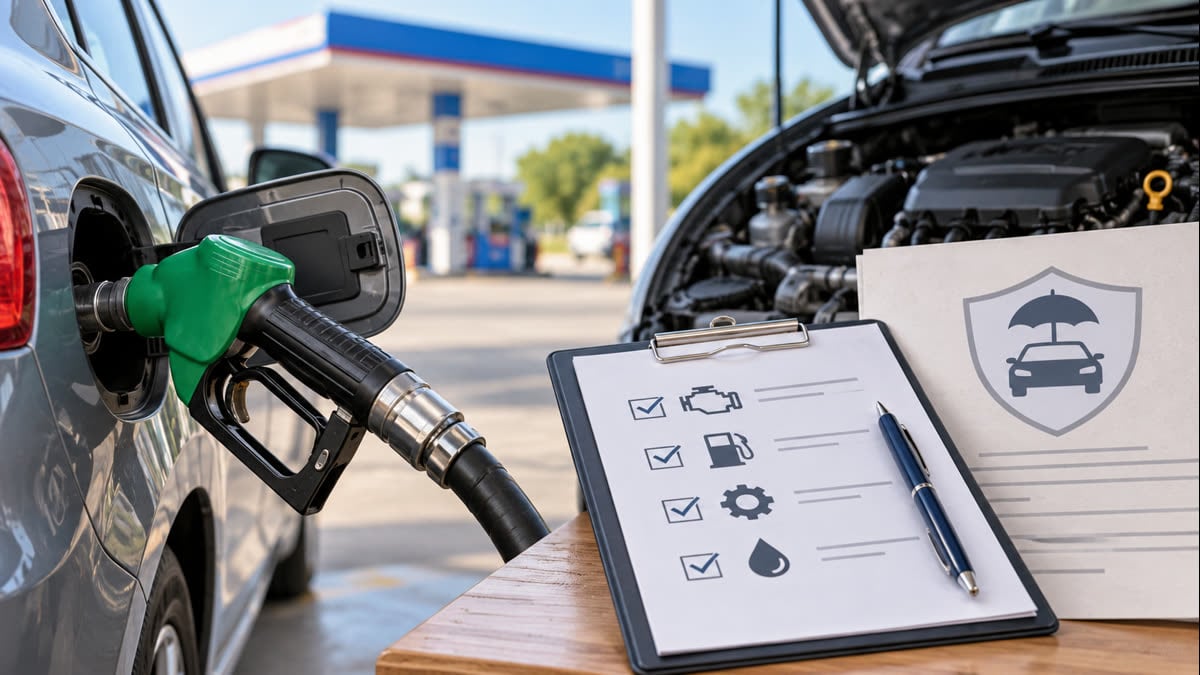
E20 petrol use alone does not cancel a motor-insurance policy, but a claim for engine or fuel-system damage in an older or incompatible car may still turn on the cause of the loss and the exclusions in the policy wording. The issue came back into focus after a 16 Oct 2026 report cited an insurer executive who said policyholders should not assume that every fuel-related repair will be reimbursed.
For drivers, the practical distinction is important: an accident claim and a mechanical-damage claim are not assessed in the same way. Government clarifications say E20 use itself does not invalidate vehicle insurance, but that does not make every repair following a fuel-related fault an automatically payable loss.
Key takeaways
- E20 is petrol blended with 20% ethanol; its use alone does not void a motor-insurance policy.
- A claim for engine or fuel-system damage can depend on whether the loss was accidental, a mechanical breakdown, gradual deterioration or a compatibility issue.
- Vehicle owners should check the fuel recommendation in the owner's manual and keep the diagnosis, service and repair records.
- Insurers may assess the cause of the damage through an inspection and technical evidence before deciding whether the loss falls within the policy.
What the latest report says
Business Today reported on 16 Oct 2026 that Shanai Ghosh, Member of the Executive Committee of the General Insurance Council and MD and CEO of Zuno General Insurance, described coverage as dependent on the policy terms, the circumstances of the loss and the cause of damage. The report focused on older petrol cars whose owners are concerned that prolonged use of E20 could affect engine, fuel-pump or other fuel-system parts.
That is a warning about claim assessment, not a blanket statement that E20 users lose cover. The same report noted that vehicle age alone does not decide whether a claim is accepted or rejected. The evidence about what failed, why it failed and which part of the policy responds remains central.
Why a valid policy does not mean every repair is covered
A comprehensive motor policy generally responds to insured events such as accidental external damage, fire, theft and other perils selected in the policy. It is not designed to pay every maintenance or reliability cost. The standard private-car package wording archived on the IRDAI website excludes categories including consequential loss, depreciation, wear and tear, and mechanical or electrical breakdown.
That exclusion does not mean an insurer can reject an accident claim merely because the vehicle was filled with E20. It means the surveyor must distinguish between damage caused by an insured event and a component failure or gradual deterioration that falls within an exclusion. If an engine fault is alleged to be fuel-related, the inspection report, workshop diagnosis, maintenance history and the policy wording can all affect the outcome.
There is also a difference between a vehicle's warranty and its insurance. A manufacturer may assess compatibility or a parts failure under its own warranty rules, while an insurer assesses the insured peril and the policy's exclusions. Owners should not treat a warranty decision as an automatic insurance decision, or the reverse.
What the government and insurers have clarified
The Ministry of Petroleum and Natural Gas has repeatedly said that E20 use does not affect the validity of vehicle insurance. In its 5 Jul 2026 EBP backgrounder, the Press Information Bureau also said insurers and vehicle makers had clarified that E20 has no impact on insurance or warranty validity in India. A separate 5 Jun 2026 PIB release carried the same position while discussing the rollout of higher-ethanol fuels.
That confirmed position addresses whether filling E20 automatically cancels cover. It does not promise payment for a disputed engine repair. Business Standard reported on 15 Jun 2026 that ICICI Lombard said it would not reject claims merely because E20 was used and that claims are assessed on the insured peril. The current discussion is therefore about causation and exclusions, not an automatic E20 penalty on every policyholder.
What older petrol-car owners should check now
- Confirm the vehicle's fuel specification. Check the owner's manual, fuel-compatibility label and the manufacturer's service guidance. If the information is unclear, ask an authorised service centre to record the recommendation in writing.
- Read the own-damage section. Note the exclusions for mechanical breakdown, wear and tear, consequential loss and maintenance-related deterioration. Also check the exact conditions of any engine or component add-on already attached to the policy.
- Preserve evidence if a fault appears. Keep fuel bills, dates, warning-light photographs, service invoices and the workshop's diagnostic report. Do not describe a failure as E20-related as a fact until a qualified technical assessment establishes the cause.
- Separate accident damage from a mechanical fault. Report an accident through the normal claims process and explain the sequence accurately. If the vehicle first develops a mechanical problem and later suffers another loss, the two events may be assessed differently.
For a step-by-step reference on documents, intimation and timelines, see this car insurance claim process guide. Owners can also use this guide to checking vehicle insurance online to confirm policy details before a problem occurs.
What this means for household fuel costs
The immediate financial risk is uncertainty, not an announced E20 surcharge on motor insurance. If a driver notices a change in mileage or service spending, the useful record is the actual fuel quantity, distance, traffic pattern and maintenance work over time. A fuel cost calculator can help separate a change in running cost from a disputed repair bill, but it cannot determine whether an insurer will accept a claim.
What to watch next
The next useful development would be clearer, standardised guidance on how insurers should assess alleged damage linked to a government-mandated fuel. Until that happens, the reader takeaway is narrow but important: E20 use alone does not cancel motor insurance, while a claim for fuel-related mechanical damage still needs a documented cause and must satisfy the policy's coverage and exclusion clauses.
Sources
- Business Today — “E20 fuel and older petrol cars: Could engine damage lead to an insurance claim rejection?” — 16 Oct 2026
- Press Information Bureau — “Ethanol Blended Petrol (EBP) Programme: Policy Evolution, Key Milestones and Frequently Raised Concerns” — 5 Jul 2026
- Press Information Bureau — “E85-powered vehicles run on domestically produced ethanol...” — 5 Jun 2026
- IRDAI archive — “Standard Form for Private Car Package Policy” — policy wording
- Business Standard — “ICICI Lombard says E-20 fuel use won't affect motor insurance claims” — 15 Jun 2026
This article is for general information only and is not financial, insurance or legal advice.