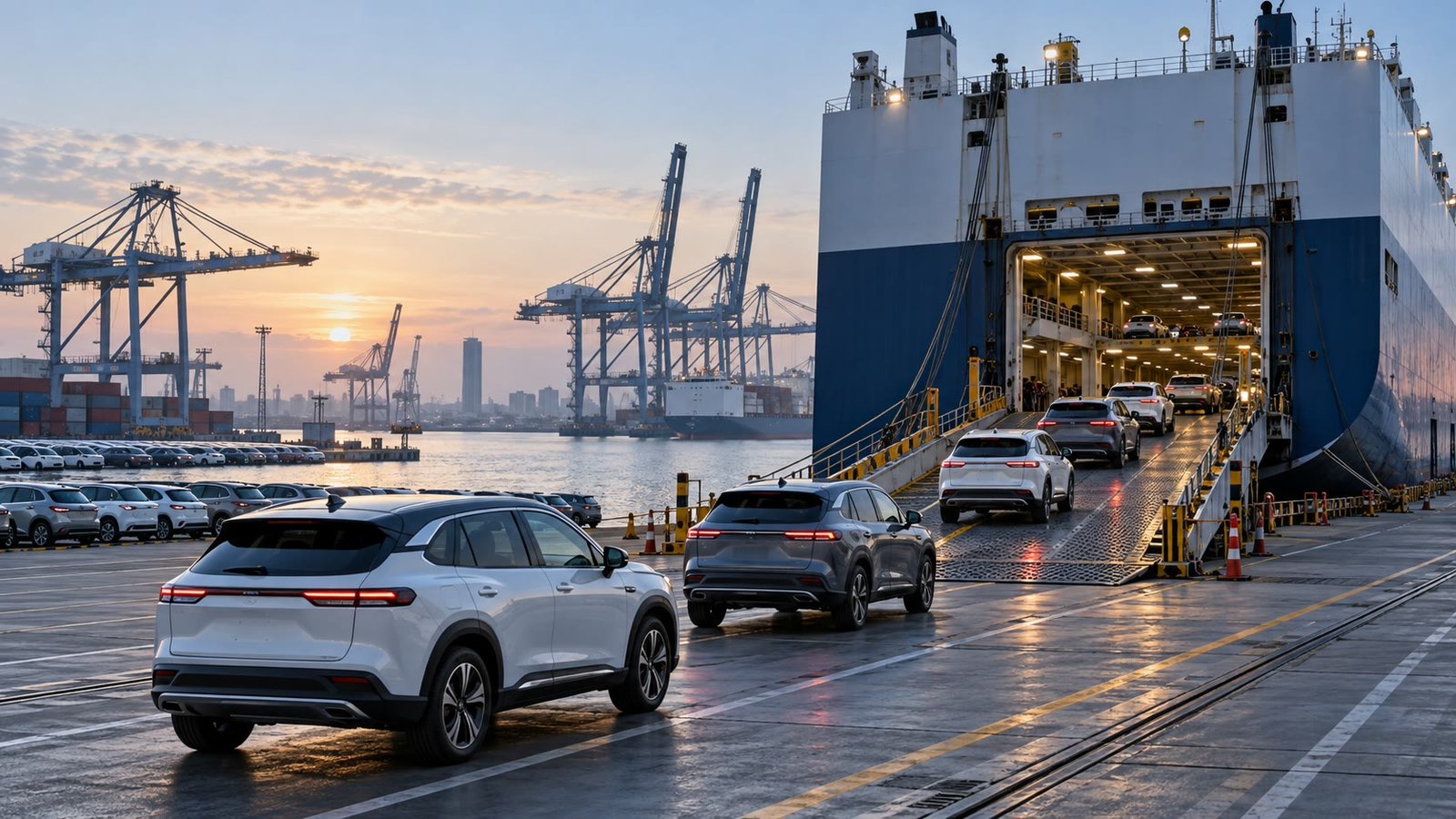
An interim EU–China trade understanding would limit imports of China-made hybrid and plug-in hybrid passenger cars to 350,000 vehicles a year, with the quota expected to start in December 2026. The move matters beyond Europe: it could redirect Chinese vehicle exports, change model availability for buyers and deepen the shift from open EV trade toward local production and managed market access.
Key takeaways
- The reported ceiling is 350,000 China-made hybrid vehicles a year, including plug-in hybrids.
- The European Commission has confirmed a shared understanding to moderate exports, but final EU endorsement and customs procedures are still pending.
- Cars made by Chinese companies inside the EU would be outside the quota; vehicles made in China by EU companies would be included, according to reporting.
- The agreement comes as Chinese automakers expand overseas while domestic passenger-car sales weaken.
What the interim deal changes
On 9 October 2026, EU Trade Commissioner Maroš Šefčovič said the EU and China had reached a shared understanding to moderate China’s exports of hybrid and plug-in hybrid vehicles to the European Union. In the official European Commission audiovisual record, he said the arrangement opened the prospect of cutting those exports by more than 50%, while stressing that the final decision would be assessed by EU leaders.
Independent reporting then supplied the concrete mechanism. The Associated Press said on 12 October that two senior EU officials described an annual import quota of 350,000 hybrid vehicles made in China, including plug-in hybrids. The Guardian reported the same 350,000-car ceiling and said the European Commission had confirmed it, with the measure expected to come into force in December.
That distinction matters. As of 13 October 2026, this is a negotiated understanding moving through the EU’s approval and implementation process, not a fully operational customs rule. The Guardian reported that vehicles arriving above the quota would not simply pay a higher tariff; they could be held at European ports. It also reported that cars assembled inside the EU by Chinese companies would not count toward the ceiling, while cars made in China by EU companies would.
Why hybrids have become the trade flashpoint
The EU already applies higher duties to China-made battery-electric vehicles. That has encouraged Chinese manufacturers to lean more heavily on hybrid and plug-in hybrid exports, which were not covered by the same measure. The Associated Press, citing a Deutsche Bank research note, reported that Chinese automakers held around 12% of Europe’s new-car market in August 2026 and one in four hybrid sales in the region.
The trade value has also risen quickly. The Guardian reported that China’s exports of hybrids to the EU reached €6.7 billion in the first half of 2026, up from €2.2 billion in the first half of 2025, based on Chinese customs data. Those figures help explain why Brussels has treated hybrids as an industrial-policy issue rather than only a vehicle-choice question.
The wider backdrop is a two-sided pressure on manufacturers. AP reported that China exported around 919,000 passenger vehicles in September 2026, up 64% from September 2025, while domestic passenger-car sales fell 27% year on year to more than 1.6 million units. Overseas growth is therefore becoming more important for Chinese automakers just as European policymakers are seeking to slow the speed of imported competition.
What it could mean for buyers and automakers
For buyers in the EU, the quota is not a retail price cap and does not ban all Chinese-branded hybrids. It limits the number of eligible vehicles that can enter from China. The practical effect will depend on how the EU allocates the quota, how quickly it is filled, how vehicles already in transit are treated and whether individual models are supplied from European plants instead.
That could make availability and delivery timing more important for popular models. It could also push manufacturers to build more cars inside the EU, where local assembly would avoid this particular import ceiling. AP reported that Chinese automakers are already expanding overseas production, including plants or planned facilities in Thailand, Indonesia, Brazil and Hungary. The EU–China arrangement therefore rewards supply chains that are closer to the customer, even if the brand itself remains Chinese.
For other markets, the immediate result is less predictable. Vehicles that no longer target the EU may be redirected to Latin America, Southeast Asia, Africa or other destinations, but that does not automatically mean lower prices or greater choice there. Each market’s tariffs, safety rules, incentives and local-production policy will determine the outcome.
The fuel and transition angle
This is a trade measure, not a fuel-economy standard. It does not directly change petrol prices, fuel taxes or how efficiently a particular hybrid drives. It does, however, shape the mix of powertrains available to consumers: conventional hybrids still use liquid fuel, while plug-in hybrids can cover some trips on electricity but retain an engine for longer journeys.
For a cross-border reader comparing running costs, the useful question is total energy use rather than the import label alone. FuelPrice’s live fuel-price pages can provide the local petrol reference, the fuel-cost calculator can estimate a route’s combustion-fuel cost, and the EV charging directory can help assess whether a plug-in or fully electric alternative is practical. Those comparisons will vary by country, vehicle, driving pattern and electricity tariff.
What happens next
The European Commission said the negotiated outcome would be presented to EU member states and leaders at the upcoming European Council. The next steps are the formal political endorsement, a legal instrument, customs monitoring and rules for administering the annual ceiling. The EU and China are also continuing discussions on other trade issues, including rare-earth export licensing and access for selected goods.
The immediate watchpoints are the final quota text, the date customs controls begin, the treatment of vehicles already shipped and the pace of Chinese investment in European assembly. The larger lesson is that global auto competition is increasingly being decided not only by battery range or sticker price, but also by where a vehicle is built and which trade rules govern its route to the buyer.
This article is for general information only and is not financial, insurance or legal advice.