Fortum has reportedly cancelled the proposed sale of its Indian Glida EV charging network to JBM Group promoters and plans to continue running it. For EV drivers, the immediate takeaway is continuity: Glida’s official website still lists more than 961 public charging points, but Fortum has not formally confirmed the reported reversal.
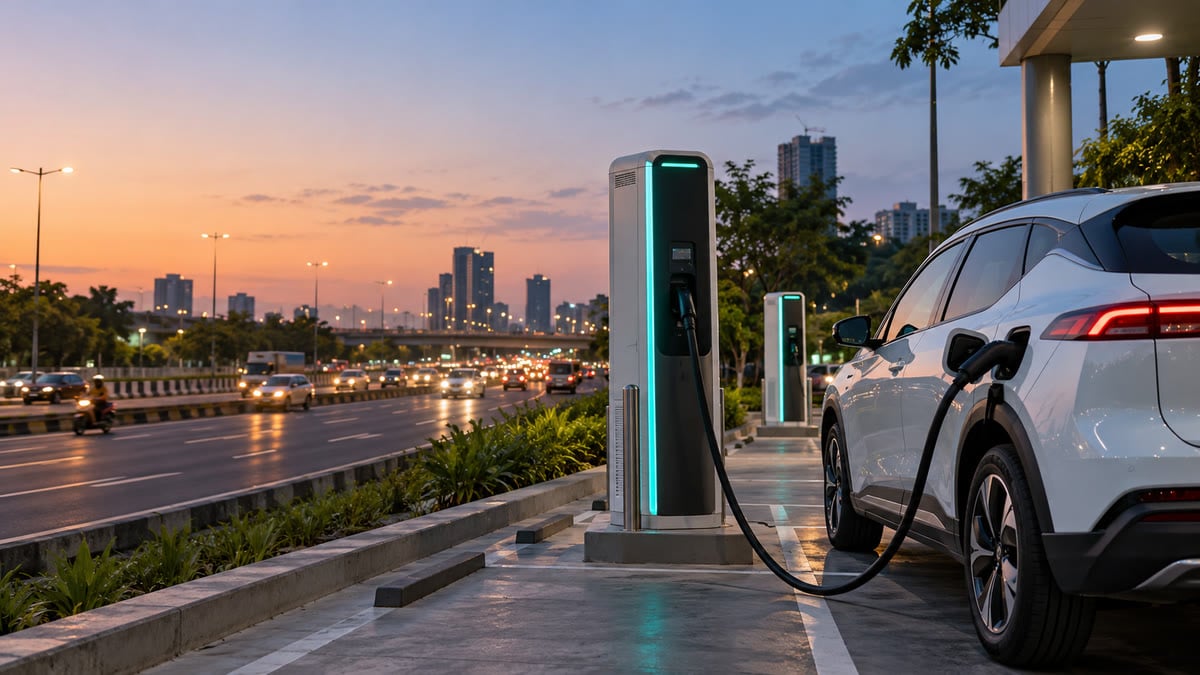
Image: Illustrative public EV-charging infrastructure created for this article; it is not an official photograph of a Glida or Fortum location.
Key takeaways
- Mint reported on 20 Oct 2026 that Fortum had called off the proposed Glida sale and intended to operate the network independently.
- Glida’s official About Us page currently lists over 961 public charging points in India.
- Fortum’s spokesperson declined to comment on what the company described as market rumours or speculation, so the sale reversal should be treated as reported rather than formally confirmed.
- No new charging tariff, app change, connector change or expansion has been announced in the sources reviewed for this report.
What changed at Glida
Mint reported on 20 Oct 2026 that Fortum had scrapped its plan to sell Glida, the Indian EV-charging business formerly known as Fortum Charge & Drive India, to promoters of the Gurugram-based JBM Group. The report said Fortum instead planned to continue operating the Glida brand in India.
The report was based on two people aware of the development. Mint said its queries to Fortum India, transaction adviser Opus Corporate Finance and JBM Group had not been answered. A Fortum Oyj spokesperson told the publication that, as a stock-listed company, it did not comment on market rumours or speculation. That qualification matters: the reported cancellation is a current news development, but it is not the same as a public company announcement or a completed transaction filing.
There is, however, independent evidence that the network remains active. Glida’s own About Us page identifies the brand as formerly Fortum Charge & Drive India and says it operates more than 961 public EV charging points across India. That matches the network size cited in Mint’s report.
What the report means for EV drivers
For a driver who already uses a Glida charger, the ownership discussion does not by itself create a new payment rule or change the charging experience. The available evidence shows a network that continues to present itself as operational; it does not announce a revised tariff, a new customer app, a different connector policy or a service guarantee. Those details should be checked at the time of travel rather than inferred from the reported transaction decision.
The more useful question is whether a station will be available when a vehicle needs it. Before a long trip, drivers can use the EV charging station directory to identify possible stops, then check the operator’s live status, connector compatibility and payment requirements. A route planned around one charger also needs a fallback stop because station availability can change with queues, maintenance or a temporary fault.
The road-trip planner can help map charging breaks alongside distance and travel time. For households comparing an electric trip with a petrol or diesel alternative, the fuel cost calculator provides a separate running-cost estimate; electricity tariffs, charging fees and vehicle efficiency still need to be checked for the specific route.
Why the ownership decision matters
Charging networks are not only collections of hardware. They also depend on station uptime, software support, payment processing, site agreements and maintenance. A change in ownership could affect those behind-the-scenes responsibilities even when the chargers themselves remain in the same locations.
If Mint’s report is accurate, Fortum’s decision would keep those responsibilities with the existing operator instead of transferring the proposed deal to JBM Group promoters. That could reduce uncertainty for users in the short term, but it does not prove that service quality will improve, that prices will fall or that new sites will open. No such promise has been made in the sources reviewed.
The development also shows why an EV route plan should not depend on a headline alone. A reported ownership reversal may have no immediate effect at a particular station, while a later app update, tariff notice or maintenance change could matter directly. The practical signal for drivers will be the network’s live availability and published customer terms.
What to watch next
- Formal confirmation: a statement from Fortum, Glida or JBM would clarify whether the proposed sale has been cancelled, paused or restructured.
- Customer-facing updates: drivers should look for changes to the Glida app, payment process, contact details, charging fees or connector information.
- Network performance: the relevant measure for a road trip is whether a listed charger is working and accessible when needed, not only the total number of points on a company webpage.
- Expansion plans: any new corridor coverage or fleet-charging investment should be reported separately once it is announced and verifiable.