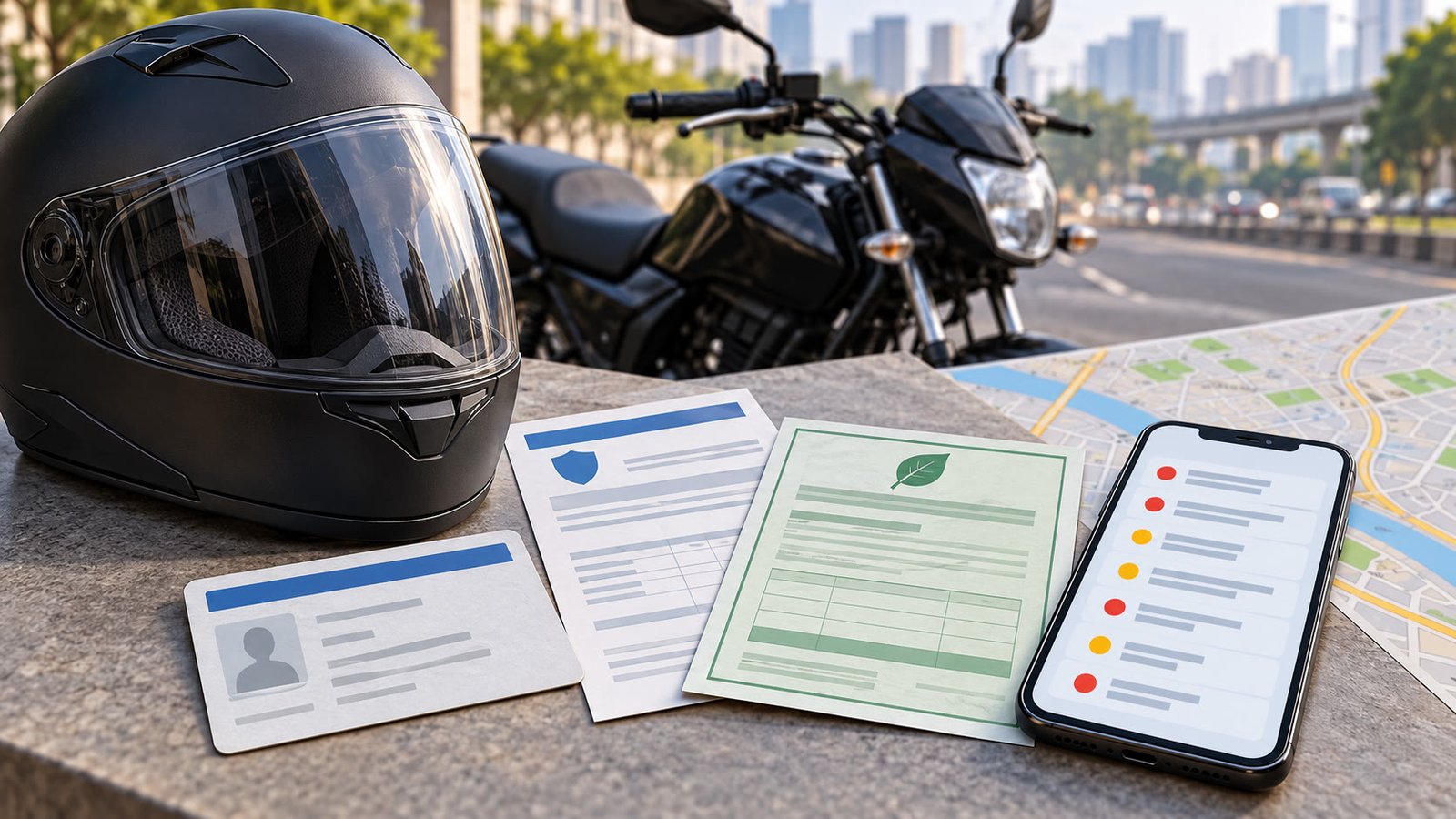
Gurugram traffic police impounded a motorcycle on 19 Oct 2026 after digital verification found 17 pending challans totalling ₹1,79,000, according to reports from PTI and The Tribune. The case matters beyond the headline figure: it shows why riders should check a vehicle’s eChallan record, Pollution Under Control (PUC) certificate, insurance and registration papers before a routine stop becomes an enforcement action.
Key takeaways
- The motorcycle was stopped near the Maruti Kunj T-point during a checking drive on 19 Oct 2026.
- Police said digital verification showed 17 pending challans with a combined value of ₹1,79,000.
- The reported violations included riding without a helmet and not having a valid PUC certificate, among other moving violations.
- The rider could not produce the required ownership and statutory documents during the check, according to the reports.
- The reports do not establish a nationwide rule that every vehicle with a fixed number of pending challans will be impounded.
What happened in Gurugram
ThePrint’s PTI report dated 19 Oct and The Tribune’s update dated 20 Oct both say that a Gurugram Traffic Police team stopped the motorcycle near the Maruti Kunj T-point on the outskirts of the city. The rider was asked to produce the vehicle’s papers but could not present valid documentation, the reports said.
Police then checked the registration data digitally. That check showed 17 pending challans under the Motor Vehicles Act, 1988, carrying a cumulative fine of ₹1,79,000. The reports attribute the figure and the action to senior traffic police officials. The listed violations included helmet-related and PUC-related offences, along with other violations. The motorcycle was subsequently impounded under relevant provisions, but the reports do not name the exact section used in this case.
The action was described as part of an ongoing drive against repeat traffic offenders and vehicles carrying long-pending fines. That is the confirmed scope of this incident. It should not be read as a new all-India penalty schedule or as proof that the same action will automatically follow for every vehicle with 17 challans.
What riders should check now
1. Check the vehicle record on the official portal
Use the official MoRTH eChallan service and search with the vehicle number or challan number. Review the count, date, location, offence description, amount and status shown for each entry. The government portal also lists options to download challan details, check payment status and raise a grievance.
Do not rely on a message or payment link received from an unknown number. The official portal warns users about fake websites and apps that imitate eChallan services. Open the government service directly, verify the vehicle details and keep the payment receipt after a legitimate transaction.
2. Keep the core documents current
A rider should verify the registration certificate, driving licence, valid motor insurance and PUC certificate before using the vehicle. The Gurugram police advisory quoted in both reports specifically urged motorists to carry valid insurance and PUC documents, as well as other required papers. A current document may help establish compliance during a check, but it does not automatically cancel an older challan; the two records should be checked separately.
For the insurance part of that check, readers can use the guide on how to check vehicle insurance online and compare the policy details with the vehicle registration. The article is useful for confirming the policy’s validity and spotting mismatches before a journey.
3. Verify disputed entries before paying
If a challan appears to have the wrong vehicle number, date, location or offence details, record the discrepancy and use the grievance route shown by the official portal or the concerned traffic department. Do not assume that a third-party app’s result is the final record. Conversely, an entry that is visible on the government service should not be ignored simply because no paper notice was received.
What this incident does not establish
Neither report gives a universal threshold of pending challans that triggers impounding, nor does either report set out a single release process for the motorcycle. The police said the vehicle was impounded under applicable provisions, so the exact next step depends on the concerned authority, the vehicle record and the nature of the outstanding cases.
That distinction matters for owners who discover an old challan. Clearing a due can remove the outstanding amount from the record after the payment is processed, but it is not a reason to guess about legal consequences or to pay an unverified demand. If a vehicle has already been detained, the owner should obtain the written instructions, receipt and designated-facility details from the traffic authority handling that case.
Pre-ride checklist for two-wheeler owners
- Search the registration number. Check pending and paid records on the official eChallan service before a long ride or an interstate trip.
- Match the documents. Confirm that the registration, insurance and PUC details belong to the same vehicle and that the driving licence is valid for the vehicle class.
- Inspect the motorcycle. Check the number plate, lights, mirrors, tyres, brakes and helmet before leaving; a document check is only one part of road compliance.
- Save proof of payment. Keep the official receipt or transaction reference instead of relying only on a bank message or a screenshot.
- Plan the trip with a time margin. Use the road-trip planner for the route, but allow extra time for a traffic check, diversion or document issue.
Why the Gurugram case matters to everyday riders
A single unpaid ticket can be easy to miss, particularly when a vehicle changes hands, a notice goes to an old mobile number or the owner assumes a camera-issued violation has been resolved. A stack of unresolved entries is different: it creates a record that can be found immediately when the registration number is checked.
The practical lesson is not to estimate how many challans might be tolerated. It is to check the official record periodically, correct disputed entries through the proper channel, keep insurance and PUC details current, and follow helmet and road rules on every ride. Drivers looking for related road, vehicle and mobility updates can also follow the latest FuelPrice news archive.
Sources
- ThePrint/PTI — Gurugram Police impounds motorcycle with pending challans of Rs 1.79 lakh — 19 Oct 2026.
- The Tribune — Gurugram Police impound bike with 17 pending challans worth Rs 1.7L — 20 Oct 2026.
- MoRTH/NIC eChallan Portal — Check Pending Challan Status and eChallan Services — accessed 20 Oct 2026.