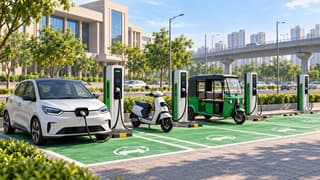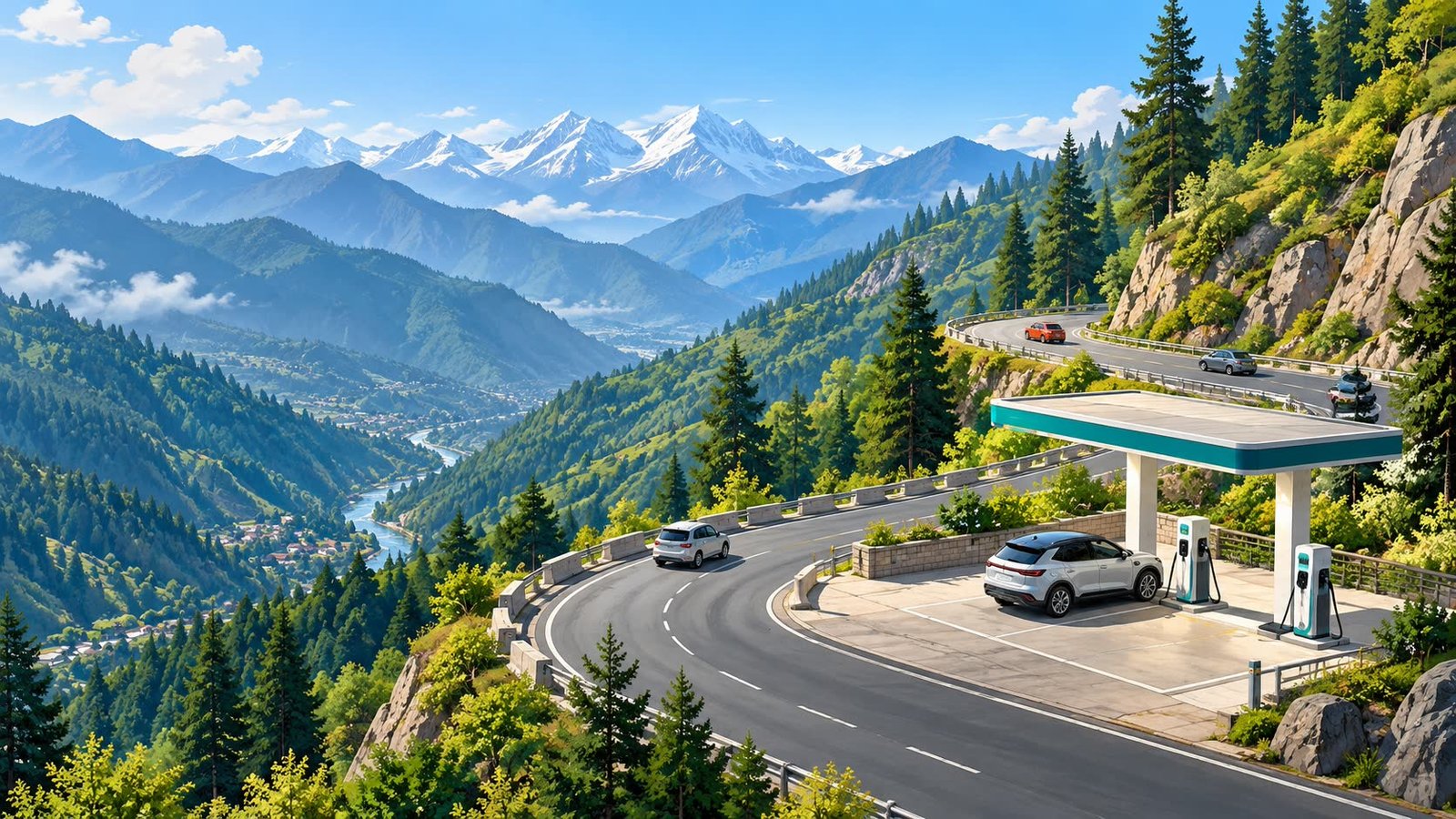
The Centre has reportedly approved ₹26.59 crore for 179 public electric-vehicle charging stations in Himachal Pradesh under the PM E-DRIVE scheme. The announcement matters to EV owners, residents and tourists because it could widen the number of places where a vehicle can recharge on hill routes, although the stations are not live yet.
The Tribune, updated on 15 Oct 2026, and Amar Ujala, published on 14 Oct 2026, report that the Union Ministry of Heavy Industries approved the grant and sent a communication to the state Transport Department. The department is expected to act as the nodal agency for the rollout.
Key takeaways
- Reports dated 14–15 Oct 2026 put the Himachal allocation at ₹26.59 crore for 179 public EV charging stations.
- The state Transport Department is the reported nodal agency for implementing the project.
- The reports do not yet provide a public list of sites, charger ratings, tariffs, operators or a commissioning date.
- The announcement is an infrastructure-funding approval, not confirmation that the new stations are already operational or that charging will be free.
What has been announced
The public information available so far identifies the Transport Department as the agency responsible for taking the project forward. That designation is important because the funding approval is only the first step: sites still have to be selected, power connections arranged, equipment procured and stations tested before drivers can rely on them.
Neither report gives a route-by-route location list or says whether the stations will be installed at government sites, existing fuel outlets, tourist facilities or private properties. The reports also do not specify whether the planned equipment will be slow, fast or high-power charging. Those details will decide how useful the network is for daily users and long-distance travellers.
Why the station count matters for hill travel
In a mountainous state, charging access is shaped by distance, elevation, road conditions and the time a driver must wait at each stop. A larger public network could reduce detours for local EV owners and make electric road trips more practical for visitors. It could also help taxis, delivery vehicles and other high-use vehicles that need predictable access rather than a charger only at a home or workplace.
However, 179 stations alone cannot show whether coverage will be adequate. A useful rollout needs sensible spacing between sites, reliable electricity supply, compatible connectors, clear payment options and enough charging capacity during tourist peaks. Uptime and maintenance will matter as much as the headline count.
Using the figures reported on 14–15 Oct 2026, a simple division of ₹26.59 crore by 179 works out to about ₹14.85 lakh per planned station. That is only a rough average, not a published per-site budget: land, civil work, grid connection, charger capacity and local access can make the actual cost vary widely.
Until the new sites are commissioned, drivers can check the current EV charging directory before leaving. It is useful for separating operating locations from a pipeline of announced projects.
For a multi-stop journey, the road-trip planner can help organise the route and breaks around known facilities. The planner should still be checked against live station availability, because an announced site is not the same as an open charger.
Drivers comparing an electric trip with a petrol or diesel alternative can use the fuel cost calculator to estimate the conventional vehicle baseline. That comparison does not predict public charging prices, which have not been announced for these planned stations.
How PM E-DRIVE fits in
The Himachal proposal sits within a wider national charging push. There is a figure difference in the reports: The Tribune and Amar Ujala describe PM E-DRIVE as having a ₹10,900 crore outlay, while a PIB backgrounder posted on 1 Oct 2026 records a revised ₹11,900 crore outlay and says implementation has been extended to 31 Mar 2028. The difference is reported here rather than silently resolved.
The later PIB backgrounder says ₹2,000 crore is earmarked for public EV charging stations across India. It also says ₹851 crore had been approved for 8,147 chargers as of 28 Sep 2026. Those national figures provide context for the Himachal grant, but they do not mean that the state project is already built or that an individual buyer receives a direct payment.
What changes now—and what does not
The immediate change is that a state-level charging project has been publicly reported with a funding amount and a named implementing agency. The reports do not announce a new charging tariff, a route-specific commissioning date or a change to EV registration rules.
For current travel, the practical position is unchanged: drivers need to use verified, operating chargers and should not plan a mountain journey around an announced station until its location and operational status are published. The same caution applies to any claim about charging speed, payment method or availability.
What to watch next
- An official list of proposed sites and the corridors or towns they will serve.
- Charger type, connector compatibility, power capacity and expected charging time.
- The procurement or operator model, construction schedule and commissioning notices.
- Published tariffs, payment options, customer support and uptime reporting once sites open.
Reader takeaway
The reported approval is a positive sign for Himachal Pradesh’s EV infrastructure, but it is a future network rather than an immediate travel facility. EV owners and tourists can treat the grant as a signal to watch for new sites, while using only confirmed, operational chargers for journeys planned today.
Sources
- The Tribune — “Centre allocates Rs 26.59 crore for 179 EV charging stations in Himachal” — 15 Oct 2026
- Amar Ujala — “PM E-DRIVE scheme: 179 new EV charging stations to be set up in Himachal; Centre approves ₹26.59 crore” — 14 Oct 2026
- Press Information Bureau — “PM E-DRIVE Scheme: A Step Towards a Sustainable Future” — 1 Oct 2026