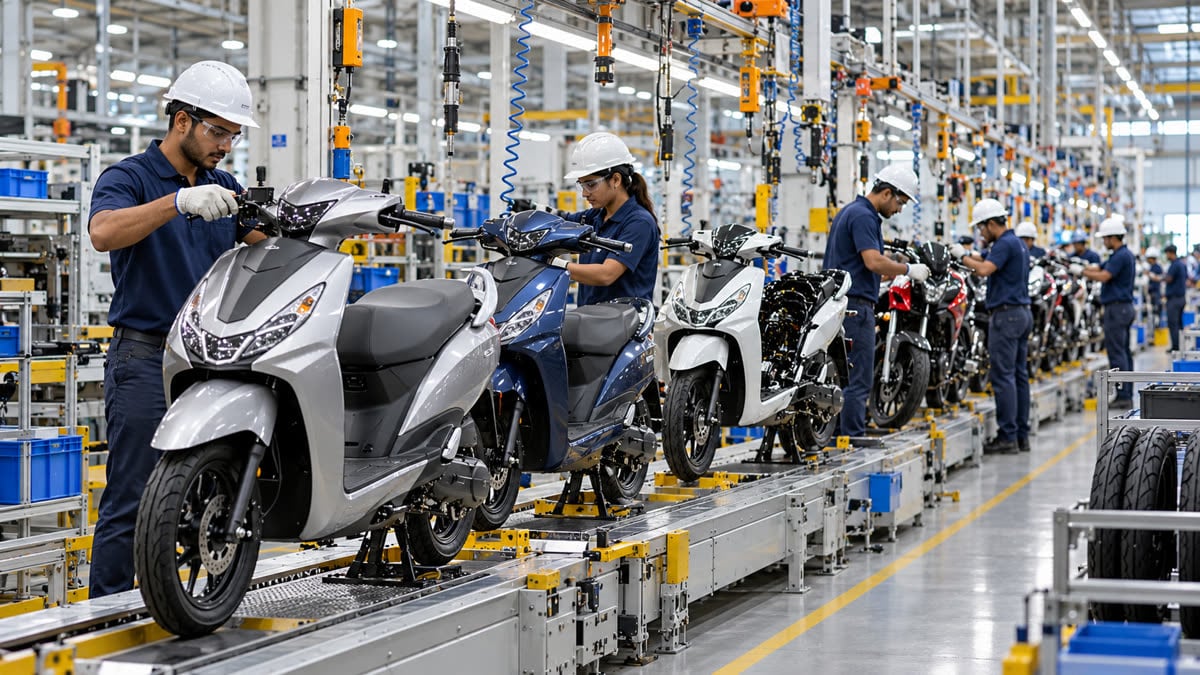
Honda Motorcycle & Scooter India (HMSI) expects its domestic two-wheeler sales volume to reach about 6 million units in FY2026–27, according to reports on 18 Oct 2026 quoting President and CEO Tsutsumu Otani. The company also plans to lift annual production capacity to about 8 million units by 2028, a move that could support more scooter, motorcycle, flex-fuel and electric options but does not guarantee lower prices or shorter waits for every model.
Illustrative image: AI-generated representative two-wheeler assembly line; not a photograph of a Honda facility or a specific model.
Key takeaways
- HMSI expects about 6 million domestic two-wheeler sales in FY2026–27, compared with 5.75 million domestic dispatches in FY2025–26.
- The outlook would represent roughly 4.3% growth if achieved, but it is a management expectation rather than a guaranteed result.
- Honda’s public 2026 business briefing confirms a plan to take India production capacity to approximately 8 million units in 2028.
- Scooters account for about 60% of Honda’s volume, so the supply push is especially relevant to urban commuters and family riders.
- The company is pursuing a multi-powertrain path covering petrol, flex-fuel and electric vehicles; final model timing, prices and specifications remain product-specific.
What Honda’s latest outlook says
HMSI’s reported 6-million-unit outlook is for domestic sales volume during the financial year ending March 2027. ET Auto, citing PTI, and Business Standard separately reported comments from Otani on 18 Oct 2026. Both accounts also linked the outlook to strong first-half momentum and the start of the festive season.
The figures below combine those 18 Oct management comments with Honda’s public business briefing. They refer to domestic dispatches or sales volume unless the row is marked as production capacity.
| Measure | Figure | Period or timing |
|---|---|---|
| HMSI domestic sales outlook | About 6 million units | FY2026–27, ending March 2027 |
| HMSI domestic dispatches | 5.75 million units | FY2025–26 |
| HMSI first-half domestic dispatches | 3.04 million units, up 13.5% year on year | April–September 2026 |
| Planned annual production capacity | Approximately 8 million units | By 2028 |
The sales outlook is not the same as registrations by final customers. Manufacturer dispatches show vehicles moving into the distribution chain; retail registrations happen later and can be affected by dealer stock, financing, local demand and the timing of festive purchases.
The target needs a strong second half
HMSI’s first-half domestic dispatches were reported at 3.04 million units. On simple arithmetic, reaching 6 million for the full year would require roughly 2.96 million units in the October–March half. That calculation explains the scale of the target, but it is not a new company forecast: festive demand, production schedules, exports and the comparison with last year will decide whether the run rate holds.
The 6-million outlook is also a modest step above the 5.75 million domestic dispatches reported for FY2025–26. The implied increase is about 2.5 lakh units, or roughly 4.3%. Readers should treat that as a volume ambition, not as evidence that every Honda scooter or motorcycle will receive a discount or become immediately available.
Scooters remain central to Honda’s mix
Management told ET Auto that scooters account for about 60% of Honda’s two-wheeler volume, compared with roughly 40% for the wider industry. That mix helps explain why a capacity expansion can matter to everyday riders even when the headline is a corporate sales target: a large share of any additional production is likely to remain connected to scooter demand, urban commuting and replacement purchases.
It does not identify which models will get additional production first. A buyer checking a festive-season offer still needs the actual variant, manufacturing month, dealer stock, delivery estimate and on-road price rather than relying on the company-wide target.
More powertrain choices, not an overnight EV switch
Otani described Honda’s India approach as a multi-powertrain strategy covering petrol, flex-fuel and electric vehicles. Honda’s 2026 global business briefing separately says the India operation will expand production capacity and continue to serve export markets. That means the planned capacity is not a promise that all additional units will be battery-powered or sold only in India.
For petrol or flex-fuel running, the fuel cost calculator can help compare a regular commute or delivery route using a realistic distance and mileage assumption. The result should be checked against the latest local fuel prices, because a company-wide sales target does not change the amount paid at a particular pump.
For an electric scooter, charging access is part of the ownership calculation. The state-wise EV charging directory can help identify public charging options, while the road-trip planner can separate a vehicle’s stated range from the stops needed on a longer journey.
What the capacity plan means for buyers
More manufacturing headroom can support availability, new variants and a wider spread of powertrains over time. It can also make India more important as an export base, which may change how production is allocated between domestic customers and overseas markets. Neither outcome guarantees a lower ex-showroom price, a shorter waiting period or a particular dealer benefit.
Before treating the company outlook as a purchase signal, readers can check four practical details:
- Whether the exact variant is in stock or only scheduled for production.
- Whether the quoted amount is ex-showroom or includes registration, insurance and accessories.
- For an electric model, the battery warranty, charging time, service coverage and replacement-part process.
- For petrol or flex-fuel models, the certified efficiency figure and the fuel compatibility stated in the final product documents.
What to watch through FY2026–27
The next useful signals will be Honda’s monthly domestic sales, the pace of festive-season dispatches and any confirmed schedule for the additional production lines. Readers should also watch for model-level announcements: capacity numbers alone do not reveal whether a new scooter, motorcycle, flex-fuel product or electric vehicle will arrive first.
For the wider two-wheeler market, the important question is whether demand remains broad after the festive period or falls back once the current low-base and seasonality effects fade. If Honda reaches its stated volume while expanding the product mix, riders could see more choice. If demand weakens or supply is directed toward exports, the effect at a local dealership may be smaller than the national headline suggests.
Reader takeaway
Honda’s 6-million-unit FY2026–27 outlook and 8-million-unit 2028 capacity plan point to continued scale in India’s two-wheeler market. For riders, the practical benefit to watch is model availability and powertrain choice—not an automatic price cut. The useful comparison remains the exact vehicle’s on-road cost, service support, fuel or charging requirement and suitability for the trips it will actually make.