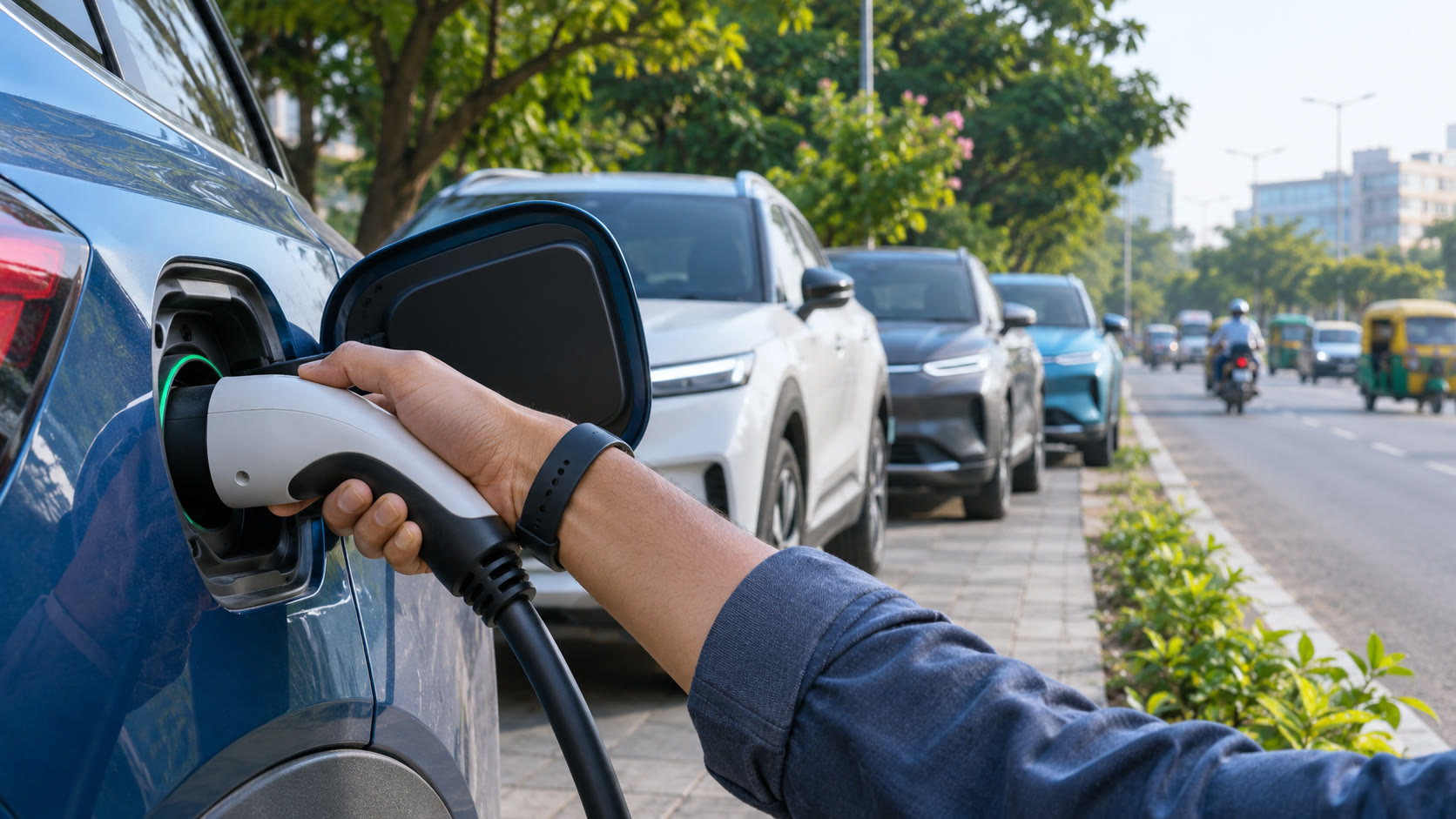
Battery-electric vehicles (BEVs) accounted for more than 8% of India’s new passenger-car registrations in September 2026, according to a BearingPoint study released on 17 Nov 2026. The finding matters to buyers because the market is moving into a wider-choice phase, but the decision still depends on charging access, battery support, warranty terms and monthly running cost—not the headline share alone.
Key takeaways
- BearingPoint puts the BEV share of new passenger-car registrations above 8% in September 2026.
- Among Indian respondents likely to buy a vehicle within the next three years, 39% preferred a new BEV, compared with 25% for a hybrid or plug-in hybrid and 17% for a new petrol- or diesel-powered vehicle.
- BearingPoint, citing FADA data, says Tata Motors and Mahindra & Mahindra together made up about 63% of new BEV passenger-car registrations in September 2026.
- For a buyer, the useful checks are charging access, battery warranty and repairability, service reach, and the full monthly ownership cost.
What the new 8% figure actually measures
The figure is a monthly market-share measure, not a count of all electric vehicles already on Indian roads. It refers to new passenger-car registrations in September 2026, so it does not describe electric two-wheelers, three-wheelers or commercial vehicles, and it is not a forecast that every new car buyer will switch to a BEV.
BearingPoint’s official 17 Nov release describes the September result as more than 8%. Its accompanying India 2026 electromobility report presents the current BEV share as 8%. Separately, India Today’s report on FADA’s September retail data put electric passenger-vehicle penetration at 8.5% of total passenger-vehicle retail sales. The figures are directionally consistent, but the rounded BearingPoint figure and the FADA-reported percentage should not be treated as identical measurements.
That distinction is important when comparing headlines. An 8%-plus share signals that BEVs are becoming a meaningful part of the new-car market; it does not, by itself, establish that a particular model is cheaper to own, easier to charge or better suited to a long daily commute.
Demand is ahead of the current sales mix
The same BearingPoint study found that 39% of Indian respondents who were likely to purchase a vehicle within the next three years preferred a new BEV. A further 25% chose a hybrid or plug-in hybrid, while 17% preferred a new petrol- or diesel-powered vehicle. EV Infrastructure News reported the same survey split on 17 Nov 2026.
These are purchase preferences, not confirmed orders or a sales forecast. The study has an urban focus, and people answering a future-purchase question may still change their choice after checking prices, financing, charging availability, insurance and resale value. Even so, the gap between stated interest and the current sales mix tells automakers and charging providers where the next friction point lies: making the ownership experience reliable enough for more interested buyers to follow through.
For readers, this is a useful way to read the trend. The market is not only adding more electric models; it is also testing whether buyers can live with the practical details around charging, downtime, battery support and service. Those details matter more than a national market-share headline when the vehicle will be used every day.
What the shift means for an EV buyer
1. Check where charging will happen
Home charging can make an electric car easier to use, but apartment parking, electrical-load limits and access to a dedicated socket can change the calculation. Public charging matters most on regular work, school and intercity routes. A buyer can check the available network in relevant states through FuelPrice’s state-wise EV charging directory before comparing vehicle prices.
2. Compare the complete monthly cost
The list price is only one part of ownership. The comparison should include charging, insurance, scheduled service, tyres, financing cost where applicable and expected resale value. A petrol or diesel benchmark can be estimated with the fuel cost calculator, while the electric vehicle’s charging assumptions need to be recorded separately rather than presented as a guaranteed saving.
3. Read the battery and service terms
Warranty duration is not the only question. Buyers can compare what the battery warranty covers, the conditions attached to it, repair or replacement processes, software support, roadside assistance and the service network near their home and frequent destinations. BearingPoint’s findings also point to safety, warranty coverage, battery repairability, brand trust and maintenance cost as important considerations for Indian respondents.
4. Match the car to the actual trip pattern
City commuting with predictable parking is a different use case from frequent highway travel. The relevant question is whether charging stops fit the usual route and whether a backup plan exists when a charger is occupied or unavailable. The road-trip planner can help map the journey, but the charger locations and operating status still need to be checked separately before a long trip.
Local brands hold a large share of the current mix
BearingPoint, citing FADA data for September 2026, says Tata Motors and Mahindra & Mahindra together accounted for about 63% of new BEV passenger-car registrations. That concentration helps explain why service reach, spare-part availability, battery repair capability and local trust are central to the next stage of competition.
The number is a market snapshot, not a recommendation of one manufacturer. It also does not mean a buyer in every city will see the same choice or support network. A model’s actual availability, delivery timing, charging compatibility and service coverage can vary by region, so the national registration mix should be treated as context rather than a substitute for local checks.
What to watch next
The next useful signal will be whether BEV share stays above the 8% mark in later registration months, especially after the effect of new launches and festive-season demand is separated from the underlying trend. Another test will be whether more affordable models, stronger financing choices and better public charging coverage convert stated interest into sustained registrations.
Battery-health certification and used-EV support are also worth watching. If buyers can verify battery condition and understand warranty transfer, a broader second-hand market could give more households a lower-cost entry point. That would make EV adoption less dependent on new-car buyers alone, while giving owners a clearer way to value the battery over the vehicle’s life.
The reader takeaway
India’s 8%-plus BEV share is a market signal, not a purchase instruction. For an individual buyer, the practical test remains whether a vehicle’s usable range, charging access, warranty, service support and full ownership cost match the regular trip pattern. The growth figure is encouraging for choice, but the right comparison still begins with the route and the charging plan.
Sources
- BearingPoint: “India’s EV market is entering its growth phase, and global automakers risk missing it” — 17 Nov 2026
- BearingPoint: “Electromobility Attractiveness Index 2026 — India” — 17 Nov 2026
- EV Infrastructure News: “India’s EV market grows as BEVs exceed 8% share, report finds” — 17 Nov 2026
- India Today: “Electric passenger vehicle retail sales rise 94.56% in September 2026” — 7 Oct 2026