Indian auto-component makers are expanding into electric-vehicle powertrain systems, advanced driver-assistance systems (ADAS) and seating through partnerships with global technology companies. The development matters because it could increase the technology available to Indian vehicle manufacturers, but these announcements do not by themselves change the price, features or delivery date of a car on sale today.
A 20 October 2026 report by Mint highlighted partnerships involving Sona Comstar, Gabriel India and other component makers. Company announcements and partner disclosures show that the push covers both the hardware fitted inside an electric vehicle and the electronics that support safety, comfort and automated-driving functions.
Key takeaways
- Sona Comstar and Denso have announced two India joint ventures covering electric and hybrid powertrain systems.
- Gabriel India has partnered with South Korea's HL Klemove for ADAS and automotive electronics in India.
- Forvia and ANAND Group have formed a seating joint venture focused on seat frames and complete seats.
- The partnerships can improve local supply capability, but they are not a notification of a new vehicle launch or a current price cut.
- Vehicle buyers should treat future features as confirmed only when the automaker publishes the model, specification and availability.
What the latest report says
The immediate story is not one new car or one new battery. It is the widening role of Indian suppliers in technology programmes that were previously more dependent on overseas development or imports. Mint reported on 20 October that Indian component makers are using global tie-ups to expand in premium and EV segments.
That distinction is useful for drivers. A supplier partnership can be an important step in an automaker's future programme, but the supplier name may not appear in a showroom brochure. A component can also be developed for more than one vehicle, market or powertrain, and a signed agreement does not automatically mean that a particular model will launch with every capability described in the announcement.
Two technology tracks to watch
Sona Comstar and Denso: EV and hybrid powertrain systems
Sona Comstar's corporate announcement on 22 July 2026 described two joint ventures with Japan's Denso Corporation. One venture is intended to develop and manufacture high-voltage traction inverters, traction motors and generators for electric and hybrid passenger and commercial vehicles. Denso holds 51% and Sona Comstar holds 49% in that venture, according to the report and the company disclosure.
The second venture is aimed at electric and hybrid powertrain systems for two- and three-wheelers. Sona Comstar holds 51% and Denso 49% in that arrangement. For Indian buyers and fleet operators, the significance is potential access to more locally developed powertrain hardware across cars, commercial vehicles and smaller urban mobility products. It is not evidence that a particular vehicle's range or charging time has already changed.
Gabriel India and HL Klemove: ADAS and electronics
Gabriel India announced on 26 August 2026 that it would enter a strategic joint venture with South Korean autonomous-driving and automotive-electronics company HL Klemove. Gabriel India said it would acquire 30% less one share in HL Klemove India for US$98.44 million, approximately ₹935 crore at the figure disclosed in the announcement.
The proposed product scope includes radar, front cameras, lidar, automated-driving and parking-control units, ADAS software, brake and steering chassis electronic control units, and torque sensors. These are the building blocks behind functions such as collision warnings, assisted parking and lane-support systems. Their actual performance still depends on how an automaker integrates, calibrates and enables them in a specific vehicle.
Forvia and ANAND: seating capability
On 6 October 2026, Forvia and ANAND Group announced a seating joint venture called Faurecia Anand Seating India. The stated ownership is Forvia 50% plus one share and Gabriel India 50% minus one share. The venture is focused on seat frames and complete seats, adding another example of Indian manufacturing capability being combined with global engineering and production expertise.
Seating is not an EV-only technology, but it is part of the same localisation trend. Global suppliers are using India as both a manufacturing base and a market for higher-value vehicle systems. That can help automakers source more functions within the country, while also creating opportunities to export components or vehicles built around them.
Why this matters to vehicle users
For an EV buyer, stronger local powertrain capability could eventually support more model choices, easier parts supply and quicker adaptation to Indian operating conditions. Those are possible medium-term benefits, not guaranteed savings or a promise of a specific range figure. The vehicle's battery size, motor output, charging architecture and warranty remain model-level questions.
For drivers comparing ADAS-equipped cars, the important question is not only whether a brochure uses the phrase “advanced safety”. Ask which functions are fitted, which are standard or optional, and whether the system is designed to assist rather than replace an attentive driver. Sensors and software can support a driver, but they do not remove the need to follow traffic rules and remain in control.
For fleet operators, buses and commercial-vehicle users, local component development may eventually affect maintenance planning and procurement. Until a supplier or automaker confirms production and service arrangements for a particular model, however, it is too early to calculate a change in running cost from these announcements alone. Operators can use the fuel-cost calculator to compare present trip costs, while EV owners can check the state-wise EV charging directory when planning charging stops.
What changes now—and what does not
There is no immediate change to petrol or diesel prices, toll charges, EV subsidies, vehicle registration rules or the advertised price of a car because of these partnerships. They describe corporate and manufacturing plans. Any effect on a buyer will arrive later through an automaker's confirmed model announcement, specification sheet, booking information and service network.
The practical next step is to separate the confirmed partnership from the future product claim. A supplier may be working on a technology without naming the vehicle that will use it. A joint venture may also take time to reach production, regulatory approval, testing and volume supply. The road-trip planner can help compare a current vehicle's trip requirements, but it should not be used to assume an unannounced future range or charging performance.
Checks before treating a future feature as confirmed
- Look for an automaker's official model announcement, not only a supplier partnership release.
- Check whether the feature is standard, optional or limited to a higher variant.
- Confirm the published range, charging time, safety function and test conditions separately.
- Check the stated launch market and production timeline; a global partnership does not guarantee an India launch.
- Compare the final price, warranty and service support after the vehicle is formally announced.
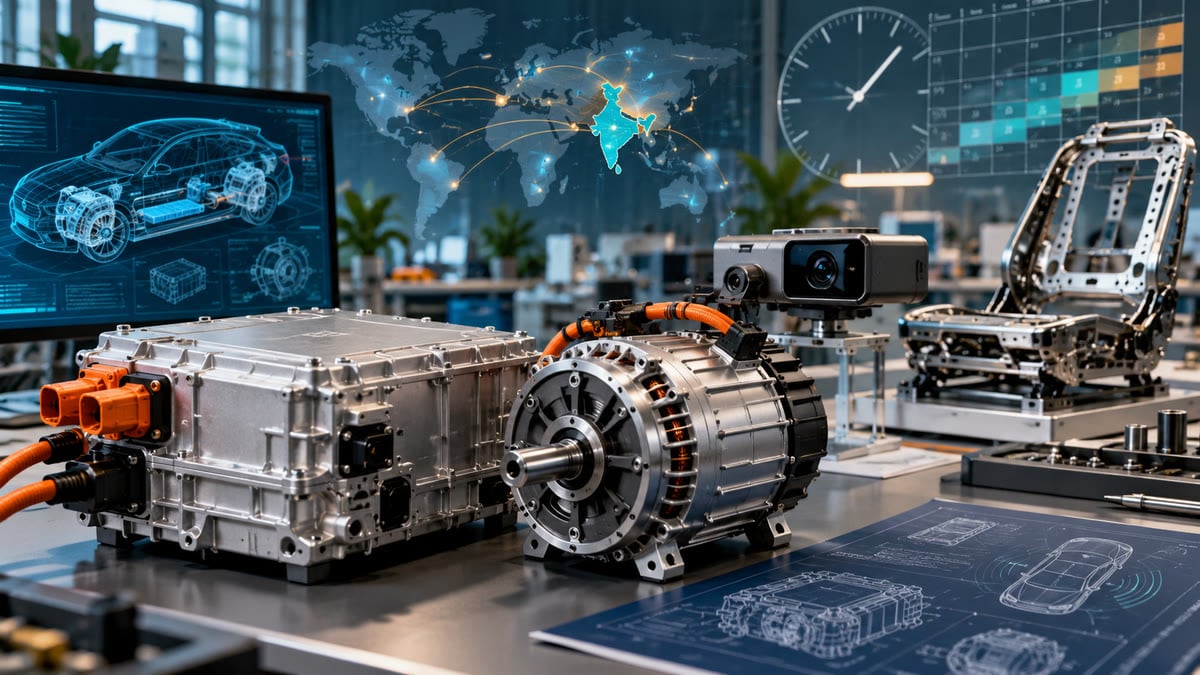
Illustrative image: an AI-generated editorial representation of automotive components and engineering. It is not an official photograph of a named company or product.
Sources
- Mint: Auto component makers tap global firms’ India appetite to expand in premium, EV segments — 20 Oct 2026
- Sona Comstar: Press Release - Sona Comstar partners with DENSO Corporation, Japan — 22 Jul 2026
- ANAND Group: Gabriel India partners with HL Klemove for ADAS and automotive electronics — 26 Aug 2026
- Forvia: Forvia and ANAND Group join forces to accelerate seating growth in India — 6 Oct 2026