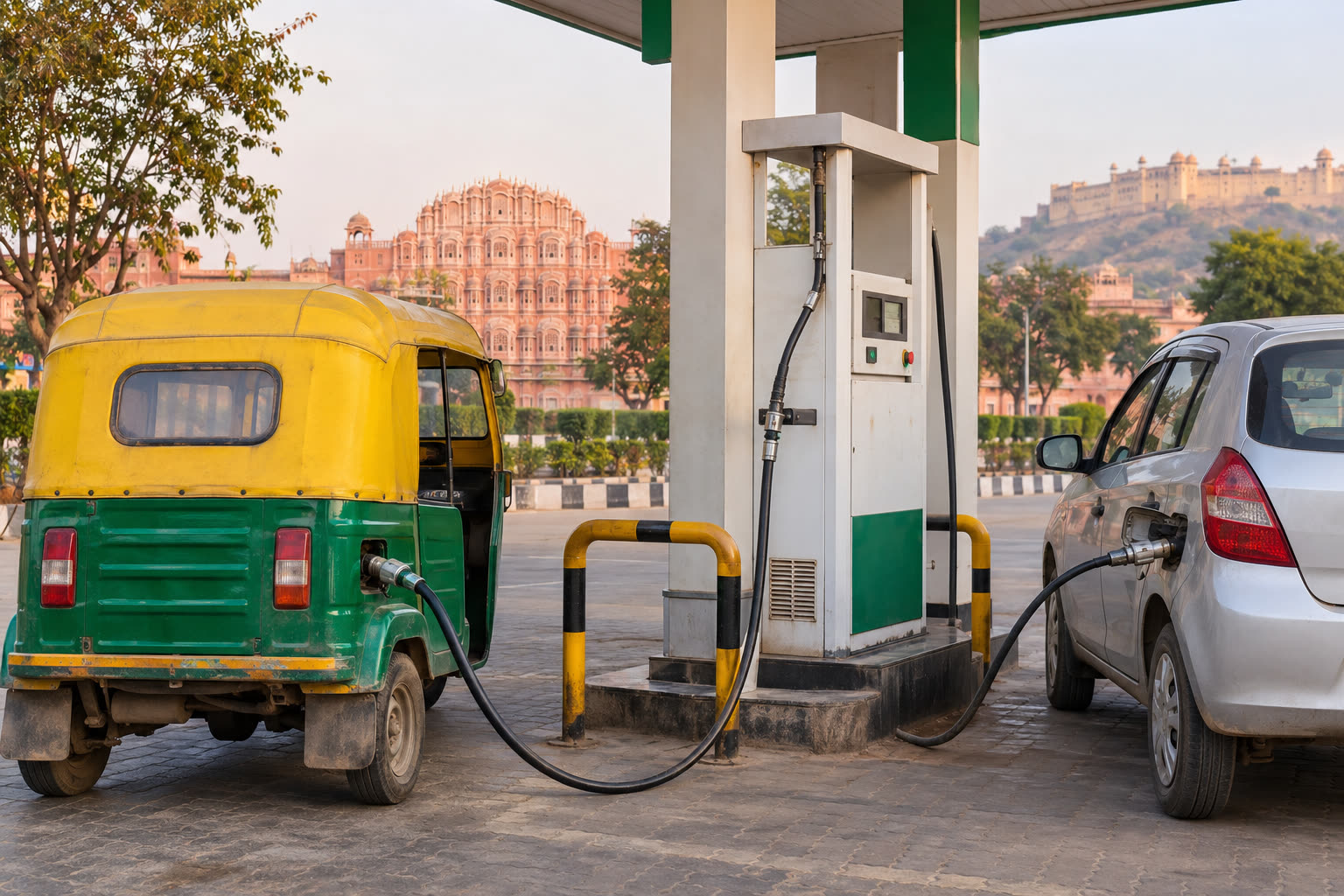
Jaipur’s CNG price rose by ₹2 per kg to a reported ₹103.50 per kg from Sunday, 29 Nov 2026. The increase matters immediately to CNG car owners, auto-rickshaw operators, taxi drivers and fleets because the fuel bill rises every time they refill.
The Times of India, Navbharat Times and First India reported that Torrent Gas made this the third Jaipur-area increase in two months. The reports put the previous rate at ₹101.50 per kg, but the latest rate should be read as a city-and-distributor-specific price, not as a new CNG rate for all of Rajasthan or India.
There is a live update discrepancy worth flagging: Goodreturns’ Jaipur tracker still displayed ₹101.50 per kg on 29 Nov 2026, while the three same-day news reports said the revised rate was ₹103.50 per kg. That may reflect update lag, so the station’s displayed price and receipt are the practical check for the amount charged.
Key takeaways
- Jaipur’s reported CNG rate is now ₹103.50 per kg, up ₹2 per kg from ₹101.50 per kg, effective 29 Nov 2026.
- This was the third increase in about two months; earlier ₹2-per-kg increases were reported on 6 Oct and 1 Nov 2026.
- At an assumed use of 5 kg per day, the latest change adds ₹10 per day, or about ₹300 over a 30-day month.
- The direct impact is on CNG vehicle users and commercial operators; petrol and diesel users are not charged this CNG revision.
- Prices can differ by city and gas distributor, so the station’s displayed rate and receipt matter when checking the amount paid.
What changed in Jaipur
The latest revision moved the reported Jaipur price from ₹101.50 to ₹103.50 per kg. The change took effect on Sunday, 29 Nov 2026, according to the reports. The Petroleum and Natural Gas Regulatory Board’s entity directory lists Torrent Gas Jaipur Private Limited as the authorised city-gas distributor for the Jaipur district, which is why this should be treated as a local distributor update rather than a nationwide fuel-price order.
Navbharat Times reported that the same round of revisions also covered other Torrent-served areas in Rajasthan, while First India reported increases across Jaipur and several nearby or adjoining service areas. That does not make ₹103.50 per kg a uniform Rajasthan rate. A driver crossing a district boundary should check the local pump board instead of carrying Jaipur’s figure into another city. FuelPrice’s CNG price hub for Indian cities is useful for a broader comparison, but the station receipt remains the final check for a purchase.
What ₹2 per kg means for a monthly budget
The increase is small on one refill but becomes more visible for high-mileage users. For an illustrative vehicle using 5 kg of CNG per day, a ₹2-per-kg rise means ₹10 more per day. If that usage continues for 30 days, the extra cost is about ₹300 for the month. This is a calculation from the reported rate change, not a claim about how much every car, auto or taxi consumes.
Actual fuel use depends on the vehicle’s efficiency, traffic, air-conditioning, route length and idle time. A driver covering a fixed route can calculate the difference more accurately by entering daily distance and mileage in the fuel-cost calculator. The relevant comparison is cost per kilometre, not just the price printed per kilogram.
Who is most exposed to the increase?
Private CNG car owners feel the change through their household travel budget, especially when the vehicle is used for a long daily commute. The effect is more direct for auto-rickshaw and taxi operators, delivery vehicles and small commercial fleets that buy fuel frequently and track operating cost per day.
The reports did not announce an automatic fare revision. Whether an operator changes a fare, absorbs the increase in margin or adjusts trip planning depends on the business, route and local competition. For passengers, the useful distinction is between the confirmed pump-price change and any later decision by an operator or local authority about fares.
The revision also does not by itself prove that CNG has lost its cost advantage over petrol or diesel. That depends on the vehicle’s real-world mileage and the current price of the alternative fuel. Drivers comparing running costs should use dated local prices and the same route assumptions for each fuel; the FuelPrice fuel-price pages can provide the starting point for that check.
What CNG users should check now
- Look at the station’s price display before refuelling and keep the receipt dated 29 Nov 2026 or later if you need to reconcile the new amount.
- Update a monthly fuel budget using actual kilograms purchased rather than a generic mileage estimate.
- If you operate an auto, taxi or fleet vehicle, separate the fuel-cost change from any fare or contract decision; the latter is not automatic.
- For an inter-city journey, check the destination’s distributor and local rate before assuming Jaipur’s ₹103.50-per-kg figure applies along the whole route. The road-trip planner can help organise the route, but it does not replace a current pump-price check.
What to watch next
The immediate question is whether the Jaipur-area price remains at the reported ₹103.50 per kg or is revised again. The two earlier increases reported for 6 Oct and 1 Nov 2026 show why a single monthly snapshot may not capture a CNG user’s full operating cost. Future changes should be checked against a dated distributor notice, station display or receipt and independently reported coverage.
For now, the clear reader takeaway is local and practical: CNG users in Jaipur should budget ₹2 more per kilogram from 29 Nov 2026, while users in other cities should verify their own distributor’s rate rather than copy Jaipur’s number.
Sources
- The Times of India — “CNG price up by Rs 2 a kg in Jaipur” (29 Nov 2026)
- Navbharat Times — “CNG Price Hike: Rajasthan’s seven cities get new rates” (29 Nov 2026)
- First India News — “Jaipur CNG price hike: third increase in two months” (29 Nov 2026)
- PNGRB — Entity directory listing Torrent Gas Jaipur for Jaipur district (accessed 30 Nov 2026)
- Goodreturns — “CNG Price in Jaipur Today” (29 Nov 2026; tracker displayed ₹101.50 per kg)