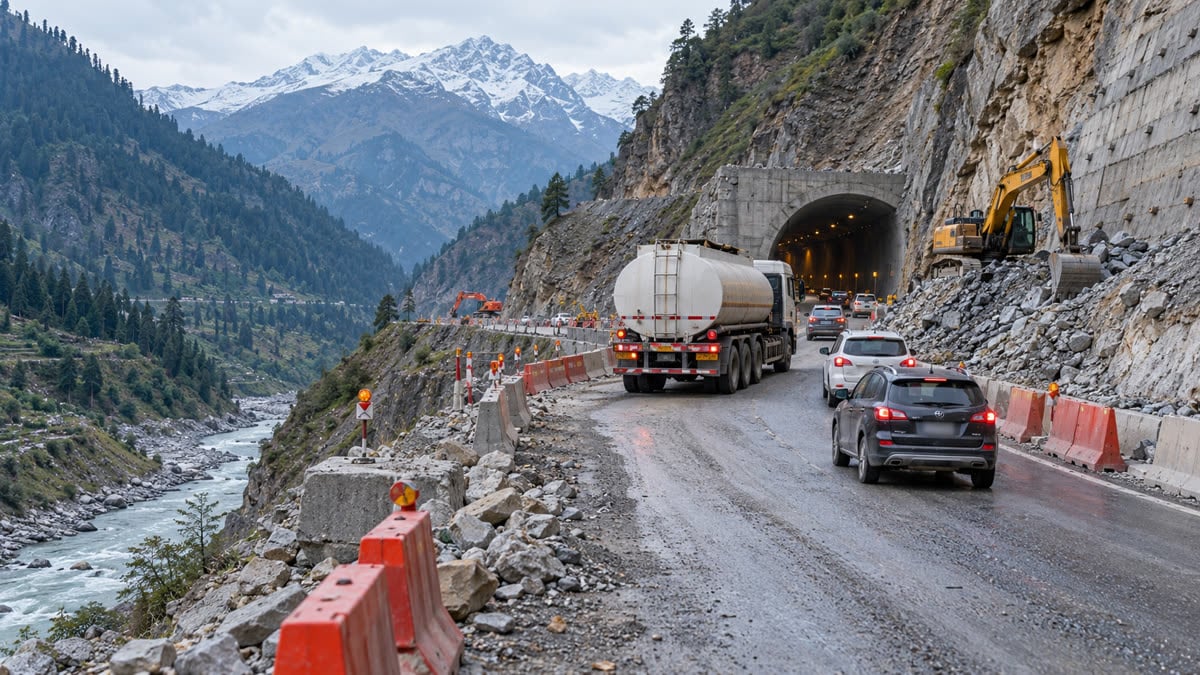
Jammu and Kashmir Traffic Police has issued a 20 Oct 2026 travel plan for the Jammu-Srinagar National Highway (NH-44), allowing passenger, private-car and goods traffic in both directions when weather and road conditions permit. The same notice warns of slow single-lane sections, ongoing work, shooting stones and landslides, so the route should not be treated as an all-clear for uninterrupted travel.
For most drivers, the practical issue is timing and uncertainty rather than a new toll charge. The advisory also matters to freight operators: Kashmir-bound tankers carrying inflammable material face tunnel-related restrictions, while the notice tells heavy-vehicle owners to check fitness, avoid overloading and carry sufficient fuel.
Key takeaways
- NH-44 is planned for two-way movement on 20 Oct 2026, but only subject to fair weather, better road conditions and confirmation by the traffic control units.
- The advisory records slow movement around a 30–40-metre single-lane section at Dhalwas in Udhampur and on the Marog–Kishtwari Pather stretch.
- Night travel between Ramban and Banihal is discouraged because of shooting stones, landslide risk, nomadic movement and construction work.
- Kashmir-bound tankers carrying inflammable material face restrictions through tunnels; the notice says upward tankers may move beyond Chenani only after 17:00 and up to 05:00, subject to the applicable clearance.
- Travellers should confirm the live road status with the listed traffic control units before leaving, because the plan can change with weather and on-ground conditions.
What the 20 October traffic plan allows
The Traffic Police Headquarters plan for 20-10-2026 says light motor vehicles, passenger vehicles, private cars and goods-carrying heavy motor vehicles may use NH-44 from Jammu towards Srinagar and in the reverse direction. That permission is conditional: the authority requires fair weather and better road conditions, and the Jammu, Srinagar and Ramban traffic control units are to coordinate before movement is allowed.
Other routes in the same advisory also have cut-off timings. These matter to travellers using a hill-route alternative or connecting road:
| Route | Movement noted for 20 Oct 2026 | Condition |
|---|---|---|
| Kishtwar–Sinthan–Anantnag NH-244 | Private cars and other light vehicles from PP Parana towards Anantnag between 08:00 and 16:00; from Daksum towards Kishtwar between 09:00 and 16:00 | No vehicle after the prescribed cut-off |
| Srinagar–Sonamarg–Gumri Road | Light vehicles up to 13:00; heavy motor vehicles from Sonamarg towards Kargil between 12:00 and 17:00 | Road-agency clearance and weather conditions apply |
| Mughal Road | Perishable-stock vehicles, light vehicles and goods vehicles up to 10 tyres between 07:00 and 18:00 | Movement depends on the maintenance agency's clearance |
The times above come from the 20 Oct plan and are not a substitute for a same-day confirmation. A vehicle that reaches a cut-off point late may have to wait, even if the route was open earlier.
Why NH-44 may still be slow
The traffic report accompanying the plan recorded very slow movement from 16:00 on 18 Oct to 16:00 on 19 Oct 2026. It cited single-lane traffic and an uneven surface at Dhalwas, Udhampur; another single-lane stretch between Marog and Kishtwari Pather; vehicle breakdowns at Nashri and Ramban; and nomadic herds crossing the Banihal–Nashri area.
Traffic was being regulated at Dhalwas because only about 30–40 metres of roadway was available as a single lane. The notice also says the Marog–Kishtwari Pather section may remain slow. These are observations for the reported period, not a fixed delay forecast for every vehicle on 20 Oct.
For a private trip, the safest planning assumption is that an apparently open route may still include a queue, a stop-and-go work zone or a weather-related hold. Use the road-trip planner to map the journey, but keep a time margin rather than relying on the usual drive time.
What tanker and freight operators need to check
The advisory links the tanker restriction to NHAI widening work on the Digdol–Khooni Nalla axis of NH-44. Tankers loaded with inflammable material are restricted through the affected tunnels during the daytime operating window. The notice says upward tankers may be allowed beyond Chenani only after 17:00 and up to 05:00; operators should confirm the live instruction before dispatch because road clearance and tunnel safety conditions control the actual movement.
Goods carriers carrying fresh or perishable stock are asked to load according to the traffic advisories and to account for shooting-stone, landslide and construction risks between Ramban and Banihal. Heavy-vehicle operators are also told not to overload, to check vehicle fitness and to carry sufficient fuel. Those checks reduce the chance that a breakdown or an unplanned stop adds to congestion on a constrained stretch.
A transporter planning the trip should confirm the commodity, vehicle fitness, driver rest plan and the relevant tanker or heavy-vehicle timing before departure. If a delay or diversion changes the distance, the fuel-cost calculator can help estimate the added fuel requirement. Check current regional rates on the live fuel prices page rather than using an old trip budget.
Checks for motorists before leaving
- Confirm the road status. The advisory lists Jammu TCU numbers 0191-2450028, 0191-2740550, 0191-2477722 and 103; Srinagar TCU numbers 0194-2450022, 2485398, 18001807003 and 103; and Ramban contacts 9419993746 and 1800-180-7043.
- Prefer daylight where possible. The traffic authority specifically advises against night travel on the vulnerable Ramban–Banihal section because of shooting stones, landslides, nomadic movement and construction.
- Do not stop casually in exposed sections. Avoid unnecessary halts between Ramban and Banihal, particularly near shooting-stone areas, and follow traffic staff through single-lane zones.
- Carry a working fuel reserve. Fuel availability and journey time can become less predictable when a road is regulated or a vehicle queue forms. A route budget should include the possibility of idling or a longer approach.
- Recheck before departure. The plan is conditional, so a fresh call or official update is more reliable than an earlier screenshot or a saved route instruction.
What drivers should take from the advisory
The 20 Oct plan keeps NH-44 available for two-way movement, but it also makes clear why the journey can take longer than a map estimate. The combination of a constrained work zone, mountain hazards, freight restrictions and changing weather means the useful decision is whether the driver has enough daylight, fuel and time buffer for the conditions that day.
There is no stated new toll fee in this traffic plan. Drivers using a changed route can still review the likely route charges through the toll-charge calculator, then confirm the live road status with the traffic control unit before setting out.
Sources
- Traffic Police Headquarters, J&K, Jammu/Srinagar — Traffic Plan and Advisory for 20 Oct 2026 — 19 Oct 2026.
- JKUpdates — Jammu-Srinagar Highway Traffic Advisory 20th Oct 2026, NH-44, SSG Road and Travel Guidelines — 19 Oct 2026.
- Kashmir Life — Jammu-Srinagar Highway: Traffic Police Issue Advisory — 14 Oct 2026.