Karnataka has asked the Centre to review how E20 petrol is implemented after the state said 11 of 14 independently tested samples contained more than 20% ethanol, with the highest reading at 31.2%. For motorists, the important distinction is that this is a disputed state finding and policy request — not a new nationwide fuel rule or proof that every petrol pump is selling over-blended fuel.
Key takeaways
- Karnataka publicised a letter to the Union Petroleum Ministry on 18 Nov 2026 seeking a review of E20 implementation and more fuel-quality disclosure.
- The state says 11 of 14 samples sent to independent laboratories had ethanol above 20%; the highest reported reading was 31.2%.
- The Petroleum Ministry and oil marketing companies reject the conclusion, citing a separate exercise in which 56 Karnataka samples were reported at 19–20% ethanol, averaging 19.30%.
- No national rollback, new E10 option or compensation scheme has been announced in the reported development. The existing central notification remains the operative rule.
What Karnataka has asked the Centre to review
Food, Civil Supplies and Consumer Affairs Minister Rizwan Arshad said Karnataka is not opposed to ethanol blending as a policy, but is concerned about what it describes as over-blending and the lack of information available to motorists. The letter asks the Centre to review implementation in consultation with the states.
The requests are aimed at making the fuel transaction easier to verify. Karnataka wants the actual ethanol percentage displayed at petrol pumps and printed on fuel bills. It has also asked for lower-blend or ethanol-free petrol to remain available, independent testing through National Accreditation Board for Testing and Calibration Laboratories (NABL)-accredited facilities, and a dedicated compensation fund for vehicle damage caused by fuel found to exceed the prescribed limit.
The state’s letter also refers to complaints from motorists about lower mileage, rough engine operation, damage to older vehicles and receiving less fuel than paid for. Those are reported complaints, not a finding that every such problem was caused by ethanol or that all vehicles are affected in the same way.
Why the test results are disputed
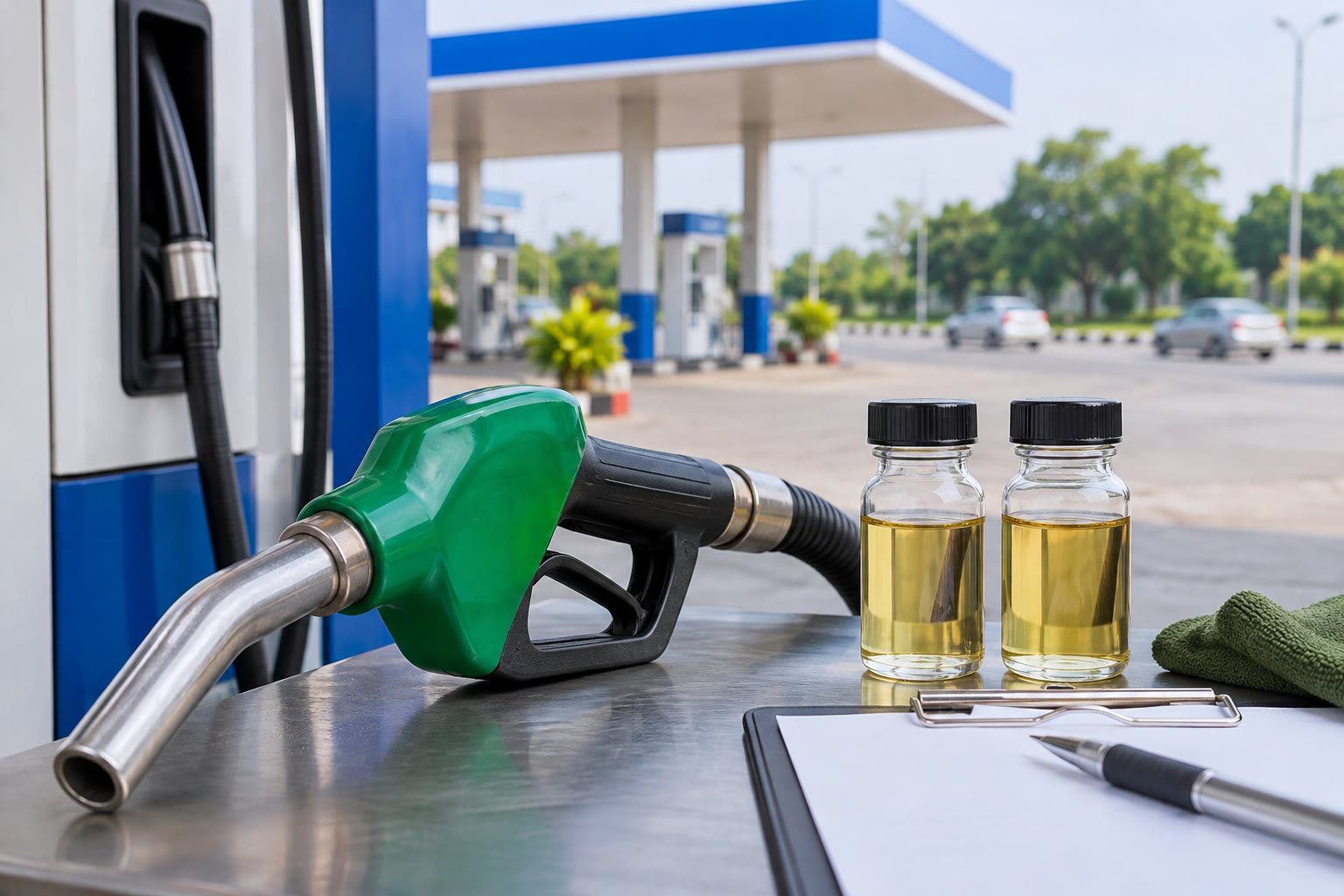
Karnataka says its independent-laboratory exercise found ethanol content above 20% in 11 of 14 samples, with readings ranging from 13.5% to 31.2%. It has defended the sampling process and says the samples were sent to NABL-accredited laboratories rather than tested by the state’s own facilities.
The oil companies and the Petroleum Ministry have challenged the state’s testing and sampling procedure. In a 7 Nov 2026 release, the Ministry said a separate quality-monitoring exercise covering 893 samples across 27 states and Union territories found all samples within the prescribed 19–21% range. The Ministry said the 56 Karnataka samples in that exercise measured between 19% and 20%, with an average of 19.30%.
| Testing exercise | Reported result | How to read it |
|---|---|---|
| Karnataka’s independent-lab exercise | 11 of 14 samples above 20%; highest at 31.2% | State-reported finding; challenged by OMCs |
| OMC–Centre for High Technology exercise | 56 Karnataka samples at 19–20%; average 19.30% | Ministry and OMC position; based on a separate sample set |
The two sides are therefore not reporting the same samples or the same testing exercise. The Ministry says the state’s certificates did not contain enough technical and retention-sample information for independent verification, while Karnataka says the samples were collected under authorised procedures and that the independent reports should be answered on their substance. Until a jointly verifiable exercise or an official adjudication resolves the difference, neither side’s result should be treated as a nationwide finding.
What the existing E20 rule says
The central rule is set out in Gazette notification S.O. 860(E), dated 17 Feb 2026 and effective from 1 Apr 2026. It directs oil companies to sell ethanol-blended motor spirit containing up to 20% ethanol in accordance with Bureau of Indian Standards specifications and with a minimum Research Octane Number of 95 across states and Union territories. The notification allows the Centre to permit a different arrangement for specified periods or regions in special circumstances.
That notification has not been replaced by Karnataka’s letter. The state has asked for a review; it has not issued a national fuel rule. The reported proposals for E10, ethanol-free petrol, pump displays, bill-level disclosure and compensation would require further government action before they become available as general consumer rights.
What it means for motorists now
Drivers should not assume from the Karnataka dispute that every fuel outlet is dispensing ethanol above the notified limit, nor should they treat the state’s request as a confirmed ban or rollback. Vehicle compatibility remains a manufacturer-specific question, so the owner’s manual and service guidance are the relevant references for the fuel blend supported by a particular car, bike or commercial vehicle.
For a practical cost check, record the vehicle’s recent kilometres and litres rather than relying on a single tank. The fuel cost calculator can help compare a normal route over several refuelling cycles. To separate a local price change from a fuel-quality question, readers can also check the latest rates on the live fuel prices page. Longer-term comparisons of petrol running costs with other powertrains are covered in the petrol, strong-hybrid and EV running-cost guide.
If a motorist believes a fuel purchase or vehicle symptom needs investigation, keeping the bill, noting the outlet and recording the vehicle’s service findings can make a later complaint easier to assess. A single experience does not establish the ethanol percentage in a tank; formal sampling and laboratory testing are needed for that.
What to watch next
The immediate developments to watch are a response from the Union petroleum and consumer-affairs ministries, any joint sampling proposal involving Karnataka and the OMCs, and whether the state publishes complete laboratory documentation. A decision on displaying ethanol content, printing it on bills or creating compensation would be a separate policy step and should not be assumed from the letter alone.
For now, the useful takeaway is narrow but important: Karnataka has raised a fresh, evidence-backed challenge to E20 implementation, while the Centre and oil companies say their own testing shows compliance. The dispute is about how fuel is tested and disclosed as much as it is about the blend itself. The next official testing or regulatory response will matter more to motorists than either side’s initial headline figure.
Sources
- Moneycontrol — E20 petrol row: Karnataka writes to Centre, says state not against ethanol blending but against over-blending — 18 Nov 2026
- The Indian Express — Karnataka minister seeks ethanol-blend details at fuel pumps and on bills — 18 Nov 2026
- Press Information Bureau, Ministry of Petroleum and Natural Gas — E20 Petrol Supplied by PSU Oil Marketing Companies Meets Prescribed Quality Standards; 893 Samples Across 27 States and UTs Found Compliant — 7 Nov 2026
- Gazette of India — S.O. 860(E), direction for sale of ethanol-blended motor spirit up to 20% with minimum RON 95 — 17 Feb 2026