The Public Accounts Committee has renewed scrutiny of slow and poor-quality National Highway works in Kerala, including concerns about pavement, drainage and waterlogging. For drivers, the development does not create a new toll exemption today; it puts unfinished or poorly performing stretches under renewed scrutiny and makes route, lane and time planning more important.
Key takeaways
- Fresh reporting on 4 Nov 2026 said the PAC pulled up the National Highways Authority of India (NHAI) over the pace of highway works in Kerala.
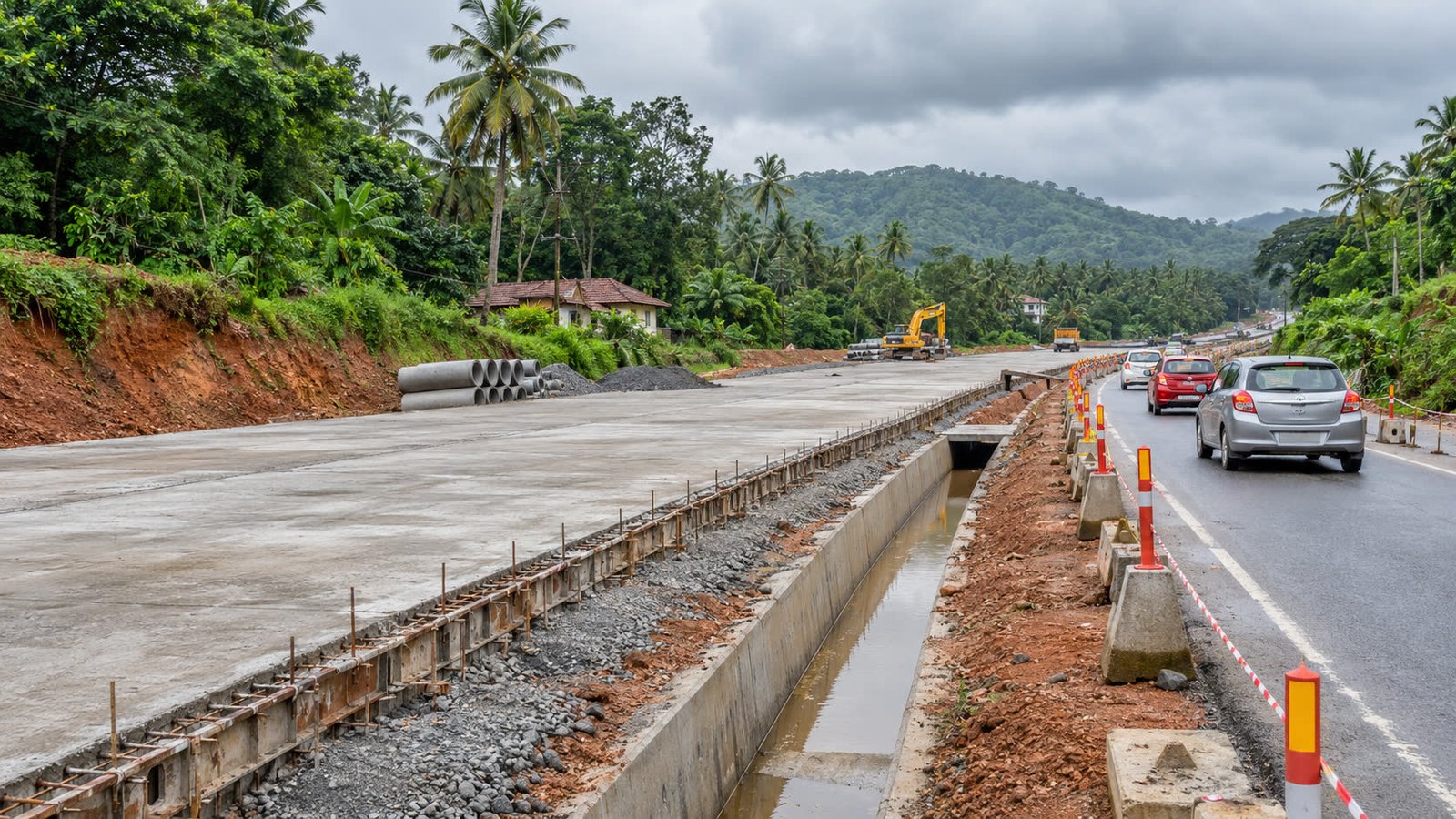
- The PAC chair cited slope failures, pavement cracking, poor drainage and waterlogging, while also referring to design and subcontracting concerns.
- A 2025 PAC report recommended that toll should not be collected where ongoing work leaves a highway incomplete, unsafe or without full access, but that recommendation is not itself a new toll rule.
- Before a trip through an active work zone, check route conditions, allow time for lane changes and identify a usable alternative before setting out.
What the latest scrutiny covers
The Hindu reported on 4 Nov 2026 that the PAC had pulled up NHAI over the slow pace of National Highway works in Kerala. A separate New Indian Express report from the Public Accounts Committee conference in Thiruvananthapuram said PAC chair K. C. Venugopal pointed to repeated slope failure, pavement cracking, poor drainage and waterlogging on highway projects in the State.
The New Indian Express report, which carried PTI inputs, also said Venugopal referred to the Road Transport and Highways Secretary's admission of design failure by the concessionaire and independent engineer, and to instances of subcontracting that allegedly contributed to low-quality highways. Those are remarks reported from the conference, not a finding that every Kerala highway stretch has the same defect.
The immediate reader value is therefore practical rather than political: a road shown as part of a National Highway corridor may still have narrow lanes, temporary surfaces, incomplete service roads or drainage work beside live traffic. A driver planning a long journey needs the current condition of the specific stretch, not just the route number.
What the PAC's earlier report said
The Parliament-hosted Thirty-Third Report of the Public Accounts Committee on MoRTH and NHAI was presented in August 2025 after the committee examined tolls, highway quality, maintenance and project oversight. Its recommendations are useful background to the current scrutiny, but they should not be read as a fresh order changing toll collection in Kerala.
In its section on ongoing works, the report said toll should not be collected when users are not getting full and safe access to the complete carriageway and related facilities such as service roads and drainage. It also recommended suspending toll collection until an affected stretch is complete and fully functional. That is a PAC recommendation to the Ministry and NHAI, not an automatic waiver that begins whenever a driver sees construction barriers.
The same report's record of committee proceedings described repeated cracks, service-road collapses, embankment failures and inundation near parts of NH-66 in Kerala. It called for stronger monitoring and an audit of construction practices, contracts and oversight. The current reports show that these concerns remain part of the public-accountability discussion; they do not announce a route-wide closure, a revised toll amount or a new compensation process.
Why this matters for a trip
Construction quality and construction speed affect more than the appearance of a road. A narrowed carriageway can reduce average speed, a diversion can add distance and a blocked drain can leave water near the usable lane after rain. The result may be a longer journey, more stop-and-go running and less predictable arrival time for commuters, buses, delivery vehicles and private cars.
For a planned journey, use the road-trip planner to compare the route and expected travel time, then check current local traffic notices for the corridor. If the practical route changes, estimate the extra fuel requirement with the fuel-cost calculator rather than assuming that the original trip budget will hold.
Toll is another part of the calculation. The toll-charge calculator can help separate the listed toll component from fuel and time costs, but a calculator cannot confirm whether a particular work zone is open, restricted or subject to a temporary concession. That information has to come from a current official notice or road-authority update.
What drivers should check now
Before leaving
- Check whether the final approach, service road or bridge section on the chosen corridor is under construction, narrowed or diverted.
- Keep a time buffer for temporary traffic control, especially if the trip includes a town entry, work-zone merge or rain-sensitive low-lying section.
- Confirm that a proposed alternative is actually open to the vehicle type being used. A local road that works for a car may not suit a bus, truck or trailer.
- Keep FASTag balance and documents in order, but do not assume a valid FASTag removes the need to follow work-zone diversions or local traffic directions.
While crossing the work zone
Follow the temporary signs, lane markers and speed instructions, and avoid stopping on a live carriageway to recheck the route. If water, a damaged surface or a missing barrier makes the lane appear unsafe, slow down and use the route authority's complaint or assistance channel when it is safe to do so. A driver report can be more useful when it records the exact corridor, direction, nearby landmark and time.
What to watch next
The next meaningful update would be project-specific: an NHAI or Ministry response, an audit timeline, a repair or drainage measure, a diversion notice, or an official decision on toll treatment for a stretch that cannot provide full access. Until one of those is published, the PAC discussion is a scrutiny and accountability signal, not proof that a blanket toll suspension is in force.
For Kerala drivers, the sensible takeaway is to plan for the road that is open today, not the road shown in a project promise. Check the condition of the exact stretch, budget for possible time and fuel variation, and treat any toll relief as confirmed only when the responsible authority publishes it.
Sources
- The Hindu — “PAC pulls up NHAI over slow pace of NH works in Keralam” — 4 Nov 2026
- The New Indian Express — “Venugopal says PAC must be taken seriously, flags absence of six chief secretaries in meeting” — 3 Nov 2026
- Public Accounts Committee, Parliament of India — “Thirty-Third Report on MoRTH and NHAI” — August 2025