Kia India says its Green Workshop network has reached 151 facilities, backed by 11.8 MW of installed solar capacity. Announced on 22 Oct 2026, the milestone matters mainly because it changes how participating service centres use electricity, water and workshop waste—not because it announces a service-price cut or a new public fast-charging rollout.
Key takeaways
- Kia says 151 workshops in its dealer network now have solar systems with cumulative capacity of 11.8 MW.
- The Green Workshop framework includes steam or dry washing, energy-saving equipment, effluent treatment and segregated waste handling.
- Kia cites 4–5 litres of water per vehicle for steam washing, against an estimated 100–120 litres for conventional washing; actual use varies.
- The company says about 2,269 barrels of used engine oil were handled during 2026.
- The announcement does not promise lower service bills, faster repairs, lower fuel consumption or public-charger access for every owner.
What Kia has announced
Kia India has crossed its previously stated target of 150 Green Workshops, with solar energy systems installed at 151 facilities, according to the company announcement reported by HT Auto and NamasteCar. Kia describes the expansion as part of its aftersales sustainability programme, carried out with dealer partners across the country.
The important distinction is between a workshop network and a charging network. These are service facilities where a car is inspected, repaired, washed or sent for body work. The 151-facility figure does not mean that Kia has created 151 public fast-charging sites, nor does it change the fuel or electricity price paid by a vehicle owner.
What the Green Workshop framework includes
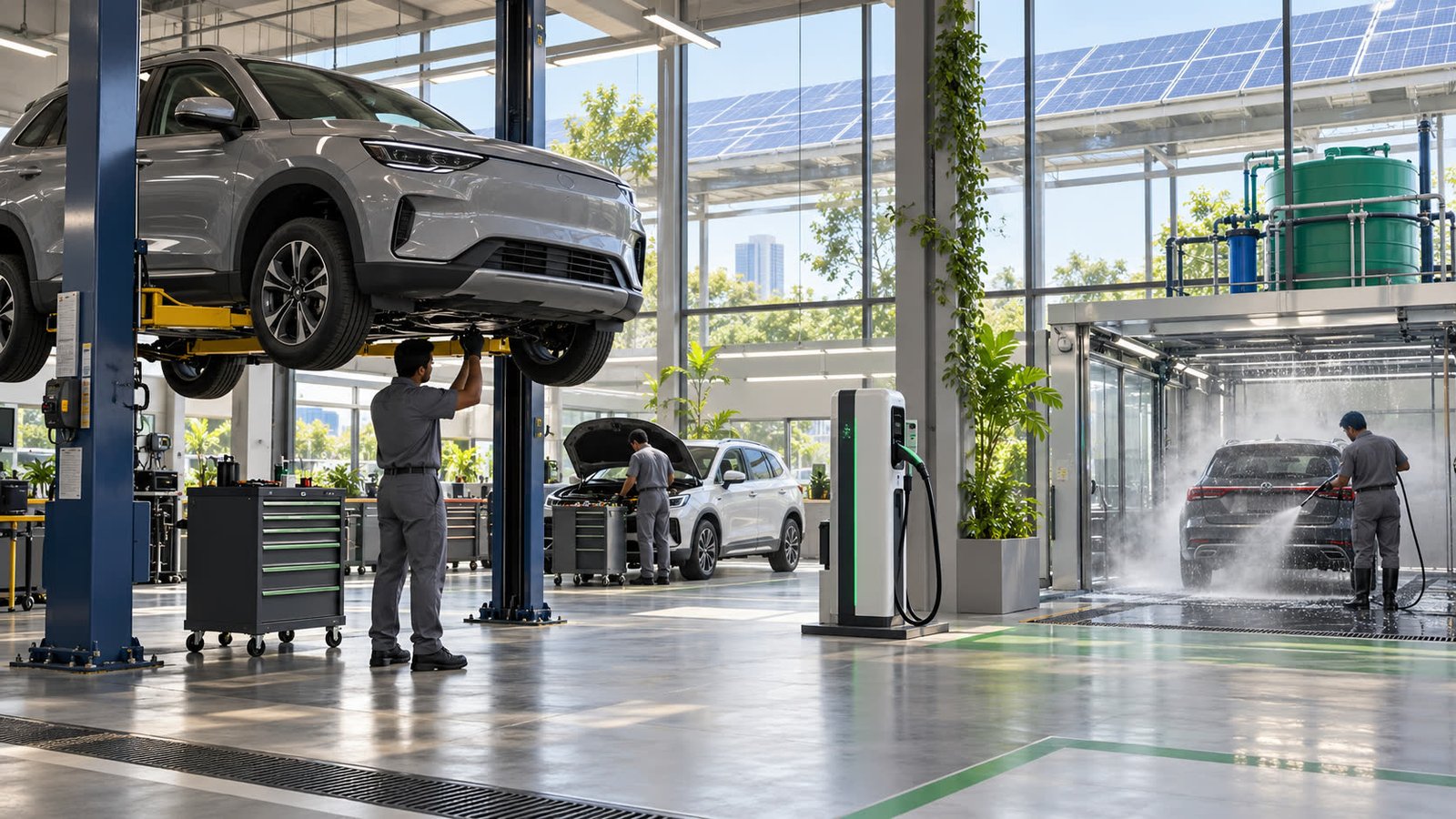
Kia says the framework combines renewable-energy use with measures intended to reduce resource consumption inside the service bay. The reported features include rooftop solar, rapid-wash facilities, natural lighting, motion-sensor-controlled lights and doors, effluent treatment plants, waterless urinals and colour-coded waste-segregation bins.
The company also says participating facilities use steam washing or dry washing. Dry washing avoids water in the wash process, while steam washing typically uses 4–5 litres per vehicle. Kia and the reports on its announcement compare that with an estimated 100–120 litres for conventional washing. The comparison is useful, but it is not a universal bill or savings calculation: water use depends on the method, equipment, vehicle condition and operating practice at a particular facility.
Used-engine-oil handling is another part of the programme. Kia says approximately 2,269 barrels of used engine oil were handled during 2026. That is a company-reported network figure, not a measure of the quantity generated by one car or of the environmental performance of every workshop.
What this means for Kia owners
For a Kia owner, this is an operations update rather than a new ownership entitlement. The announcement does not state that routine service prices, labour rates, warranty coverage or repair turnaround times will change. A Green Workshop label should therefore not be read as a promise of a cheaper service bill or a lower fuel bill.
It may still matter to customers who care about how routine maintenance is delivered. A service visit can involve electricity, water, cleaning materials, lubricants and waste handling even when the vehicle itself is unchanged. Owners can check whether their chosen Kia facility is part of the Green Workshop network and what services it currently offers, then compare the job card and estimate separately from the sustainability label.
EV owners should keep another distinction clear: a workshop’s own charging equipment or solar system is not the same as public highway charging. For route-level availability, use our state-wise EV station directory rather than assuming that every Green Workshop is a public charging stop.
For petrol and diesel Kia owners, the sustainability measures do not alter the vehicle’s certified mileage or the price of fuel. To estimate the fuel spend for a planned journey, use the fuel cost calculator and enter the current rate and distance for the trip.
Why the milestone matters beyond Kia
India’s vehicle-transition story is often told through tailpipe emissions, battery capacity or the number of charging points. Aftersales infrastructure is another part of the picture. Workshops service vehicles for years after purchase, so their electricity demand, wash practices, lubricant handling and waste systems can affect the footprint of everyday ownership.
The Kia announcement also shows why a workshop count is only a starting point. A larger network makes the programme more visible, but it does not by itself quantify emissions avoided, water used per service, solar power consumed on site or the share of waste recovered. Those measures would help owners and dealers compare the operational effect of the programme over time.
What to watch next
- Whether Kia publishes a location-level list so owners can identify the participating facility nearest to them.
- Whether the company reports comparable water, solar-energy and waste figures per vehicle serviced.
- Whether more Green Workshops add clearly identified EV service and charging support, without being presented as public charging infrastructure.
For an EV road trip, workshop sustainability and charging availability answer different questions. Drivers planning a longer journey can combine the road-trip planner with a separate charging check before leaving.
Reader takeaway
Kia’s 151-workshop milestone is a meaningful update to the service side of vehicle ownership, especially because it combines solar capacity with water and waste measures. It is not a price revision, a fuel-efficiency upgrade or a guarantee of public charging access. Owners should treat it as a network-practice update and verify the specific facility’s services, estimate and charging arrangements before a visit.
Sources
- Kia India, “Kia India Surpasses 150 Green Workshops, Accelerating Sustainability Across its Aftersales Network” — 22 Oct 2026
- HT Auto, “Kia India surpasses 150 Green Workshops, accelerates sustainable aftersales network drive” — 23 Oct 2026
- NamasteCar, “Kia India Crosses 150 Green Workshops, Expands Solar Power Capacity to 11.88 MW” — 22 Oct 2026