France's President Emmanuel Macron began a three-day Gulf tour on 19 October 2026 to seek additional diesel and oil supplies and discuss safer transport routes as disruption around the Strait of Hormuz keeps global fuel markets under pressure. The first UAE–France talks addressed maritime security and global energy supplies, but no new supply agreement has been publicly confirmed.
Key takeaways
- The tour runs from 19–21 October 2026 and covers Kuwait, the United Arab Emirates, Bahrain and Qatar.
- France is reported to be seeking additional Gulf volumes of diesel and oil, while also considering access to diesel and jet-fuel reserves in Oman for some overseas territories.
- The official UAE readout confirms that energy and maritime security were discussed, but it does not announce a new cargo contract or reserve release.
- The IEA says about 20 million barrels per day of oil and oil products moved through Hormuz in 2025, equal to around 25% of seaborne oil trade; Qatar and the UAE's LNG exports through the strait represented about 19% of global LNG trade.
What France is trying to secure
Macron's route takes him to four Gulf capitals during a period when European governments are trying to limit the effect of higher fuel and transport costs. Le Monde reports that the Élysée is seeking additional volumes of diesel and oil from Gulf partners. It also reports that Paris was considering diesel and jet-fuel reserves stored in Oman for use in overseas territories such as Mayotte and Réunion.
That is a contingency discussion, not confirmation that France has released those stocks or signed a new supply contract. The National describes the trip as an effort to strengthen energy ties and diversify supply routes. In its 19 October readout, the Emirates News Agency said Macron and UAE President Sheikh Mohamed bin Zayed reviewed the effect of the Middle East crisis on maritime security and global energy supplies.
The distinction matters. A diplomatic meeting can open the door to additional cargoes, swaps or route agreements, but it does not immediately put more diesel into a refinery or lower a pump price. The volume, delivery window, insurance terms and transport route would all determine whether a political commitment becomes physical supply.
Why the Strait of Hormuz matters beyond France
Hormuz is a global energy chokepoint rather than a France-only concern. The International Energy Agency says an average of about 20 million barrels per day of crude oil and oil products passed through the strait in 2025. That was around 25% of the world's seaborne oil trade, with most of the flow heading to Asian markets.
The gas exposure is also significant. The IEA says LNG exports from Qatar and the UAE that transit Hormuz represented about 19% of global LNG trade in 2025. Even where cargoes are not bound for Europe, disruption can affect benchmark prices, freight, marine insurance, refinery margins and the cost of moving goods. That is why a French search for secure supply routes has relevance for drivers, airlines, manufacturers and fleet operators well beyond France.
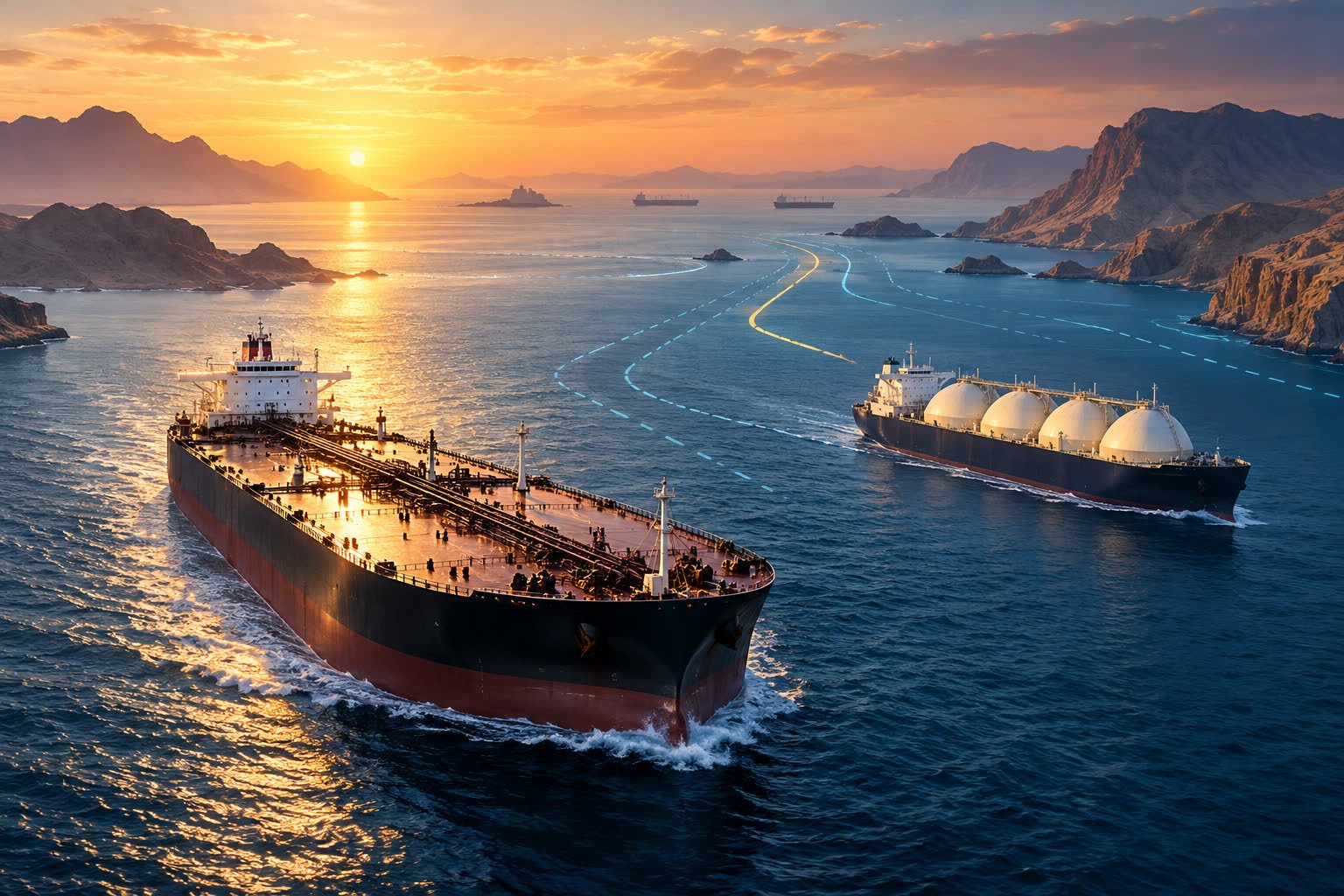
The IEA also notes that bypass capacity is limited. Saudi Arabia and the UAE have alternative crude export routes, but the available capacity is not a like-for-like replacement for every disrupted cargo. This helps explain why governments are discussing both new supply arrangements and safer shipping corridors rather than relying on one quick fix.
What it means for drivers and fleet operators
For motorists, the diplomatic push should not be read as an immediate promise of cheaper petrol or diesel. Local pump prices reflect crude and refined-product costs, freight and insurance, currency movements, refining capacity and national taxes. A new Gulf agreement could help supply security, but any effect at retail stations would arrive only after cargoes, refining and distribution catch up.
Drivers comparing a journey should use the live fuel-prices tracker for the local rate available to them, rather than converting a headline about oil into a pump-price forecast. For a specific route, the fuel cost calculator can show how a change in the rate affects the trip total using the vehicle's distance and efficiency.
Fleet and road-trip users also need to watch route length, delivery timing and fuel availability. The road-trip planner can help compare routes while the energy situation remains unsettled. The practical question is not only whether crude is available, but whether refined fuel can reach the right market at an acceptable transport and insurance cost.
Confirmed, reported and still open
- Confirmed: Macron met the UAE president on 19 October 2026, and the official readout says the two sides discussed energy, maritime security and the impact on global energy supplies. The National also confirms the four-country, 19–21 October schedule.
- Reported: Le Monde says the Élysée is seeking additional Gulf diesel and oil volumes and was considering Omani diesel and jet-fuel reserves for overseas territories.
- Not confirmed: the public readouts reviewed for this article do not state the volume, price, timing or final contract for any new French supply arrangement. They also do not confirm a broad retail-price cut.
What to watch next
The next useful signals are concrete commitments from the remaining meetings, especially any statement from Qatar or Bahrain that names cargo volumes, delivery dates or route protections. A separate signal will come from shippers and insurers: if vessels can move more reliably through or around the Gulf, the cost pressure on refined fuels may ease even before crude production changes.
For households and businesses, the safer reading is that France is preparing for an unstable market, not announcing that the problem is solved. Track local fuel prices, freight conditions and confirmed government or company notices. Treat claims of guaranteed savings or an immediate pump-price reversal as unconfirmed until a dated supply or pricing measure is published.
Sources
- Emirates News Agency (WAM), “UAE and French Presidents discuss cooperation and regional developments”, 19 October 2026.
- Le Monde, “On tour in the Persian Gulf, Macron seeks a solution to soaring fuel prices”, 20 October 2026.
- The National, “President Sheikh Mohamed holds talks with Macron on energy and AI”, 19 October 2026, updated 20 October 2026.
- International Energy Agency, “Strait of Hormuz” factsheet, updated February 2026.
This article is for general information only and is not financial, insurance or legal advice.