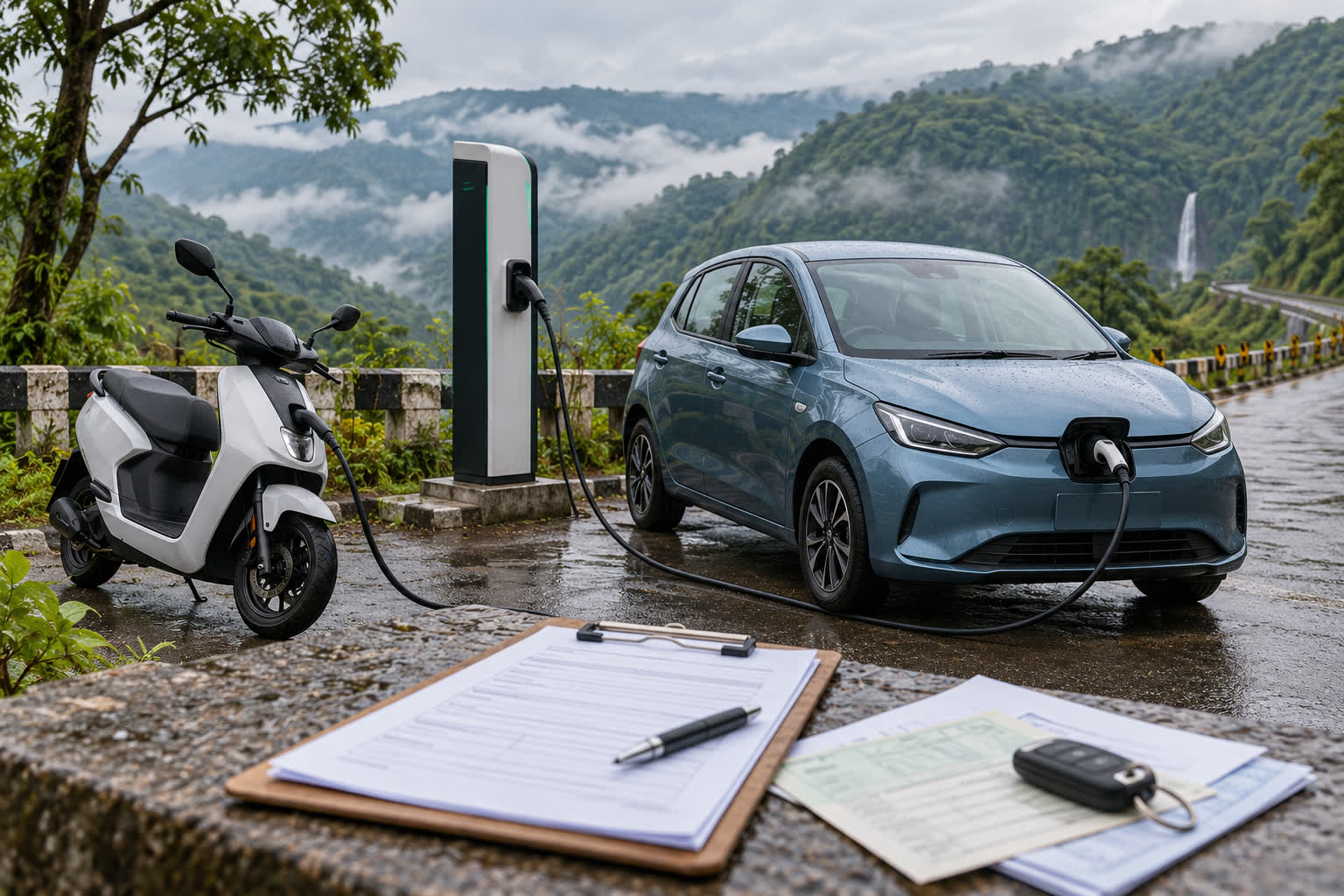
Meghalaya has notified its Electric Vehicle Policy 2026, opening a state-level support framework for electric two-wheelers, three-wheelers and cars. The change matters to buyers because the July cabinet announcement put a ₹25,000 purchase incentive and full registration-fee waiver on the table, while the official application portal now marks the monetary benefit as variable and lists the documents applicants must submit.
That distinction is important: ₹25,000 is the figure reported when the Cabinet approved the policy, not a blanket final quote for every vehicle or applicant. The current Meghalaya e-District service shows that claims are being processed through the Transport Department, but buyers should verify the applicable category, battery-capacity condition and benefit amount before treating the incentive as part of an on-road price.
Key takeaways
- Meghalaya has notified a new EV policy that replaces the 2021 framework, according to a 19 Oct 2026 report by Hub Network.
- The Cabinet-approved headline was a ₹25,000 incentive for an EV purchase and a full waiver of registration fees, as reported by India Today and EastMojo in July.
- The official Meghalaya e-District incentive service accepts individual applications online, by hand or through a kiosk.
- The portal lists the vehicle registration certificate, purchase certificate or Form 21/tax invoice showing battery capacity, bank passbook and, where relevant, a certificate of deposit.
- The policy also aims to support charging, battery swapping and wider EV use across private, commercial, public-transport, tourism and shared-mobility segments.
What Meghalaya has notified
Hub Network reported on 19 Oct that the Governor has notified the Meghalaya EV Policy 2026 and that it replaces the Meghalaya Electric Vehicle Policy 2021. The report says the new framework covers purchase incentives, exemptions linked to motor-vehicle tax and registration fees, scrappage benefits, charging infrastructure and battery swapping.
The same report says the policy is intended to run for three years from the date of notification. It also places the policy in a wider mobility context: the state wants electric vehicles to serve private owners as well as commercial fleets, public transport, tourism operators and shared-mobility services. Those are reported policy provisions; the operational details that matter to a buyer are the eligibility rules and the claim process.
The live government service page is useful because it shows the policy is not only a cabinet announcement. It identifies the Transport Department as the line department, lists an individual citizen as the beneficiary and describes the deliverable as a monetary certificate or report paid through internet banking.
What the ₹25,000 figure means
When the Meghalaya Cabinet approved the policy in July, India Today reported that every EV buyer would receive a ₹25,000 incentive and that registration fees would be fully waived. EastMojo separately reported the same Cabinet decision and said the support would cover electric two-wheelers, three-wheelers and four-wheelers.
Those reports describe the Cabinet decision. The current e-District page does not display a single universal rupee amount; it labels the monetary benefit as variable. That may mean the final process depends on vehicle type, battery capacity, purchase documents, funding limits or an implementing order. Until the Transport Department publishes or confirms the category-wise schedule, the safe reading is that ₹25,000 is the announced headline figure, not an automatic amount to subtract from every EV quotation.
For a buyer comparing an electric scooter or car, that difference affects the real calculation. A registration-fee waiver can reduce the initial RTO outgo, while a purchase incentive can reduce the upfront price if the applicant meets the final conditions. Neither should be treated as a guaranteed dealer discount, and the policy does not remove other ownership costs such as insurance, charging equipment, electricity, maintenance or financing.
How the application process looks
The government portal gives a practical checklist for an individual applicant. It says the service can be submitted online, by hand or through a kiosk. The listed documents are:
- Identity proof such as a driving licence, voter ID, Aadhaar or passport.
- The vehicle registration certificate.
- The purchase certificate, including Form 21 or the tax invoice, with battery capacity mentioned.
- A bank passbook for the payment route.
- A certificate of deposit where the claim is connected with vehicle scrappage.
The battery-capacity reference is worth checking before a purchase is finalised. It suggests that the invoice and vehicle records will be central to deciding whether an application can be processed. Applicants should retain the final invoice, registration papers and bank details in the same name and confirm whether the dealer has recorded the correct battery specification.
What it means for buyers and fleet operators
For Meghalaya residents, the policy makes the upfront-cost comparison more relevant, but it does not make every EV equally suitable. A two-wheeler used mainly in Shillong may have a different charging and running-cost profile from a car used for inter-district travel. A commercial operator also needs to check payload, route length, charging downtime and service support before counting a purchase incentive as a business saving.
The charging side will determine how much of the policy becomes visible on the road. Buyers can use FuelPrice's state-wise EV charging directory to check the public network around a planned route. For longer journeys, the road-trip planner can help map stops and driving time. A user comparing an EV with a petrol or CNG vehicle can also use the fuel-cost calculator as a starting point, while remembering that electricity tariffs and home-charging losses need to be entered or estimated separately.
For fleet owners, the policy's value may be less about one ₹25,000 payment and more about whether registration relief, scrappage support, charging access and predictable claim processing work together. The useful test will be how quickly applications are approved, whether the incentive is capped by segment or battery size, and whether commercial vehicles receive the same treatment as private vehicles.
What to verify before claiming the benefit
- Confirm that the final policy schedule covers the exact vehicle type and battery capacity.
- Ask whether the ₹25,000 amount is fixed, variable, capped or subject to available funds.
- Check whether the registration-fee waiver is applied at the RTO stage or reimbursed later.
- Keep the invoice, Form 21, registration certificate and bank details consistent with the applicant's name.
- If using a scrappage certificate, confirm how it interacts with the EV incentive and the state vehicle-scrappage rules.
- Check charger availability and service support before assuming that the policy alone makes an inter-city EV route practical.
What to watch next
The next useful update will be a category-wise implementation schedule from the Meghalaya Transport Department: the final rupee amount, eligible vehicle classes, battery-capacity thresholds, claim window and treatment of commercial fleets. Buyers should also watch whether the state publishes a list of approved charging locations and whether the application portal adds a status-tracking facility.
The reader takeaway is straightforward. Meghalaya's 2026 EV policy creates a clearer state support framework and a live route to apply, but the cabinet-announced ₹25,000 figure still needs to be read alongside the portal's variable-benefit wording. Check the final eligibility and documents before booking an EV or building the incentive into an ownership-cost calculation.
This article is for general information only and is not financial, insurance or legal advice.
Sources
- Meghalaya e-District, Application for Incentive under Meghalaya Electric Vehicle Policy 2026, accessed 19 Oct 2026
- Hub Network, Switch to electric: Meghalaya offers incentives for two-wheelers, cars and e-autos, 19 Oct 2026
- India Today, Meghalaya offers Rs 25,000 incentive, registration fee waiver for EV buyers, 27 Jul 2026
- EastMojo, Meghalaya approves new EV policy with ₹25,000 purchase incentive, 28 Jul 2026