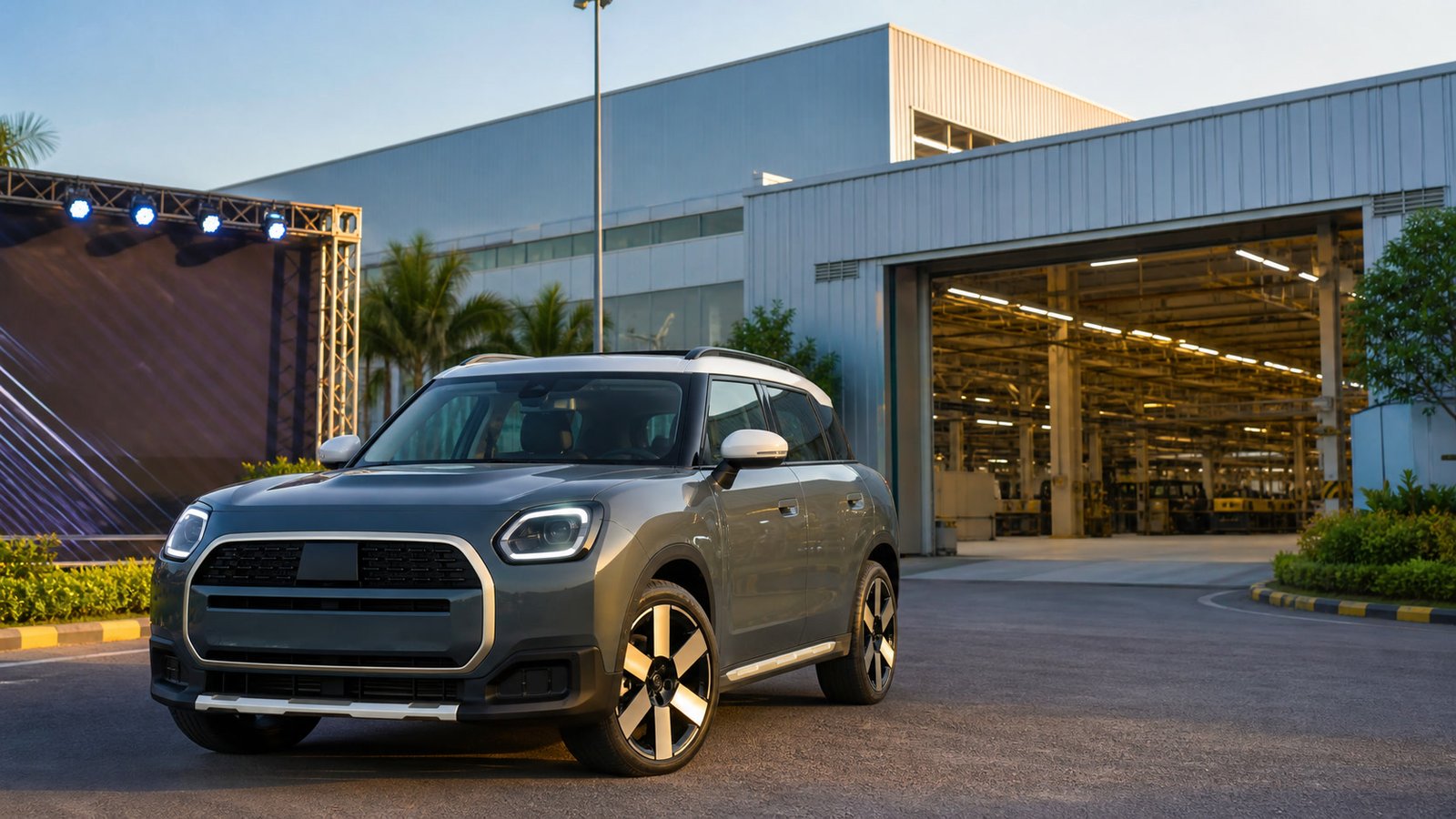
MINI India has moved the Countryman story beyond teasers and booking announcements. The India-made Mini Countryman C is set to launch today, June 17, 2026, and the timing matters because it shows how a premium global brand is now trying to play more seriously in the locally manufactured luxury-SUV space. For buyers who have always liked MINI's design identity but wanted a more practical and better-supported Indian ownership proposition, this launch is the key moment in the brand's 2026 calendar.
What makes the Countryman C relevant is not just the badge. It is the combination of local production, premium positioning and compact-SUV usability. According to Times of India reports, the model will be manufactured at the BMW Group plant in Chennai, bookings are already open through MINI dealerships, and deliveries are expected to begin immediately after the official launch. In a market where premium compact SUVs attract buyers who want something different from the usual German trio, that local-production angle matters a lot.
What buyers should know first
Industry reports have consistently pointed to a price band of around Rs 40 lakh to Rs 45 lakh (ex-showroom), which places the Countryman C in the same conversation as some of India's most visible luxury compact SUVs. That is not an entry-level price by any means, but it does indicate MINI is not trying to win on volume alone. The brand is targeting buyers who want design, badge appeal and a more premium urban-SUV feel than the mainstream market can offer.
TOI's launch coverage also says the Countryman C will compete with the BMW X1, Audi Q3, Mercedes-Benz GLA and Volvo XC40. That is the right battleground because these are exactly the SUVs that attract style-conscious urban buyers who are comparing size, image, convenience and ownership confidence more than outright practicality. MINI's challenge is to remind buyers that it offers a distinct personality in a segment that can otherwise feel very similar from brand to brand.
| Key point | Launch-day detail | Why it matters |
|---|---|---|
| Launch date | June 17, 2026 | Fresh premium-auto news for Indian buyers. |
| Manufacturing | Locally produced at BMW Group plant in Chennai | Supports supply, localization and pricing strategy. |
| Bookings | Already open through MINI dealerships | Indicates demand-building started ahead of launch. |
| Expected price | About Rs 40 lakh to Rs 45 lakh (ex-showroom) | Places it in premium compact-SUV territory. |
| Main rivals | BMW X1, Audi Q3, Mercedes-Benz GLA, Volvo XC40 | Shows the exact battleground MINI is entering. |
Why local manufacturing changes the story
MINI is a brand that sells emotion as much as engineering. But in India, emotion alone is not enough to win premium buyers. They also want predictable delivery times, strong after-sales support and a price that is not inflated purely by import duties. That is where Chennai assembly changes the conversation.
Local production can help MINI reduce some of the cost pressure that comes with fully imported premium cars. It also makes the product story easier to sell to buyers who increasingly ask a practical question before they sign: if I am paying luxury money, what am I getting in terms of availability, service and ownership confidence? A locally manufactured Countryman C gives MINI more flexibility on those fronts, even if the vehicle still sits in a high-price bracket.
There is also a broader industry signal here. Premium manufacturers are still betting on India, but they are doing it more selectively. Instead of chasing mass-market volumes, they are using local assembly to sharpen their premium offering. The Countryman C fits that playbook well because it is small enough for city use, premium enough for a badge-driven audience and distinctive enough to stand apart from the larger crowd of luxury SUVs already on sale.
Who is likely to buy it
The Countryman C is likely to appeal to a very specific buyer profile. Think of urban professionals, family buyers moving up from mainstream SUVs, and existing premium-car users who want something that feels less conventional than the usual German choices. MINI buyers often value design, driving feel and brand personality. The India-made Countryman C should make that pitch more credible because it adds local relevance to a badge that has historically been seen as more niche than practical in India.
That niche positioning is not a weakness if MINI executes the pricing and dealership experience well. In the premium compact-SUV segment, buyers are not always searching for the biggest car. They are searching for the most interesting one that still fits daily life. MINI's challenge is to convince them that the Countryman C is that balance point.
What to watch after the launch
The most important numbers to watch will be the official ex-showroom price, the variant structure and the first delivery timeline. Those will tell us whether MINI is aiming for a narrow enthusiast audience or a broader premium audience. Another important detail will be how the company positions the Countryman C against the BMW X1 and Audi Q3, which are established nameplates with strong showroom presence in India.
It will also be worth watching the dealership response. Since bookings are already open, launch-day interest will reveal whether local production has improved the Countryman's market appeal. If MINI can keep the product story focused on design, local assembly and premium ownership support, the Countryman C could become one of the more interesting launches in the luxury-SUV space this year.
The takeaway is simple. This is not just another premium SUV launch. It is a test of how far MINI can stretch its India story with local manufacturing. If the pricing lands well, the Countryman C could give premium buyers a fresh alternative in a crowded segment while also showing how global brands are adapting to India rather than simply importing their global playbooks.
Sources: Times of India: launch tomorrow, Times of India: launch date and booking details.