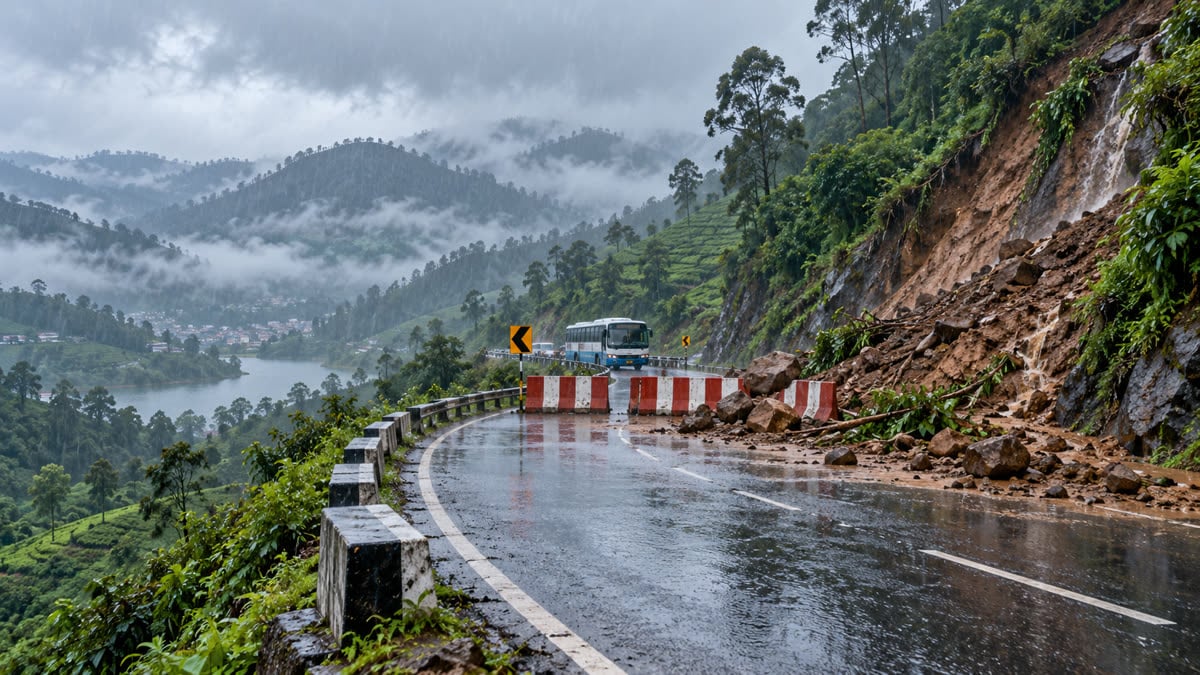
Heavy rain and landslides have disrupted the Mettupalayam–Coonoor ghat route into Tamil Nadu’s Nilgiris, including the death of a Tamil Nadu State Transport Corporation (TNSTC) bus driver. The district administration has closed tourist destinations and imposed overnight vehicle restrictions, so anyone planning an Ooty trip should verify the route before leaving.
The disruption followed torrential rain near Burliar, where a landslide buried a government bus on the ghat road. The driver died and the conductor was rescued with injuries, according to reports from The New Indian Express and The Times of India. Multiple slides and fallen trees also stranded travellers and affected access to the hill district.
Key takeaways
- The Mettupalayam–Coonoor approach to Ooty has been hit by landslides, with the Coonoor and Kotagiri ghat corridors both under restrictions.
- Tourist destinations in the Nilgiris have been closed until further notice, while authorities have advised visitors to avoid the district during the three-day restriction period.
- Burliar recorded 250 mm of rain and Kil Kotagiri Estate 200 mm in the relevant 24-hour period, figures reported by both The New Indian Express and The Times of India.
- The Regional Meteorological Centre, Chennai, warned of extremely heavy rain on 25 October, very heavy rain on 26 October and heavy rain on 27 October 2026.
What happened on the Ooty route
The landslide struck after heavy rain on the Mettupalayam–Coonoor ghat road. The Times of India reported that the bus had been travelling between Ooty and Coimbatore after its passengers were moved to another vehicle following a tyre problem. The bus was later caught when earth, rocks and uprooted trees came down near Burliar. The New Indian Express separately reported the bus burial, the driver’s death and the rescue of the conductor.
Reports also point to a wider corridor problem rather than a single blocked spot. The Times of India said landslides affected more than 19 locations on the ghat road, while The New Indian Express reported landslides at 19 locations and tree falls at 18 locations. The differing descriptions still establish the practical point for motorists: debris and further slides can make conditions change along the approach, even after one obstruction is cleared.
Hindustan Times reported that landslides also affected parts of the Nilgiris and neighbouring Coimbatore district, with officials inspecting the affected areas and monitoring restoration. That makes the incident relevant not only to tourists but also to buses, goods vehicles, local residents and operators using the hill routes for work.
What the traffic restrictions mean
The New Indian Express reported that Nilgiris Collector Lakshmi Bhavya Taneeru ordered tourist spots closed until further orders, asked tourists to avoid the district for three days and restricted vehicle movement between 6pm and 7am for three days, apart from ambulances and essential vehicles. The Times of India reported a similar three-day restriction on the Coonoor and Kotagiri ghat corridors, but gave the overnight window as 6pm to 6am.
That one-hour difference matters to anyone trying to time a late arrival or an early departure. It should be treated as a live local instruction rather than resolved by assumption. Travellers should confirm the current window with the district administration, police or transport operator before starting, and should not treat a route as open simply because a map app shows a usable road.
Rain risk remains high
The official IMD warning issued on 25 October 2026 placed Tamil Nadu and Puducherry under an extremely heavy rain warning for 25 October, followed by very heavy rain on 26 October and heavy rain on 27 October. The warning is not a route-reopening notice: even if rainfall eases at one location, local authorities still need to inspect slopes, clear debris and confirm that the road is safe.
What drivers and operators should do now
- Postpone non-essential hill travel during the restriction period, especially journeys that would reach the ghat roads near the overnight cutoff.
- Check the latest local closure and clearance update before leaving. Build extra time for a possible hold-up and do not cross barricades or drive around debris.
- Use the road-trip planner to review the route and journey timing before departure. A map route is not a substitute for an official clearance.
- If a permitted detour or delay changes the distance, estimate the revised outlay with the fuel cost calculator and check current rates on the fuel prices page.
- Bus, taxi and freight operators should confirm operating instructions with their dispatch or local transport authority instead of relying only on the published timetable.
What to watch next
The next meaningful update will be an official clearance or a change to the tourist and overnight-traffic restrictions. The IMD forecast extending through 27 October suggests that road conditions can remain unsettled; its later “no warning” entries should not be read as an automatic reopening date. Until local officials confirm otherwise, drivers should plan for delays, changing access and the possibility that an alternate route will also be controlled.
Sources
- The New Indian Express — “Heavy rains, multiple mudslides bring Nilgiris to knees; bus buried, driver killed” — 25 Oct 2026
- Hindustan Times — “Landslides rock Tamil Nadu’s Nilgiris and Coimbatore as house gets washed away, bus driver dies” — 24 Oct 2026
- The Times of India — “Driver dies as TNSTC bus buried under landslide on Mettupalayam-Coonoor Ghat Road during heavy rain” — 24 Oct 2026
- India Meteorological Department, Regional Meteorological Centre Chennai — “Sub-Divisionwise Warning” — 25 Oct 2026