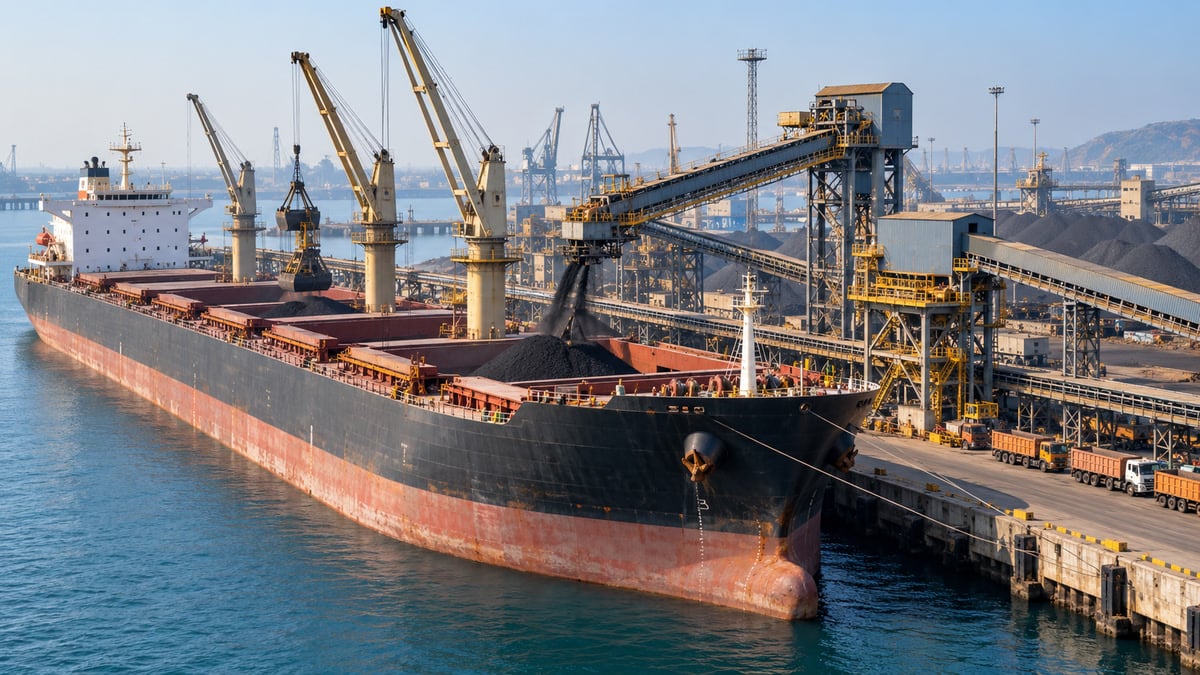
The Baltic Panamax index fell about 2% to 2,109 points on 23 Oct 2026, its lowest level since 24 Aug, according to reports from Maritime Gateway and Trading Economics. For Indian coal and grain importers, the move may improve negotiating conditions for suitable cargoes, but it is not proof that every delivered shipment has become cheaper.
Key takeaways
- The Panamax benchmark reached 2,109 points on 23 Oct 2026, after falling about 2% that day.
- The wider Baltic Dry Index ended at 2,660 points, down 1.2% in the session, although it was still up 5.9% over the week.
- A dry-bulk benchmark is a market signal, not an individual voyage quotation.
- Delivered cargo cost also depends on port handling, inland transport, storage, inventory timing and the shipment route.
- Indian buyers should compare the full landed-cost sheet before treating a lower benchmark as a saving.
What changed in the freight market
Panamax vessels sit between the largest capesize ships and smaller handy-size vessels in the dry-bulk market. They are commonly used for bulk commodities such as coal and grain, so their freight benchmark can offer a useful read on the cost of moving large cargoes by sea.
Maritime Gateway and Trading Economics both reported that the Baltic Panamax index declined about 2% to 2,109 points on 23 Oct 2026. Both reports also placed that reading at the lowest level since 24 Aug. The broader Baltic Dry Index fell 1.2% to 2,660 points on the same day, ending a four-session rise, while the weekly measure remained positive.
The daily move matters because freight markets can change before a physical cargo is fixed. It does not, however, tell an importer what a shipowner will quote for a particular load, port pair or delivery window.
Why Indian importers may care
India’s bulk buyers can include power generators, industrial users, steelmakers, cement producers, grain traders and other businesses that move large cargoes through ports. A softer Panamax benchmark can create room to compare offers or negotiate freight when the cargo, vessel size and route fit the market being measured.
The effect is indirect for drivers and transport operators. A lower ocean-freight benchmark does not automatically change petrol or diesel prices, and it does not guarantee a lower price at a power plant, factory or warehouse. But freight is one part of the delivered cost of imported commodities. If the ocean leg is cheaper and other costs are stable, the total landed-cost calculation may improve.
Once cargo leaves a port, the road leg still matters. Importers and logistics teams can check current fuel-rate inputs through the live fuel prices tool, then estimate truck movement with the fuel cost calculator. Port-to-warehouse movements may also carry tolls, so a route estimate should include the relevant toll charges and trip-cost tools rather than treating ocean freight as the whole bill.
Why a lower index is not an invoice
Freight benchmarks are constructed from market assessments and representative routes. An actual quote can vary with the loading region, discharge port, cargo quantity, vessel availability, laycan dates, weather, congestion, fuel costs and the terms agreed between the parties.
For an Indian importer, port handling and documentation may be quoted separately. So can demurrage, inspection, insurance, stevedoring, storage and inland haulage. A shipment may also be fixed before the benchmark moves, or a contract may use a different reference period. Those details can outweigh a one-day change in the index.
What to check in a freight quote
- Benchmark date: confirm whether the quote reflects the latest market assessment or an earlier fixing.
- Route and cargo: check the loading port, discharge port, commodity, quantity and vessel specification.
- Included costs: identify what is covered for port handling, agency, documentation, demurrage and storage.
- Inland leg: price fuel, tolls, distance and vehicle capacity from the port to the receiving facility.
- Delivery timing: compare the cost of waiting for a lower rate with the cost of holding inventory or delaying production.
This checklist is useful even when the freight market is falling. The objective is to compare like-for-like delivered cargo costs, not to chase a headline index reading.
What to watch next
The next signal will come from the balance between available ships and cargo. Daily Cargo News described persistent downward pressure in the Panamax-Kamsarmax market in its 23 Oct weekly report, with weaker Atlantic cargo demand and vessel oversupply contributing to the softer tone. At the same time, demand from coal and grain routes can change quickly as power-station inventories, crop loadings and industrial buying adjust.
For India, the useful question is whether a weaker benchmark lasts long enough to affect cargoes that have not yet been fixed. Watch new vessel fixtures, coal restocking, grain export activity and any changes to production or export policy in major supplying countries. These are market developments to monitor, not promises about future freight or commodity prices.
The reader takeaway
The Panamax index’s 23 Oct decline gives Indian bulk importers a clearer negotiating reference, but it is only one line in the cost sheet. Buyers, fleet operators and other logistics users should date the benchmark, verify the route and compare the full ocean-to-warehouse cost before concluding that a shipment has become cheaper.
Sources
- Maritime Gateway — Panamax Freight Rates Slide as Indian Bulk Importers Weigh Shipping Costs — 26 Oct 2026
- Trading Economics — Baltic Dry Index Snaps 4-Day Winning Run — 23 Oct 2026
- Daily Cargo News — Baltic Exchange Weekly Report: 23 October 2026 — 25 Oct 2026
- The Baltic Exchange — Market Information — accessed 26 Oct 2026
- APBI-ICMA / Argus Media — India’s thermal coal imports set for October rebound — 26 Oct 2026