The Ministry of Heavy Industries has approved ₹851 crore for 8,147 public EV chargers across three oil marketing companies and 10 states as of 28 Sep 2026, according to the official PIB factsheet posted on 1 Oct 2026. For Indian EV owners, the update is a useful signal that more public charging capacity is being funded, but it does not mean 8,147 chargers are already installed, live or available on a particular route.
Key takeaways
- Confirmed: ₹851 crore was approved for 8,147 public chargers by 28 Sep 2026.
- The approvals cover three oil marketing companies and 10 states, but the published update does not give a state-wise or company-wise split.
- PM E-DRIVE has earmarked ₹2,000 crore for public EV charging; the ₹1,149 crore difference is a calculation from the published figures, not a separate announcement.
- The ministry has not published a total for chargers already installed and working under this approval.
What PM E-DRIVE has approved
PM E-DRIVE was implemented in October 2024 to support EV adoption, charging infrastructure and the domestic electric-vehicle manufacturing ecosystem. The government factsheet says the scheme has a total outlay of ₹11,900 crore and has been extended until 31 Mar 2028. It covers electric two-wheelers and three-wheelers, e-ambulances, e-trucks, e-buses, public charging stations and upgrades to vehicle-testing agencies.
The same factsheet records 26.59 lakh EV sales as of June 2026 against an incentive-supported target of about 28.30 lakh vehicles. That is a scheme-wide figure, not a count of electric cars alone. For eligible electric two-wheelers, the scheme provides an incentive of ₹2,500 per kWh, capped at ₹5,000 per vehicle, for models priced up to ₹1.5 lakh ex-factory. The benefit is delivered as an upfront price reduction through an e-voucher, subject to the scheme’s eligibility and funding conditions.
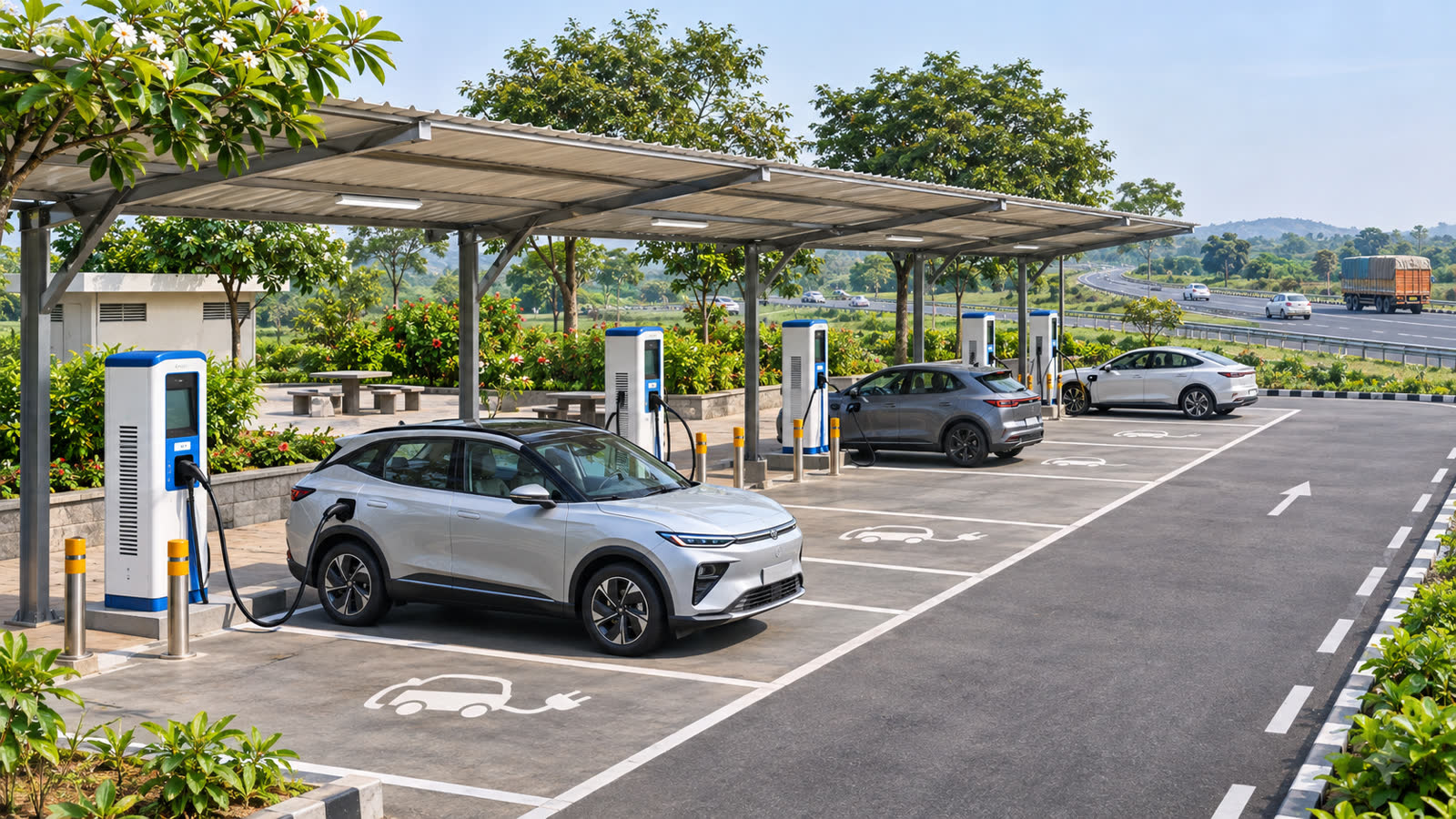
For charging infrastructure specifically, ₹2,000 crore has been earmarked for EV public charging stations across India. The latest government snapshot says ₹851 crore had been approved for 8,147 chargers through three oil marketing companies and 10 states as of 28 Sep 2026.
Why this matters for Indian EV trips
Public charging is one of the practical limits on longer electric-vehicle journeys. A larger network can reduce the distance a driver must plan between charging stops, give fleet operators more options for repeat routes and make EV ownership easier outside large cities. The approval also links charging support with oil-marketing companies and state-level deployment, which could place some new chargers at familiar highway and fuel-station locations.
That is the potential benefit, not a promise of immediate coverage. A sanction or approval is a funding and deployment step. It does not tell a driver whether a charger is open, whether it has the connector needed by a particular vehicle, what charging power it offers, or what price the operator will charge. The official factsheet gives the approved total, but not a list of live sites, charger ratings or commissioning dates.
What the ₹851 crore figure does—and does not—tell drivers
Comparing the ₹851 crore approval with the ₹2,000 crore charging earmark leaves ₹1,149 crore that had not been approved in that reporting snapshot. The arithmetic works out to roughly 43% of the earmark, with average approved support of about ₹10.4 lakh per charger. That average is only a calculation; it should not be read as a fixed grant for every charger or as the price of installing one.
- It is a charger count, not necessarily a site count: one location can host more than one charger, so 8,147 chargers cannot be treated as 8,147 separate stops.
- It is an approval figure, not a live-network figure: the latest public update does not state how many of the approved chargers have been installed, tested and opened to drivers.
- It does not identify the best routes: without a state-wise, highway-wise and power-rating breakdown, drivers cannot use the total to assume that a particular corridor is covered.
The distinction matters for both private owners and commercial operators. An EV taxi, delivery vehicle or inter-city fleet needs dependable uptime, compatible connectors and predictable payment access. Those operating details will matter more at trip level than the headline approval amount.
What EV owners can check now
Before a long journey, use the state-wise EV charging directory to identify possible charging points along the route. Treat the directory as a planning aid and confirm availability, connector type, operating hours and pricing with the station operator before leaving.
Use the road-trip planner to map distance, stops and travel time. For a route where an EV is being compared with a petrol or diesel vehicle, the fuel cost calculator can estimate the conventional vehicle’s fuel outlay; it is not an EV charging-cost quote.
The practical takeaway is to plan around chargers that are confirmed and usable today. The PM E-DRIVE approval is a medium-term network signal, not a guarantee that a new charger will be ready before the next trip.
What to watch next
The next useful disclosure would show how the ₹851 crore is divided among the three oil marketing companies and 10 states, which agency is procuring each package, the charger type and power rating, expected commissioning dates, and the number already working. Those details would let drivers connect the policy announcement to real route planning.
Until that information is published, EV buyers and fleet operators should separate three questions: whether a vehicle is eligible for a purchase incentive, whether a charging project has been approved, and whether a particular station is operational. They are related parts of the scheme, but they are not the same benefit.
Sources
- Press Information Bureau — “PM E-DRIVE Scheme: A Step Towards a Sustainable Future” — 1 Oct 2026
- DD News — “PM E-DRIVE accelerates India’s electric mobility push with 26.59 lakh EV sales, ₹11,900-crore outlay” — 11 Nov 2026
- ThatsMyEV — “PM E-DRIVE has approved ₹851 crore for 8,147 public EV chargers across three oil companies and 10 states” — 11 Nov 2026