Tata Motors and Iveco are identifying selected commercial vehicles that could be localised in India, initially through semi-knocked-down (SKD) assembly, after the companies’ new global combination. The 3 Nov 2026 disclosure matters to Indian fleet operators because it may widen future truck and bus choices, but no model, plant, start date or customer price has been confirmed.
At a joint press conference in Turin, Tata Sons Chairman N Chandrasekaran said the companies were already identifying Iveco products relevant to India and would begin with semi-knocked-down manufacturing. The announcement is a materially new follow-up to Tata Motors taking control of Iveco; FuelPrice’s earlier report on the Tata-Iveco takeover covers that ownership change.
Key takeaways
- What changed: Tata Motors and Iveco are exploring India localisation for selected Iveco commercial vehicles through an initial SKD route.
- What is not known: The companies have not named a model, Indian assembly plant, start date, local-content target or customer price.
- Why fleets should care: A future localised product line could affect vehicle availability, parts planning and model choice, but it does not change current truck or bus supply today.
- Group scale: The 3 Nov company release describes a combined enterprise with more than 130 countries of presence, 27 manufacturing sites, 25 research and development centres and over 73,000 employees.
- Next proof point: The promised detailed business plans and the first India-bound product will matter more than the strategic announcement.
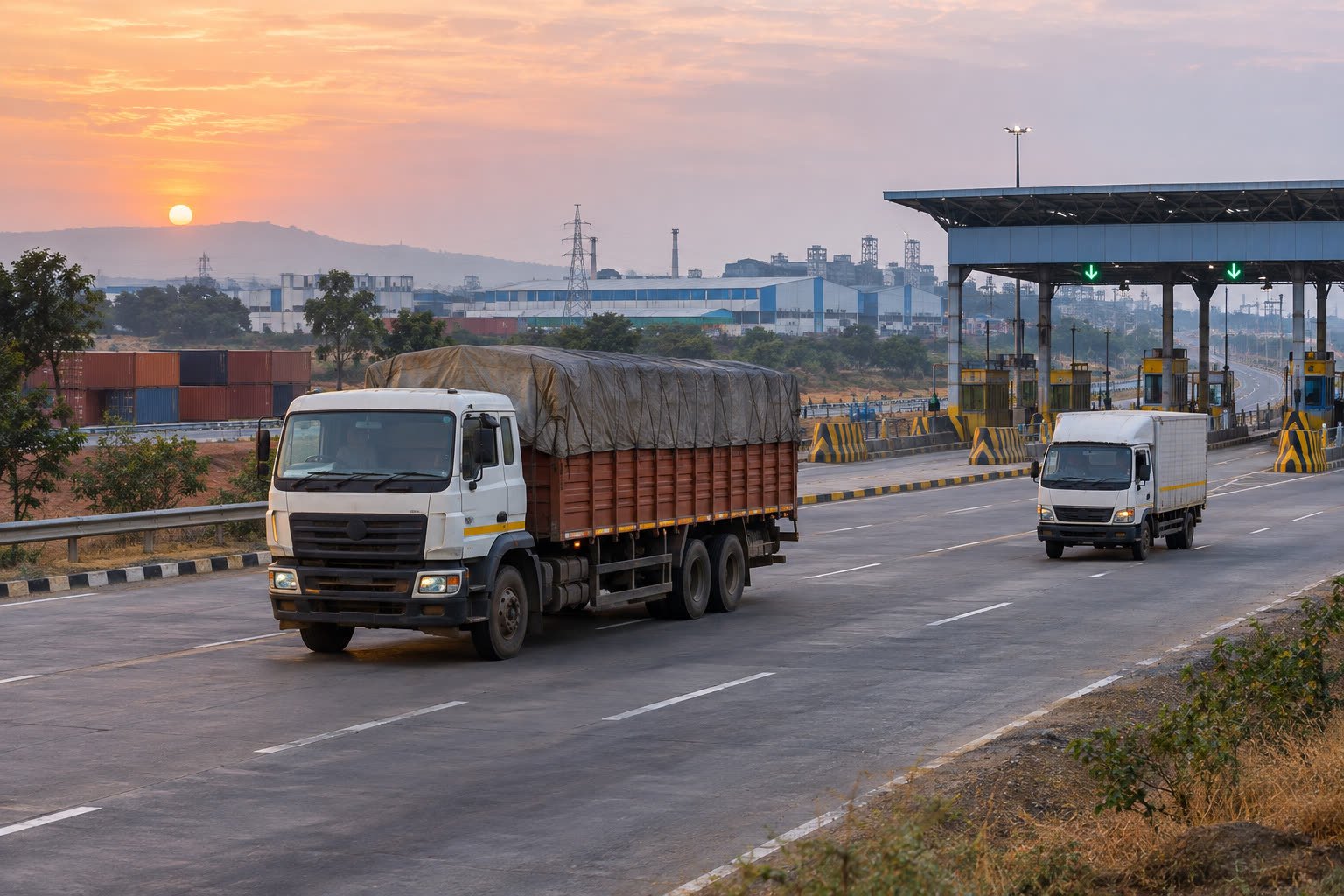
Image note: The hero is an illustrative freight and toll-corridor visual, not a photograph of a specific Tata or Iveco vehicle.
What Tata Motors and Iveco announced
Business Standard reported on 3 Nov 2026 that Tata Motors is exploring the local assembly of select Iveco vehicles in India through the semi-knocked-down route. The Economic Times, in a PTI report published the same day, carried the same core detail: Iveco products with relevance to India are being identified, with localisation planned initially through semi-knocked-down manufacturing.
SKD assembly generally means that major vehicle systems or modules arrive for local assembly rather than the entire vehicle arriving fully built. That description explains the proposed route, but it does not establish how much of an Iveco vehicle would be sourced in India. Local content, component suppliers, testing, homologation and the eventual manufacturing location have not been disclosed.
The companies’ joint 3 Nov press release confirms the broader combination and says the two sides will use complementary engineering, sourcing, distribution and customer networks. It also says existing customer contracts, dealer and supplier relationships, warranties and aftermarket commitments continue unchanged. Those statements describe continuity during integration, not an immediate new truck launch in India.
Why the follow-up matters to Indian fleets
Commercial-vehicle buyers and operators plan around uptime rather than a brochure headline. A new India-bound Iveco product would need a clear payload and duty-cycle fit, a parts and service plan, usable delivery timelines and a total operating cost that can be compared with vehicles already available in the country. None of those product-level details has been announced.
Local assembly could eventually improve supply flexibility or make component sourcing more relevant to Indian operating conditions, but that is an inference, not a company promise. The outcome will depend on the models selected, production volumes, localisation depth, supplier readiness and approvals. There is no basis yet for saying that Iveco trucks will become cheaper, arrive sooner or replace any current Tata Motors product.
For a transporter, fuel remains one of the largest variable costs even when the purchase decision is about a future vehicle. The fuel-cost calculator can be used to establish a baseline for a representative route once an engine, load and mileage assumption are known; it cannot predict the fuel economy of an unannounced India-spec Iveco model.
The scale behind the combination
The scale helps explain why the companies are examining products and technologies across markets, but it should not be mistaken for an India product plan. The figures below are from the companies’ 3 Nov release and were also reported by Business Standard and The Economic Times.
| Combined group measure | Reported position on 3 Nov 2026 | What it signals |
|---|---|---|
| Geographic presence | More than 130 countries | Products could be evaluated across established markets, but market entry still needs approval and a business plan |
| Manufacturing and engineering | 27 manufacturing sites and 25 R&D centres | Both groups bring existing industrial and technology capabilities to the integration |
| Customer network | About 9,300 sales and service centres globally | Distribution reach is a strategic asset; it does not confirm Indian dealer expansion |
| People | More than 73,000 employees | The combination is global in scale, with local execution still to be defined |
| Current combined volumes and revenue | About 590,000 vehicles and about €21 billion in revenue | A starting scale described by the companies, not a forecast for India sales |
The Economic Times reported that the combined business includes trucks, buses, specialised vehicles, digital operations and powertrain capabilities. Business Standard added that the management team had not yet set out numerical growth targets, saying detailed business plans would follow. That distinction matters: the group has stated an ambition for higher volumes and margins, but it has not published an India product calendar.
What could change for trucks, buses and logistics
The most direct possible effect is a broader choice of commercial vehicles over time. Iveco brings light, medium and heavy commercial vehicles and city and intercity buses, while Tata Motors has deep operating experience in India and emerging markets. The companies say those portfolios are complementary, but they have not said which Iveco segments are being considered for local assembly.
Powertrain choices are also open. The official release refers to combustion, natural gas, battery-electric, hydrogen and other low-emission technologies across the combined enterprise. That is a description of the group’s overall capability, not confirmation that any particular fuel, electric truck or bus will be assembled in India first. Fleet planning should therefore continue to use currently available vehicle specifications and verified fuel or charging data.
Toll exposure is another practical variable for fleet operators. A product that improves payload or uptime can change the economics of a route, but the result depends on the corridor, axle category, toll schedule, loading pattern and turnaround time. Operators can use the toll-charge calculator to model an existing route while waiting for product-level specifications.
Fleet checklist when details arrive
- Vehicle and segment: Identify whether the first India-bound product is a light, medium or heavy truck, bus or specialised vehicle.
- Localisation: Check which modules and components are assembled or sourced in India, rather than assuming SKD means full local manufacturing.
- Operating fit: Compare payload, axle configuration, fuel or energy consumption, service intervals and duty-cycle performance with the existing fleet.
- Support: Confirm the dealer, workshop, spare-parts and warranty plan before treating a new model as an operational replacement.
- Commercial terms: Wait for the official price, delivery timeline, financing arrangements and homologation details before calculating the total ownership cost.
What to watch next
The next meaningful update should identify the first product or product family, the Indian assembly arrangement and the timeline for pilot or commercial production. The companies may also clarify how Tata Motors’ component and manufacturing network will work with Iveco’s brands, FPT powertrain business and international distribution footprint.
For now, the verified takeaway is narrower than a launch headline: Tata Motors and Iveco have begun identifying commercial vehicles that could be localised in India through SKD assembly. Until a model, plant, price and schedule are announced, the change is a strategic possibility for future fleet supply, not an immediate change to what Indian operators can buy or run.
Sources
- Tata Group — Tata Motors and Iveco Group Come Together to Build for the Future — 3 Nov 2026
- Business Standard — Tata Motors plans local assembly of Iveco vehicles, eyes global expansion — 3 Nov 2026
- The Economic Times — Tata-Iveco combine eyes significant growth in volumes, revenues over next 5 years: Chandrasekaran — 3 Nov 2026
- The Times of India — TaMo looks at manufacturing Iveco in India — 4 Nov 2026