India’s first dedicated green-methanol bunkering facility at V.O. Chidambaranar Port (VOC Port) in Thoothukudi is expected to start commercial operations by the end of November 2026, according to current reports and a statement from the port authority. For Indian drivers and fleet operators, the immediate point is that this is a marine-fuel supply project—not a change to petrol, diesel or CNG pump prices—but it could eventually influence port activity, shipping choices and freight economics.
Key takeaways
- The end-November 2026 date is a target, not a confirmed commercial opening; port-readiness work, trial bunkering, clearances and operator selection remain pending.
- The facility has 1,500 m³ of storage in two 750 m³ tanks, with a 2.8-km stainless-steel pipeline to the jetty, according to both Deccan Chronicle and India Shipping News.
- Two pumps are rated at 120 m³ per hour each, with designed transfer of about 1,20,000 litres per hour, according to both current reports.
- The reports put Ministry of New and Renewable Energy support at ₹35.34 crore under the National Green Hydrogen Mission and identify VOC Port Authority as the system implementing agency.
- Road users should not treat the project as a retail fuel-price change; petrol, diesel and CNG prices remain governed by their own market, tax and city-level factors.
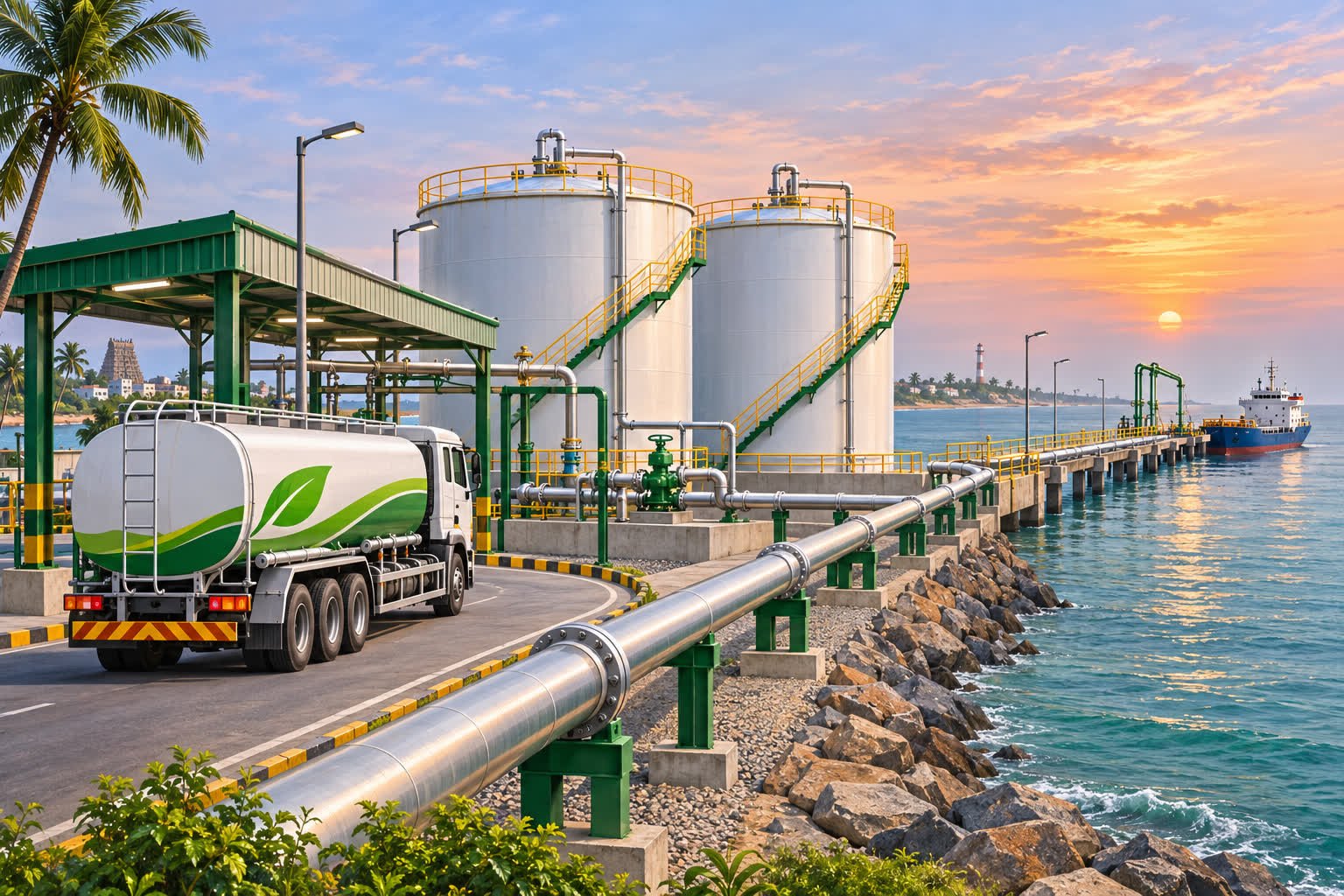
Illustration note: The hero image is an editorial illustration of the planned transfer setup, not a photograph of the VOC Port facility.
What VOC Port is building
The project is designed to receive green methanol by road tanker or vessel, hold it at the port and transfer it to ships at the jetty. Green methanol is a marine-fuel category, not a fuel that is being added to ordinary petrol pumps. Its lower-carbon benefit also depends on how the methanol is produced and on the emissions across the full supply chain.
Deccan Chronicle and India Shipping News both report a storage capacity of 1,500 cubic metres, split between two tanks of 750 cubic metres each. They also report a 2.8-km stainless-steel pipeline from the storage installation to the bunkering point. The physical design matters because a ship-fuelling operation needs a controlled link between storage, transfer equipment and the berth; it is not simply a tank installed near the shoreline.
The same two reports say the system has two transfer pumps, each rated at 120 cubic metres per hour, and is designed to move about 1,20,000 litres of methanol per hour. Automated controls, remotely operated valves, emergency shutdown arrangements and dedicated fire-protection systems are part of the reported setup. These are infrastructure specifications, not a guarantee that the facility will operate at its maximum designed rate on every vessel call.
The policy foundation is also established. An official Ministry of New and Renewable Energy and Press Information Bureau release says that VOC Port Authority was awarded a project to develop a green-methanol bunkering and refuelling facility under the shipping pilot projects of the National Green Hydrogen Mission. The port’s own 2025–26 bulletin had earlier described a pilot facility with two 750-cubic-metre tanks under development.
Why the Thoothukudi location matters
VOC Port’s case rests on its position near the east–west international shipping route. Both current reports attribute an estimate to the port that nearly 80% of cargo vessels on that route pass within 130 nautical miles of Thoothukudi. The location could let the port serve ships that call there as well as vessels seeking fuel close to the Rotterdam–Thoothukudi–Singapore maritime corridor.
That geographic advantage is an opportunity, not a confirmed volume forecast. A vessel will still need the right engine or fuel system, an available supply contract, compatible safety procedures and a commercially workable price. The wider market is also still building its network: Lloyd’s Register’s 2 November 2026 assessment described alternative-fuel vessel capability growing faster than the readiness of many ports to supply those fuels.
For VOC Port, the test will therefore be whether the facility moves from a completed installation to repeatable, safe and commercially contracted bunkering. Storage capacity alone cannot establish a shipping corridor.
What it means for Indian fuel users
No immediate petrol or diesel price change
The project does not announce a new petrol, diesel or CNG rate for Indian motorists. A green-methanol bunkering service is aimed at ships, so it should not be used to explain a rise or fall in a city’s road-fuel price. Drivers can continue to check current petrol, diesel and CNG prices for the relevant city.
For a planned drive, the practical calculation remains the same: use the local pump price, the vehicle’s realistic efficiency and the distance. FuelPrice’s fuel-cost calculator can estimate that road-trip input; the VOC Port project does not replace those variables.
A possible longer-term freight signal
The indirect effect is more relevant to transporters and businesses that depend on shipping. If alternative-fuel bunkering attracts more vessel calls or supports new green-shipping services, it could strengthen port activity and influence how some cargo routes are planned. That is a possible logistics effect, not a current promise of lower freight rates or cheaper goods.
For anyone comparing a road route that connects with port cargo movement, a road-trip planner can help separate driving time and fuel cost from broader freight-market changes. The two should not be treated as the same price signal.
What must happen before commercial launch
VOC Port is still completing safety arrangements, statutory requirements and operational preparations, according to the two current reports. The port has floated an expression of interest to identify a bunkering operator, while trial bunkering and other readiness activities are under way. Commercial supply is expected only after the necessary arrangements and clearances are complete.
The useful milestones to watch are the confirmed operating date, the appointed operator, the first ship to receive fuel, and evidence that supply can be repeated safely beyond a one-time trial. Pricing and availability will also matter: a facility can be strategically important while still having limited early volumes.
The reader takeaway
VOC Port’s green-methanol facility is a meaningful addition to India’s fuel and shipping infrastructure, but its immediate effect is narrower than the headline may suggest. The end-November date remains a target, and the project concerns marine fuel rather than road-fuel retail. For drivers, the action today is simply to keep using dated city fuel prices and trip-cost inputs; for fleet and logistics operators, the development is worth watching as a potential future change in port and freight options.
Sources
- Deccan Chronicle — “India’s First Green Methanol Bunkering Facility to Begin Operations in Thoothukudi VOC Port” — 7 Nov 2026
- India Shipping News — “India’s first dedicated Green Methanol Bunkering Hub nears commercial launch at VOC Port” — 7 Nov 2026
- Ministry of New and Renewable Energy / Press Information Bureau — “Government Driving National Green Hydrogen Mission Forward with Whole-of-Government Coordination” — 8 Dec 2025
- V.O. Chidambaranar Port Authority — “KORKAI: The e-Bulletin of V.O. Chidambaranar Port Authority, Oct–Dec 2025” — 2025
- Lloyd’s Register — “Alternative-fuel ships outpace port readiness, new LR report finds” — 2 Nov 2026