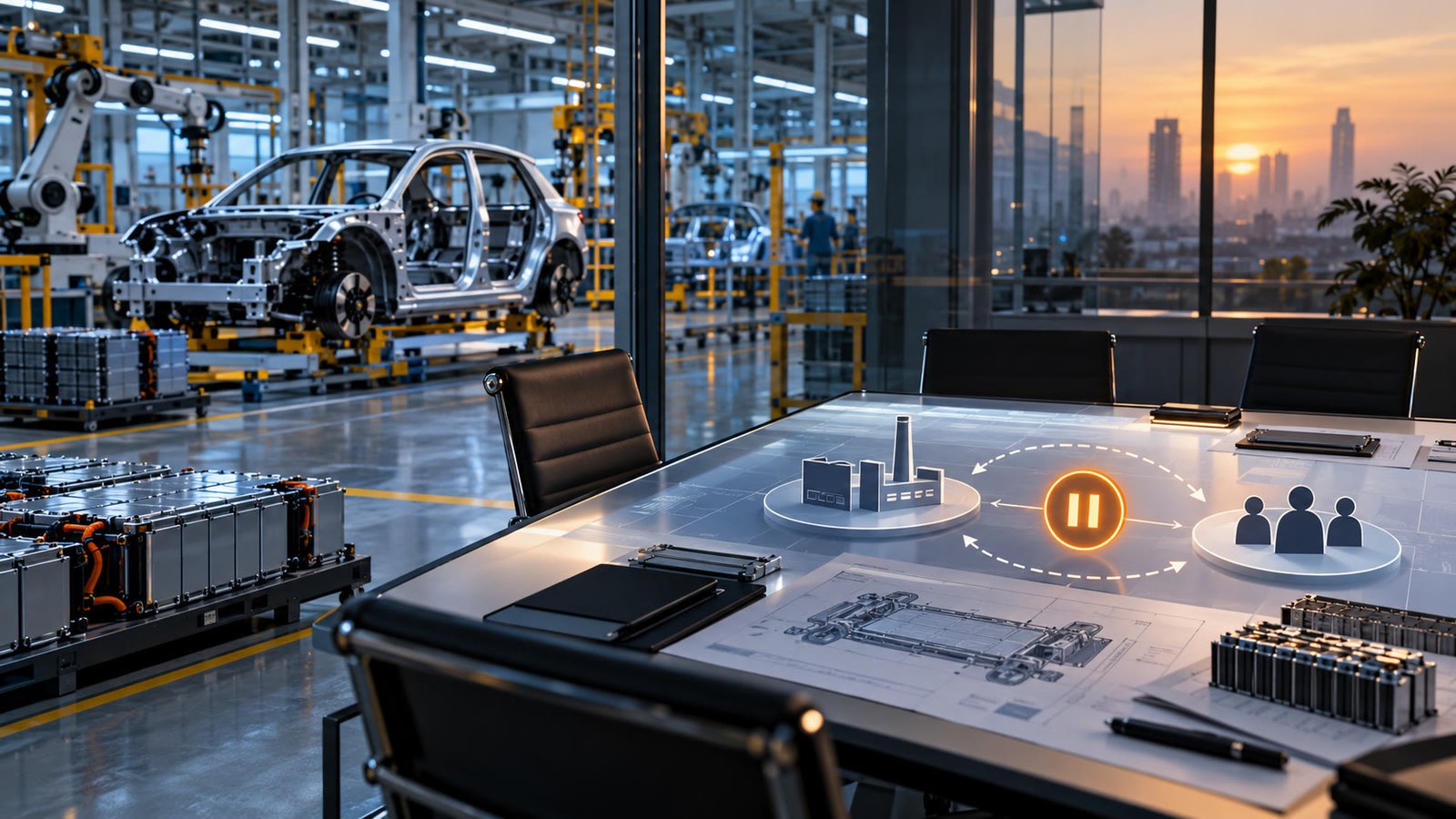
Volkswagen has paused new spending on its India electric-vehicle programme while it seeks clearer terms for a possible partnership with JSW Group, Bloomberg reported on 23 Oct 2026. The report does not say the programme has been cancelled, but it puts the timing of future locally assembled Volkswagen and Skoda EVs on watch for Indian buyers.
Key takeaways
- The reported pause concerns fresh investment in Volkswagen's India EV programme, not an announced withdrawal from the market.
- Volkswagen has reportedly completed design work for a lower-cost EV project, but wants a clearer commercial plan before committing more money.
- JSW Group and Skoda Auto Volkswagen India have a non-binding 51:49 alliance proposal; a final binding agreement is still pending.
- There is no new price, booking or delivery date for a future Volkswagen or Skoda EV in the reports reviewed.
What Bloomberg reported
The Bloomberg report, republished by TradingView through Seeking Alpha, said Volkswagen is holding back new spending on its India electric-vehicle initiative until it has more clarity on a possible JSW partnership. People familiar with the matter told Bloomberg that the design work needed to restart the project quickly is complete.
The reported programme would use a lower-cost electric architecture first developed for China. However, the report did not identify a production model, India launch price, battery specification or start-of-production date. Those details matter to Indian buyers because local sourcing and assembly would determine whether a future model can compete with the prices and running costs of the EVs already available here.
The wording is important: this is a reported investment pause, not a confirmed cancellation. Volkswagen has not, in the sources reviewed for this article, announced that its India EV plan has been scrapped. The next formal statement from the company or the proposed alliance will therefore carry more weight than speculation about launch timing.
Why the JSW partnership matters
The possible partnership is not a new rumour. The Economic Times reported on 9 Sep 2026 that JSW Group and Volkswagen had signed a non-binding memorandum of understanding for a proposed 51:49 alliance covering Volkswagen's India passenger-vehicle operations. The report said the two sides were beginning exclusive discussions and were targeting a final binding agreement by the end of 2026.
Reuters separately reported on the same date that Volkswagen's India unit was exploring a strategic partnership with JSW to expand products, deepen localisation and strengthen manufacturing and research capabilities. A Skoda Auto Volkswagen India spokesperson confirmed those aims to Reuters. The proposed alliance would include future electric vehicles, but the MoU itself does not guarantee a launch, a price or a production schedule.
That distinction is useful for buyers. A non-binding MoU can set the direction of negotiations without creating a customer-facing product commitment. If the alliance is completed, shared investment, existing plants and higher local content could improve the economics of future models. If negotiations take longer, the same EV roadmap may move out without changing the price or support arrangements for vehicles already sold.
The wider cost-pressure backdrop
Volkswagen's own 23 Oct 2026 release confirms that the group is pursuing a broad cost and competitiveness programme. It said the company wants to reduce labour costs as part of its Future Plan 2030 and described a transformation programme focused on a leaner product portfolio and lower costs across the value chain.
That official release does not mention the India EV spending pause. It does, however, explain why new projects are being assessed against tighter capital and profitability hurdles. For India, the practical question is whether a local partner can share investment, raise plant utilisation and make a future EV programme commercially viable without weakening the product or service proposition.
What this means for Indian EV buyers
For someone considering an electric car now, the immediate impact is limited. The reported pause is about future programme spending; it is not a notice of a new price, a booking suspension or a service change for an existing Volkswagen or Skoda vehicle. A future launch should be treated as unconfirmed until the companies publish a binding agreement and a model-specific schedule.
The useful comparison remains the total cost of a vehicle rather than only its purchase price. A buyer can use the fuel cost calculator to compare an EV's energy spend with a petrol or diesel vehicle over a normal commute, while the state-wise EV charging directory helps check whether charging access matches the intended route.
For longer journeys, the road-trip planner can help map distance and stops. Those checks are relevant because a delayed model may eventually arrive with a different battery, charging package, financing structure or local-content level than early reports suggest.
What to watch next
- A binding JSW-Volkswagen agreement, including ownership, investment and plant responsibilities.
- Whether the proposed alliance confirms two locally assembled battery-electric vehicles and gives a firm timeline.
- Which platform, battery size and local sourcing plan are selected for India.
- A formal Volkswagen update that confirms, narrows or reverses the reported spending pause.
Reader takeaway
Volkswagen's India EV plan is best described as delayed or being held for review, not cancelled. The proposed JSW alliance could still give the group a route to more localised and competitively priced EVs, but Indian buyers should wait for a binding partnership and model-specific details before treating the roadmap as a confirmed product promise.
Sources
- Volkswagen slows down its EV investment plan in India as it eyes options — TradingView/Seeking Alpha, 23 Oct 2026
- JSW, Skoda-Volkswagen India stitch up 51:49 JV plan; sign non-binding MoU, begin exclusive valuation talks — The Economic Times, 9 Sep 2026
- Volkswagen India explores partnership with JSW Group to boost localisation, manufacturing — Reuters via MarketScreener, 9 Sep 2026
- Second revision talk: Volkswagen AG and IG Metall agree to open negotiations — Volkswagen Group, 23 Oct 2026