A car-loan EMI is only one part of what a vehicle costs you. The tenure, interest type, processing charges and any prepayment decision can change the total rupees paid by a large margin, even when the monthly instalment looks comfortable.
This guide shows how to calculate the EMI, compare three tenure choices, read the lender’s Key Facts Statement and estimate the effect of an early part-payment. The examples are for understanding the method, not a quote or recommendation from any lender.
Key takeaways
- TransUnion CIBIL reported on 13 Oct 2026 that the average passenger-vehicle loan reached ₹8.2 lakh in H1 2026, up 49% from H1 2019, while the average tenure rose to 62 months.
- A longer tenure reduces the monthly EMI but increases total interest when the loan amount and rate stay the same.
- Use the EMI formula for a quick estimate, then compare the lender’s APR, amortisation schedule and all charges in the KFS.
- Prepayment math depends on the outstanding principal, the remaining schedule, the charge in the contract and whether the lender reduces the EMI or the tenure.
- Budget the EMI alongside fuel, insurance, service, parking and tolls; a car is affordable only when the full running cost fits the household cash flow.
Why car-loan tenure deserves attention
The current financing trend makes this calculation more important. TransUnion CIBIL’s Shifting Gears 2026 report said the average passenger-vehicle loan amount was ₹8.2 lakh in H1 2026, 49% higher than in H1 2019. It also put the average repayment tenure at 62 months, five months longer than in H1 2019. Business Standard reported the same figures from the report on 13 Oct 2026.
A larger loan spread over more months can make a higher-priced car appear easier to fit into a monthly budget. The trade-off is that interest continues to accrue for longer. The useful question is therefore not only “Can I pay this EMI?” but also “What will the loan cost in total, and what other car costs arrive every month?”
How to calculate a car-loan EMI
For a standard reducing-balance loan, the EMI calculator uses the principal, the monthly interest rate and the number of monthly instalments. ICICI Bank’s official car-loan calculator publishes the following formula:
EMI = P × R × (1 + R)^N ÷ ((1 + R)^N − 1)
- P is the amount borrowed, not automatically the car’s full on-road price.
- R is the periodic interest rate. Convert an annual rate to a monthly rate before using the formula.
- N is the number of monthly instalments.
- Total scheduled repayment is the EMI multiplied by the number of instalments. Interest in the schedule is total repayment minus the principal, before considering separate charges.
Worked example: ₹8.2 lakh borrowed
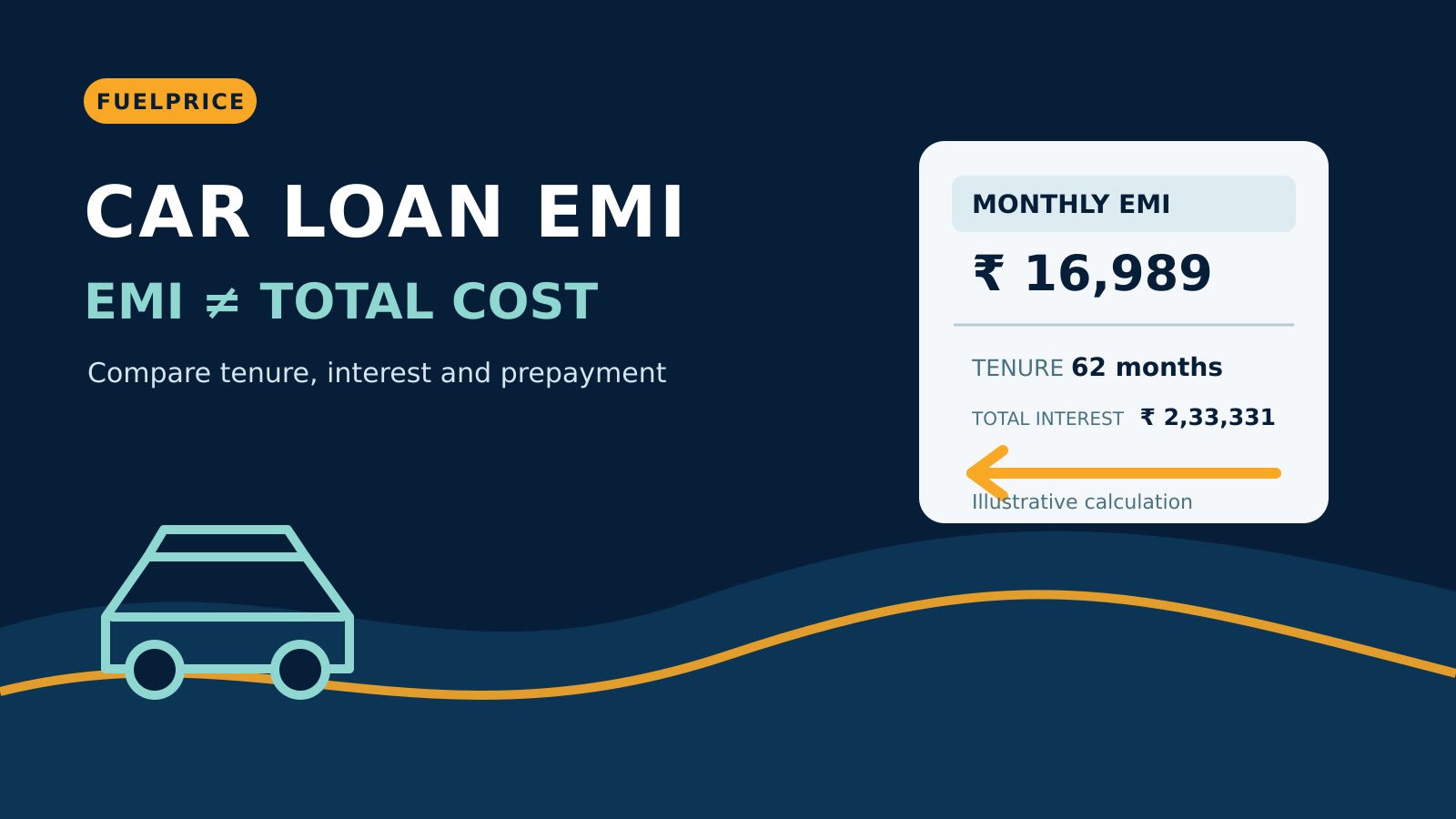
Take a principal of ₹8,20,000, an illustrative rate of 10% per year and a 62-month tenure. The 10% rate is an assumption for clear comparison, not a current market quote. Applying the formula gives an EMI of about ₹16,989. Paying that amount for 62 months gives scheduled repayments of about ₹10,53,331, of which about ₹2,33,331 is interest.
The calculation excludes processing fees, insurance recovered through the loan, documentation charges and taxes. Those items belong in the total-cost comparison because a lower advertised rate can still have a higher all-in cost if the fee structure is different.
Tenure comparison: lower EMI versus higher interest
The table below keeps the principal at ₹8,20,000 and the assumed rate at 10% per year. It compares the 62-month reference tenure with shorter and longer choices. Figures are calculated using the formula above and rounded to the nearest rupee on 15 Oct 2026; they are illustrative, not lender offers.
| Tenure | Illustrative EMI | Total scheduled repayment | Scheduled interest |
|---|---|---|---|
| 48 months | ₹20,797 | ₹9,98,271 | ₹1,78,271 |
| 62 months | ₹16,989 | ₹10,53,331 | ₹2,33,331 |
| 84 months | ₹13,613 | ₹11,43,490 | ₹3,23,490 |
- The 84-month option lowers the example EMI compared with 48 months, but adds about ₹1,45,219 of scheduled interest compared with the shorter option.
- The 48-month option reduces the interest bill, but its monthly commitment is higher. It must be tested against rent, household expenses, fuel and irregular costs.
- The 62-month row is a reference point linked to the H1 2026 CIBIL average tenure; it is not a rule about the right tenure for every buyer.
Run the same comparison with the actual principal and rate in the lender’s offer. A calculator is most useful when it shows EMI, total interest and total repayment together rather than only the first number.
What changes the EMI and total cost
1. Loan amount and down payment
The principal is the starting point for every later interest calculation. Confirm whether the loan finances only the balance vehicle price or also includes accessories, service packages, insurance or other items. A larger down payment reduces the principal, but the cash used for it should not leave the household without an emergency buffer. Compare the final disbursal amount with the on-road quotation and the KFS.
2. Interest type and borrower profile
Do not assume that every car loan behaves the same way. The documents should identify whether the rate is fixed or floating, the benchmark or reset method where relevant, and the consequences of a reset. The rate offered can vary with the borrower’s profile, loan amount, vehicle and lender policy, so an online headline rate is not a personal quote.
3. APR and charges
RBI’s 15 Apr 2024 KFS circular applies to retail and MSME term loans from regulated entities. It defines APR as the annual cost of credit including interest and associated charges, and requires the KFS to include an APR calculation sheet and the loan’s amortisation schedule. Charges recovered by the lender for third-party services must be disclosed separately when applicable.
The same RBI circular says that charges not mentioned in the KFS cannot be charged during the loan term without the borrower’s explicit consent. For a new retail term loan sanctioned on or after 1 Oct 2024, the lender must follow the KFS framework. The statement must also be provided for a validity period of at least three working days for loans with a tenor of seven days or more, giving the borrower time to review the terms.
How to evaluate a part-prepayment
Part-prepayment is a calculation, not automatically a saving. Start with the latest outstanding-principal statement. Then compare the interest that would be paid under the existing schedule with the interest after the part-payment and any applicable charge. Ask the lender to show both possible outcomes: keeping the EMI and shortening the tenure, or keeping the tenure and reducing the EMI.
Worked prepayment example
Using the same illustrative ₹8,20,000 loan at 10% for 62 months, the EMI is about ₹16,989. After 24 scheduled payments, the calculated outstanding balance is about ₹5,51,408, leaving 38 instalments. If ₹1,00,000 is paid towards principal and there is no prepayment charge, the remaining principal becomes about ₹4,51,408.
If the lender keeps the remaining 38-month term and recalculates the EMI, the example payment falls to about ₹13,908. The remaining scheduled payments would be about ₹5,28,510, versus about ₹6,45,590 without the part-payment. After accounting for the ₹1,00,000 paid upfront, the gross interest-and-payment difference is about ₹17,080. The result changes if the lender keeps the original EMI, charges a fee or applies a different amortisation method.
RBI’s UCB master circular says urban co-operative banks cannot charge foreclosure or prepayment penalties on floating-rate term loans sanctioned to individual borrowers. That is a specific rule for the lender and loan category described there, not a blanket waiver for every fixed-rate car loan or every lender. Read the contract and ask for a written foreclosure or part-prepayment quote before paying.
Read the loan as part of the ownership budget
The EMI is fixed in the illustration, but the car’s other costs continue. Estimate monthly kilometres, realistic mileage, fuel price, insurance, service, tyres, parking, tolls and irregular repairs. Use the FuelPrice fuel cost calculator to convert your expected driving into a monthly running-cost estimate, and check the live fuel-price hub when comparing petrol, diesel or CNG assumptions.
For buyers comparing a financed new car with a used car, the new-versus-used car-loan cost guide adds the purchase-price and repayment context. For a vehicle that will be used on frequent long drives, the road-trip planner can help expose fuel and toll costs that a monthly EMI calculation leaves out.
Car-loan checklist before signing
- Write down the on-road price, down payment and exact amount proposed for disbursal.
- Run the actual principal through at least three tenure choices and record EMI, total interest and total repayment.
- Compare APR and the all-in rupee cost, not only the advertised interest rate.
- Read the KFS for interest type, EMI, tenure, processing charge, insurance or third-party charges, late charges and prepayment terms.
- Ask whether a part-payment changes the EMI, the tenure or both, and request the calculation in writing.
- Check when interest begins. RBI’s fair-practices circular says interest should not be charged from sanction or agreement date when the funds have not yet been disbursed.
- Keep fuel, insurance, maintenance, parking and toll estimates beside the EMI before assessing affordability.
- After the final payment, obtain the closure statement and the documents needed to remove hypothecation from the vehicle record.
Frequently asked questions
Does a longer car-loan tenure reduce the total cost?
Usually, no, when the principal and rate are unchanged. It reduces the monthly EMI by spreading repayment across more instalments, but the worked table shows that the scheduled interest rises.
Can I use an EMI calculator for a used car?
The formula still works if the principal, rate and tenure are correct, but used-car loans can have different rates, fees and eligibility conditions. Replace the illustrative inputs with the offer in the KFS and compare the total repayment.
Is car-loan prepayment always free?
No single answer covers every product. The agreement and lender category matter; the RBI UCB rule for floating-rate term loans to individual borrowers does not automatically apply to every fixed-rate car loan or lender.
What is more important: the interest rate or APR?
The interest rate explains the charge on the principal, while APR is intended to show the annual cost including associated charges. Use the KFS’s APR and amortisation schedule to compare offers on the same loan amount and tenure.
Sources
- TransUnion CIBIL, “Rising Car Prices and Aspirational Consumer Choices Drive Higher Auto Loan Sizes”, 13 Oct 2026
- Business Standard, “Average car loan size jumps 49% to ₹8.2 lakh as buyers shift to SUVs”, 13 Oct 2026
- Reserve Bank of India, “Key Facts Statement (KFS) for Loans & Advances”, 15 Apr 2024
- Reserve Bank of India, “Fair Practices Code for Lenders – Charging of Interest”, 29 Apr 2024
- ICICI Bank, “Car Loan EMI Calculator”, accessed 15 Oct 2026
This article is for general information only and is not financial, insurance or legal advice.