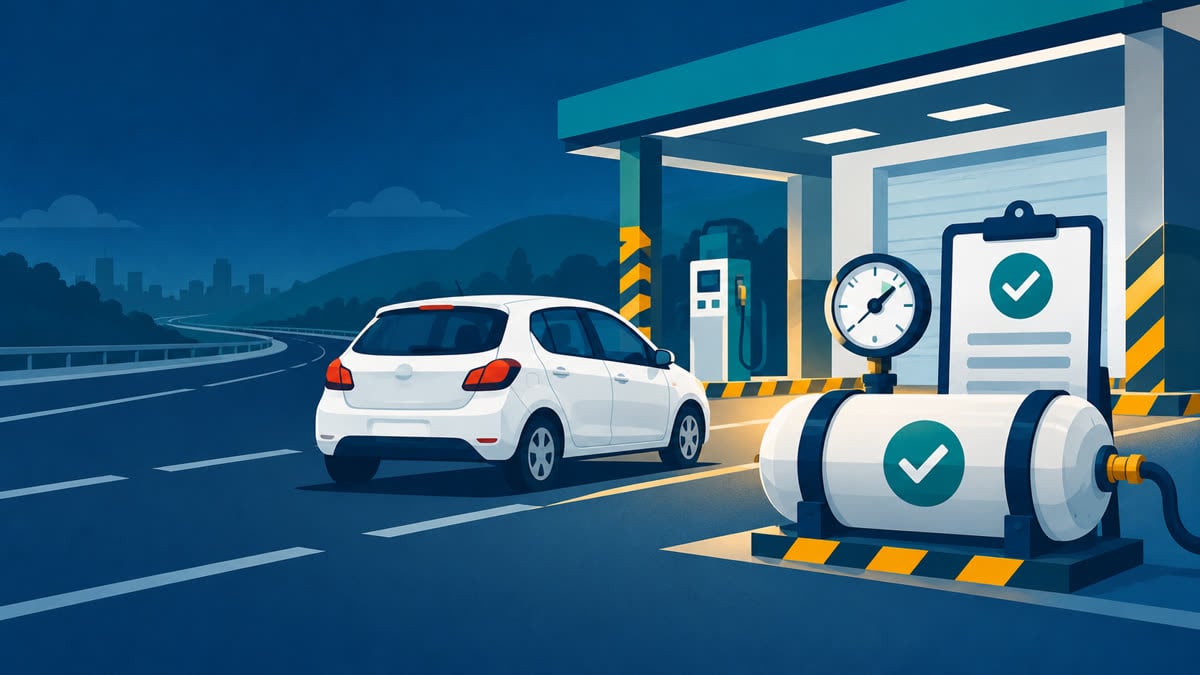
A CNG vehicle owner needs to treat the cylinder test certificate as a safety and refuelling document, not as optional service paperwork. This guide explains the three-year testing cycle, the documents to keep, how to use the Petroleum and Explosives Safety Organisation (PESO) list of approved testing stations, and what recent checks at CNG outlets mean for everyday drivers.
The practical takeaway is simple: find the last cylinder-test date before the next refill or road trip, make sure the certificate matches the vehicle and cylinder, and arrange testing only through an approved channel if the validity period has ended.
Key takeaways
- IGL says an on-board CNG cylinder has a periodic test life of three years. The current compliance discussion is also tied to Rule 35(1) of the Gas Cylinders (Amendment) Rules, 2025.
- PESO published a circular on 8 Jul 2026 about verifying the validity of CNG cylinder test certificates before filling CNG, while recent reports describe tighter checks at IGL stations.
- A hydro-test certificate is different from a PUC certificate, insurance document or routine service invoice. Keep the cylinder and vehicle details together.
- Use the current PESO list of approved CNG cylinder testing stations. A roadside workshop or an unauthorised kit installer is not a substitute.
- At refuelling, follow the station safety process: switch off the engine, do not smoke, leave the vehicle when asked, and wait until the hose is disconnected before starting.
Why CNG cylinder checks matter now
The immediate trigger is a change in enforcement visibility. FuelPrice covered the Delhi checks in its CNG cylinder verification news update; PESO’s official circular list records an 8 Jul 2026 update titled Verification of the validity of CNG Cylinder Test Certificate before filling CNG. In September 2026, NDTV Profit reported that IGL was requiring a valid hydro-test certificate before dispensing CNG, and The Economic Times later reported that IGL had begun technology-assisted verification at selected outlets.
Those reports do not create a new nationwide refuelling timetable by themselves. They show why an owner should not wait for a station attendant to discover an expired document. The underlying safety requirement is older and broader: IGL’s customer guidance says the installed cylinder must remain within its three-year periodic test life, and PESO’s rules and approvals provide the regulatory framework for authorised testing and filling.
What a CNG hydro test checks
A hydro test is a formal examination of the high-pressure cylinder by an approved testing station. It is concerned with the condition and certification of the cylinder and its identity; it is not the same as checking engine emissions, renewing insurance or getting a normal periodic service.
- Cylinder condition: The testing agency examines the cylinder under the applicable gas-cylinder safety procedure and records whether it can continue in service.
- Certificate validity: The owner receives a test record or certificate that should be kept available for inspection and refuelling verification.
- Vehicle linkage: The cylinder record needs to be consistent with the vehicle and installation details. This matters more when a vehicle has been retrofitted.
- Authorised work: IGL advises owners to use approved cylinders and licensed retrofitters. AIS-024 and the related CNG safety standards also point owners and workshops toward approved installation and inspection processes.
Do not confuse a hydro-test certificate with a PUC certificate. PUC is about emissions; the cylinder test is about the pressure container and the safety of the CNG system. A vehicle may need both documents, and one does not replace the other.
The three-year rule: how to read your dates
As of October 2026, IGL’s published customer safety guidance says the periodic test life of an installed CNG cylinder is three years. NDTV Profit’s September 2026 report also described the requirement under Rule 35(1) of the Gas Cylinders (Amendment) Rules, 2025 as hydrostatic testing once every three years at a PESO-authorised centre.
Use the test date and validity shown on your latest certificate rather than guessing from the vehicle’s registration year. A factory-fitted CNG car and a retrofitted car both need a current cylinder record; factory fitment does not mean the pressure cylinder is exempt from periodic testing.
- Find the most recent certificate and note the test date and validity wording.
- Compare the certificate’s vehicle registration, cylinder identification and installer or testing-station details with the car.
- Plan the next test before the certificate expires, especially before a highway trip or a period when you rely on CNG for daily commuting.
- If the cylinder has been burnt, badly damaged, modified or involved in a serious crash, do not treat an old certificate as proof that it is safe. Ask an authorised professional to inspect the system.
Factory-fitted versus retrofitted CNG: what changes
The paperwork route differs, but the owner’s basic safety responsibility does not. The comparison below is a practical guide for Indian owners. It uses the three-year test interval and the current refuelling requirement described by IGL, PESO and recent reporting, all checked as of October 2026.
| Check | Factory-fitted CNG | Retrofitted CNG | Owner action |
|---|---|---|---|
| Who fitted the system | Vehicle manufacturer or its approved production process | Licensed or authorised retrofit workshop | Keep the original vehicle or retrofit paperwork |
| Periodic cylinder test | Three-year cycle still applies | Three-year cycle still applies | Use the latest certificate date, not the purchase date |
| First document trail | Manufacturer handover documents and cylinder details | Kit fitment, installer and cylinder documents | Check that the details identify the same vehicle |
| When refuelling is checked | Certificate may be checked at the station | Certificate may be checked at the station | Carry a readable copy and keep the original safely |
| If a record is missing | Contact the manufacturer or authorised service channel | Contact the authorised retrofitter or testing station | Do not create or alter a certificate |
Documents to keep in the car file
Keep one physical or digital folder for the CNG system. The exact documents vary by vehicle and installation history, but a useful owner file should contain:
- The latest hydro-test certificate or cylinder test record.
- The vehicle registration document, with the fuel mode and any retrofit information recorded as required by the transport authority.
- The CNG kit or fitment document for a converted vehicle, including the installer’s details.
- Cylinder identification information, including the details that let a testing centre or station match the certificate to the installed cylinder.
- Invoices or inspection notes for repairs, valve work or cylinder replacement.
When a certificate is lost, ask the original testing centre, authorised retrofitter or gas distributor about the correct recovery process. Do not rely on a photograph with missing pages, a handwritten expiry date or a document that names a different vehicle. A mismatch can delay refuelling even when the cylinder was tested correctly.
How to find an authorised testing centre
PESO maintains an official page for approved CNG cylinder testing stations. Start there, then confirm that the centre is currently listed and is equipped for the vehicle-cylinder work you need. IGL’s safety page also directs customers to approved testing facilities rather than general repair garages.
- Open the current approved testing-station list published through the PESO website.
- Filter by your state or nearby city, then call the centre using the contact details shown in the current listing.
- Ask what vehicle, cylinder and registration documents are required before taking the car.
- Confirm how the certificate will identify the vehicle and cylinder after testing.
- Keep the receipt and the completed certificate together, and check the spelling, vehicle number and cylinder details before leaving.
Do not have a cylinder welded, patched or replaced with an unapproved container. IGL specifically warns against unauthorised conversion work and against using cylinders that are not designed and certified for vehicle CNG. A cheaper-looking repair can create a larger safety and refuelling problem later.
What happens at the CNG station
Station checks can be manual, technology-assisted or both, depending on the gas distributor and outlet. Recent reporting says IGL staff may verify the certificate before dispensing fuel, while the company’s published safety guidance asks customers to cooperate with inspection. If the certificate is expired or cannot be verified, the practical outcome may be a refusal to fill until the record is corrected.
- Arrive with the certificate or accepted digital record available.
- Switch off the engine before the nozzle is connected.
- Do not smoke or use an ignition source around the dispenser.
- Follow the attendant’s instruction about passengers leaving the vehicle during filling.
- Do not start the car until the hose has been removed and the attendant signals that it is safe.
- If you believe a valid record was rejected, note the station, time, vehicle number, certificate details and transaction attempt, then use the distributor’s customer-care route for clarification.
Worked rupee example: keep safety and fuel budgets separate
Fuel cost is not the same as cylinder-test cost, and the test price varies by centre, so this example does not invent a testing fee. IGL lists Delhi CNG at ₹86.98 per kg with effect from 29 Aug 2026; Moneycontrol reported the same revision from the distributor. Suppose a driver’s own trip record shows that a 150 km journey used 6 kg of CNG. The fuel calculation is 6 × ₹86.98 = ₹521.88, or about ₹3.48 per km.
The 6 kg and 150 km are illustrative inputs, not a promised mileage figure. Replace them with your actual refill quantity and distance, then check the current price for your city. The important budgeting point is that the ₹521.88 fuel example does not make an expired certificate acceptable: refuelling eligibility and trip cost are separate checks. Use FuelPrice’s live fuel-price pages for the local rate and the fuel-cost calculator for your own route.
Owner checklist before a refill or road trip
- Check the date. Find the latest cylinder-test certificate and confirm that its three-year validity has not ended.
- Check the identity. Match the registration number, cylinder details and vehicle documents.
- Check the source. Make sure any test or repair was handled by a PESO-approved testing station or an authorised installer.
- Check the file. Keep a readable certificate, fitment record and relevant RC information together.
- Check before departure. For a long trip, verify the document before the tank becomes low rather than discovering the issue at the next pump.
- Check the route budget. Use the road-trip planner and fuel-cost tool to estimate CNG and petrol backup needs.
- Check the pump process. Follow the engine-off, no-smoking and hose-disconnected instructions every time.
- Check a mismatch promptly. If a station rejects the record, stop using the CNG system until an authorised channel explains and corrects the issue.
Frequently asked questions
How often does a CNG cylinder need hydro testing in India?
The current owner guidance from IGL and recent reporting on Rule 35(1) describe a three-year periodic test cycle. Read the validity shown on your latest certificate and confirm any special instruction with an approved testing centre.
Can a CNG station refuse to fill an expired cylinder?
Yes, a station can require a valid certificate before dispensing CNG. NDTV Profit reported that IGL’s safety checks deny refuelling when the certificate is not valid, and IGL’s own guidance asks customers to keep the certificate available.
Is a CNG hydro test the same as a PUC test?
No. A hydro test concerns the high-pressure CNG cylinder and its certification. PUC concerns vehicle emissions, so the two documents serve different purposes.
Do factory-fitted CNG cars also need cylinder testing?
Factory fitment does not remove the periodic cylinder-test requirement. The cylinder still needs a valid record, although the manufacturer’s document trail may be different from a retrofit vehicle’s paperwork.
Where can I find a PESO-approved CNG testing centre?
Use the approved CNG cylinder testing-station list on the PESO website and verify the centre’s current details before visiting. Avoid relying on an unauthorised workshop’s certificate or verbal assurance.
Sources
- PESO — Verification of the validity of CNG Cylinder Test Certificate before filling CNG — 8 Jul 2026
- PESO — Gas Cylinders (Amendment) Rules, 2025 — official rules page
- PESO — Approved CNG Cylinders Testing Station — accessed 23 Oct 2026
- Indraprastha Gas Limited — Safety information for CNG customers — accessed 23 Oct 2026
- NDTV Profit — CNG Safety Crackdown: IGL Makes Valid Hydro-Test Certificate Mandatory For Refuelling — 9 Sep 2026
- The Economic Times — CNG pumps check for expired cylinder certificates automatically now — 23 Sep 2026
- Indraprastha Gas Limited — CNG retail prices, effective 29 Aug 2026
- Moneycontrol — Delhi CNG price rises to ₹86.98 per kg from 29 Aug 2026 — 29 Aug 2026
- Ministry of Road Transport and Highways — AIS-024 and AIS-028 CNG standards — official document
This article is for general information only and is not financial, insurance or legal advice.