Indraprastha Gas Limited (IGL) has rolled out an AI-enabled system at its Delhi CNG stations to verify the hydrotest status of vehicle cylinders before refuelling. The 21 Oct 2026 rollout means a vehicle with an expired or invalid certificate may be flagged before gas is dispensed, so CNG owners need to keep their test record current and accessible.
The system was inaugurated at IGL's Shantipath CNG station in New Delhi by Sanjay Kumar Singh, Joint Chief Controller of Explosives (North Circle) at the Petroleum and Explosives Safety Organisation (PESO), according to reports by ETAuto and Autocar Professional. For a driver, the immediate issue is compliance at the pump, not a change in the CNG price. The reports describe a safety-verification rollout and do not announce a new Delhi CNG rate.
Key takeaways
- IGL is using vehicle recognition and digital verification to check CNG-cylinder hydrotest validity before refuelling at participating Delhi stations.
- The system links the verification workflow to the online PESO portal and can alert station staff when a certificate is expired or invalid.
- Drivers should keep the latest hydrotest certificate or record available and check the next due date before starting a long trip.
- IGL plans to extend the deployment to more outlets across Delhi-NCR; coverage may vary while the rollout expands.
- The announcement is about cylinder safety checks. It does not announce a change to the CNG price or a new nationwide refuelling rule.
What IGL's new CNG verification system does
IGL has deployed a system developed by fuel-tech company Nawgati. It is designed to connect a vehicle's registration number with the cylinder-test information available through the PESO-linked verification process. That gives the station a digital way to check a document that was previously handled mainly through manual inspection.
Autocar Professional reported that the rollout at key Delhi stations was inaugurated on 21 Oct 2026. ETAuto reported the same-day deployment across IGL's Delhi CNG stations and said the company plans to expand it to more outlets across Delhi-NCR. Because the two reports use slightly different descriptions of the initial coverage, drivers should treat the system as a rollout at participating outlets rather than assume that every IGL station has identical equipment on day one.
How the three-part check works
- Nawgati Fuelling App: The consumer-facing app lets vehicle owners check hydrotest status and display a compliance pass before reaching the station.
- Aaveg Compliance App: Station staff and queue marshals can use a handheld workflow to verify vehicles waiting to refuel.
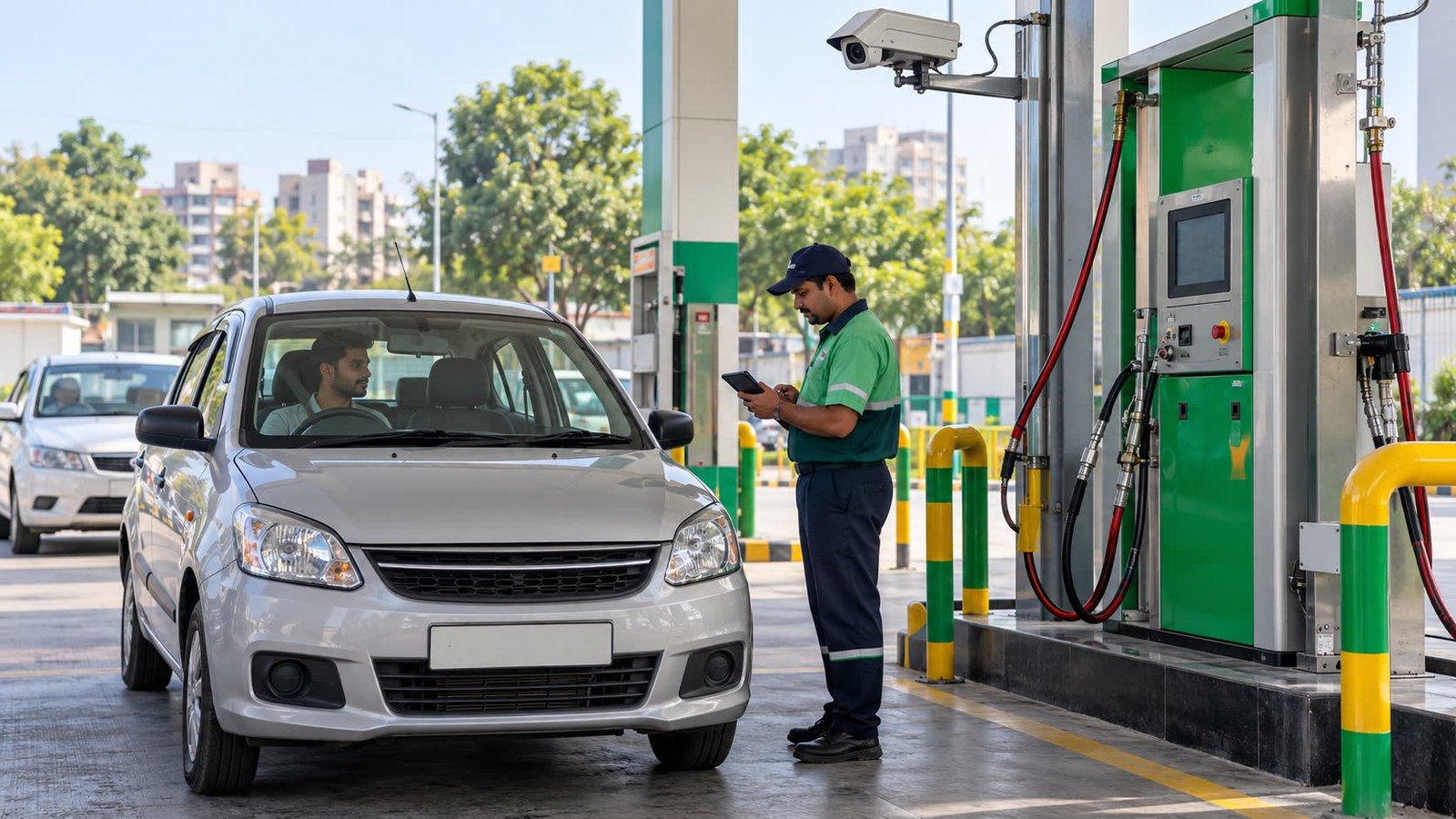
- Aaveg station system: Cameras scan vehicle number plates and show the hydrotest status on an LED display, reducing dependence on a manual paper check alone.
If the system finds that a cylinder certificate is expired or invalid, it can send an alert to station staff through handheld devices, the LED display and a public-address system. The practical result is that staff may stop the vehicle from refuelling until the compliance issue is resolved.
What the PESO direction means for CNG owners
PESO published a circular titled “Verification of the validity of CNG Cylinder Test Certificate before filling CNG” on 8 Jul 2026. The circular is the regulatory backdrop for checking the certificate before gas is filled; IGL's October rollout is the station-level technology implementation reported by the two auto-industry outlets.
The Petroleum and Natural Gas Regulatory Board's safety checklist says the cylinder fitted to a CNG vehicle should be re-examined or re-tested at least once every three years, and that the driver should carry a record showing the last examination and the next due date. This three-year interval is an existing safety reference in the official checklist, not a new deadline announced in IGL's 21 Oct rollout. The station system is intended to make that status easier to verify.
What changes at the pump
A compliant vehicle should move through the normal refuelling process, subject to the station's operational checks. The difference is that the vehicle number and certificate status may be checked automatically as the car enters or waits in the queue. That can make an expired record more visible and may reduce the chance of a vehicle reaching the dispenser before staff identify the problem.
For the latest city-wise CNG rates, readers can check CNG prices across Indian cities. The rollout itself does not set a new rate. It is also not an announcement that every CNG operator outside IGL's network will use the same app or camera system.
Driver checklist before refuelling
- Check the due date: Look at the latest hydrotest certificate or record and confirm that the next-test date has not passed.
- Keep proof accessible: PNGRB's checklist refers to the driver carrying the relevant examination record. Keep a clear copy or the accepted digital record available, especially for commercial use and inter-city trips.
- Use an approved testing route: If the certificate has expired, arrange testing through an appropriate PESO-approved channel before relying on the vehicle for a trip. The PESO website maintains information on approved CNG-cylinder testing stations.
- Check a possible mismatch: If a compliant vehicle is flagged, ask station staff to run the handheld verification again and compare the vehicle details with the certificate. A camera or database mismatch should be treated as a verification issue, not ignored.
- Plan for a compliance stop: If the vehicle is refused CNG, do not assume that a low fuel warning can be managed indefinitely. Use the fuel cost calculator to reassess the trip and the road-trip planner to review the route after the cylinder issue is addressed.
What to watch next
IGL says the technology will be expanded to more outlets across Delhi-NCR. The next useful detail for drivers will be the list of stations covered and how a motorist can resolve a wrong or incomplete certificate match without adding a long queue delay. Fleet operators will also need to check whether their vehicles' records are consistently mapped to the registration details used by the system.
For drivers outside Delhi, the immediate takeaway is to keep the cylinder-test record current and follow the instructions at the local CNG station. The IGL deployment is a Delhi rollout, while the safety documents and testing requirements should be checked against the applicable authority and the vehicle's own certificate.
Sources
- ETAuto, “IGL deploys AI-based CNG cylinder compliance system across Delhi stations”, 21 Oct 2026
- Autocar Professional, “IGL Deploys Nawgati’s Hydrotest Verification System at Delhi CNG Stations”, 21 Oct 2026
- PESO, “Verification of the validity of CNG Cylinder Test Certificate before filling CNG”, 8 Jul 2026
- PNGRB, “Checklist for PNGRB Technical Standards and Specifications including Safety Standards for City or Local Natural Gas Distribution Networks”, official checklist
- The Times of India, “IGL launches AI system to check CNG cylinder safety at 10 stations”, 16 Oct 2026