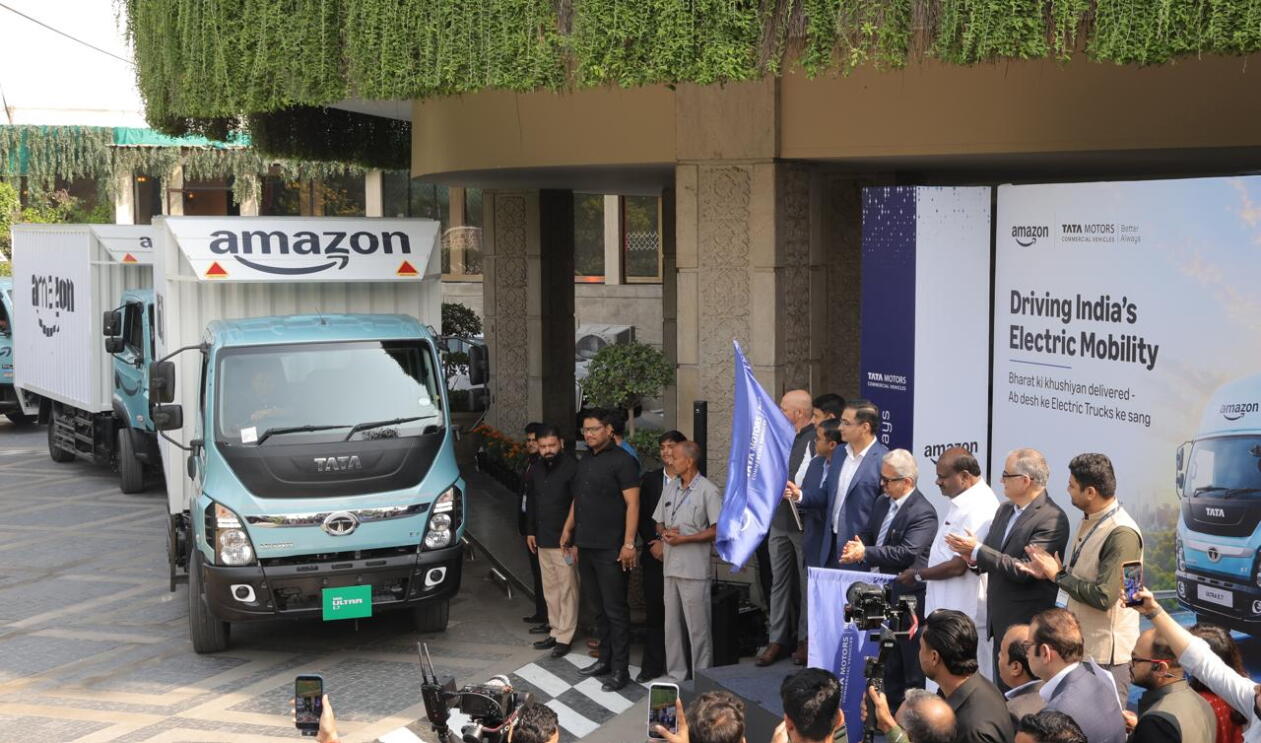
Amazon expects its India electric-vehicle fleet to rise from more than 15,000 now to above 20,000 over the next year, a senior operations executive told Business Standard on 27 Oct 2026. The expansion sits alongside a 3,000-truck Tata Motors rollout and 10 charging yards, but Amazon said the forecast is an expectation, not a formal target.
Key takeaways
- The reported fleet expectation is a growth outlook, not a binding procurement schedule.
- Amazon's official 27 Oct 2026 announcement says more than 15,000 EVs already operate across 500-plus Indian cities.
- The new light- and medium-duty truck rollout starts in Delhi and is intended to expand into middle-mile freight.
- The next phase targets a 2,800-km Delhi–Bengaluru–Chennai corridor along NH48, supported by 10 charging yards.
What Amazon's new EV forecast means
The over-20,000 figure is reported guidance from an Amazon executive rather than a confirmed fleet order. That distinction matters for transport operators: a forecast can change with freight demand, vehicle supply, financing, charging capacity and the performance of the first routes.
It is also a new layer of detail around the company's wider commercial-EV push. FuelPrice's earlier report on the 3,000-truck deployment covered the partnership with Tata Motors. The latest update adds the operating logic behind that rollout: Amazon is trying to connect vehicle supply, freight demand, charging and route utilisation rather than treat truck purchases as a stand-alone target.
Charging is the operating constraint
In the 27 Oct 2026 announcement, Amazon said its Indian EV network is supported by 10 charging yards developed with Yahhvi. Business Standard separately reported that the yards are positioned near major logistics centres, including Delhi, Hyderabad, Bengaluru, Chennai and Jaipur. These are commercial operating assets, not necessarily public chargers that any private EV owner can use.
That distinction is important for fleet owners. A vehicle can be cheaper to run on a busy route and still lose money if it waits for a charger, returns empty, or needs to be diverted for service. Depot power capacity, charger uptime, battery size, payload, driver shift patterns and the availability of a backhaul all matter as much as the advertised vehicle specification. The state-wise EV charging directory can help with an initial public-charger check, but it should not be treated as a map of Amazon's private logistics yards.
Where the electric trucks will run first
Amazon's primary announcement says the initial deployment will begin in Delhi during the 2026 festive season. The trucks are light- and medium-duty vehicles intended for middle-mile movement between facilities and cities, with carrier partners owning and operating them while Amazon provides freight demand and works with manufacturers and financing partners.
The next phase is planned for major national highways. The stated 2,800-km route links Delhi, Bengaluru and Chennai along NH48, spans seven states and connects six major e-commerce regions. Those figures and the corridor description come from Amazon's announcement dated 27 Oct 2026; NDTV Profit also reported the Delhi start, the highway expansion and the charging-yard plan.
For the corridor to work, the trucks need predictable loads in both directions. A route with strong outbound parcel volumes but weak return freight can reduce utilisation, increase idle time and make the battery investment harder to justify. That is why the programme's commercial test is not simply whether an electric truck can complete a journey, but whether it can complete enough paid journeys each day.
Why fleet operators need a route-level calculation
Business Standard reported that Amazon is assessing electric vehicles through total cost of ownership and better route planning. The company's official announcement also describes the Tata electric truck as having the potential for lower operating costs and improved uptime. Neither statement guarantees a saving for every operator: electricity tariffs, demand charges, financing, maintenance, payload and route length can change the result.
Operators comparing an electric truck with an existing diesel vehicle can first use the fuel-cost calculator to establish a diesel baseline for a representative route. The comparison then needs the actual electricity tariff, charging losses, charger cost, battery warranty, service terms and vehicle-finance cost. A lower energy bill alone does not prove a lower total cost.
For a long inter-city movement, the road-trip planner can help estimate distance and stops. It does not replace a commercial fleet model, because delivery windows, payload, loading time and return loads are central to the decision.
What changes now—and what does not
- What changes now: Amazon is moving beyond last-mile EVs into a larger middle-mile electric-truck deployment, beginning in Delhi and then testing national-corridor operations.
- What does not change yet: the announcement does not make every delivery vehicle electric, publish a nationwide conversion deadline or promise lower delivery charges for customers.
- What to watch next: charger uptime, service coverage, vehicle utilisation, battery performance under load, financing terms and the availability of return freight.
Reader takeaway
The useful signal is not only the reported possibility of Amazon crossing 20,000 EVs. It is the shift from small delivery vehicles to a freight network that needs dependable charging, high utilisation and route-level economics. For ordinary drivers, this does not change pump prices today. For fleet operators, it creates a live case study in whether electric trucks can move from pilots into repeatable, commercially viable highway work.
Sources
- About Amazon India — Amazon to add 3,000 Tata Motors electric trucks to its transportation network in India — 27 Oct 2026
- Business Standard — Amazon expects India EV fleet to cross 20,000 vehicles over next year — 27 Oct 2026
- NDTV Profit — India's Biggest E-Com EV Bet: Amazon, Tata Motors Partner To Deploy 3,000 Electric Trucks — 27 Oct 2026