Amazon and Tata Motors said on 27 October 2026 that they will deploy 3,000 electric trucks across Amazon's India transportation network, beginning with Tata Ultra E.7 vehicles in Delhi during the festive season. For transport operators, the move matters because it shifts electric freight from small last-mile pilots towards contracted middle-mile routes where charging, uptime and financing determine whether the trucks can replace diesel on working routes.
Key takeaways
- The announced fleet is planned to be deployed within three years, according to PTI reporting carried by Daily Excelsior.
- The first phase is in Delhi; the plan then expands to national highways and freight corridors, with Amazon's carrier partners owning and operating the vehicles.
- The companies also plan a 2,800-km Delhi-Bengaluru-Chennai route along NH48, supported by charging hubs.
- Delhi's EV policy has a no-entry exemption for the first 1,000 eligible private N2 electric trucks, but its three-month registration window from the 30 June 2026 notification had ended by this announcement.
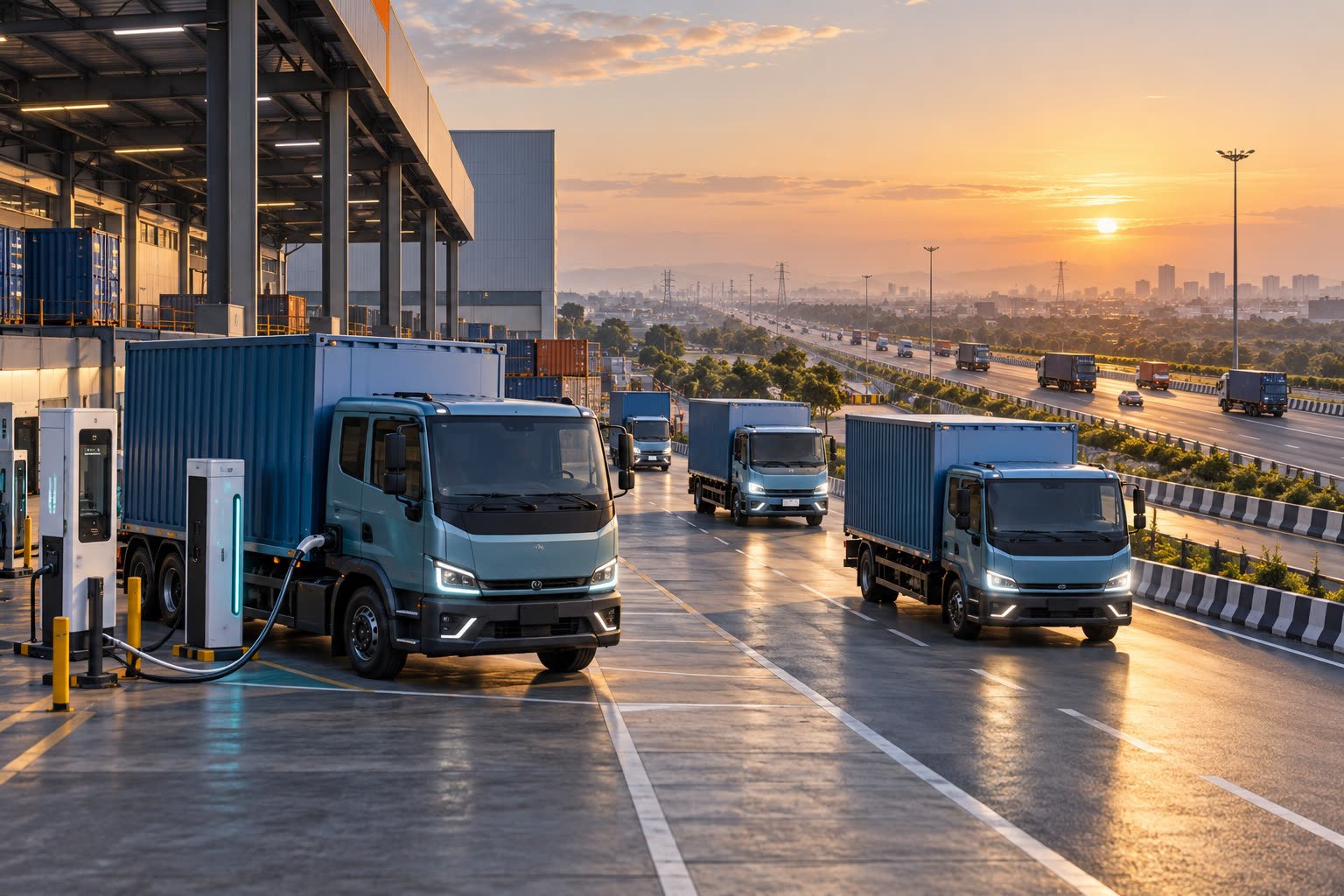
Illustrative visual: generic electric middle-mile trucks at a charging hub; it is not a photograph of the Tata Ultra E.7.
What Amazon and Tata Motors announced
The collaboration is aimed at Amazon's middle-mile network: the movement of shipments between fulfilment centres, sort centres, delivery stations and cities. That is a different operating problem from last-mile delivery, because the vehicles have to carry predictable loads on repeat routes while meeting delivery schedules and returning for charging or maintenance.
EVreporter said the initial deployment will use Tata Ultra E.7 electric trucks in Delhi during the festive season. Tata Motors will supply the vehicles, while Amazon's carrier partners will own and operate them. The arrangement makes the programme relevant to third-party fleet operators, not only to the two companies named in the announcement.
Daily Excelsior, carrying a PTI report, said a senior Amazon executive expects all 3,000 trucks to be deployed within three years. The announcement does not disclose the value of the supply arrangement, a truck-by-truck delivery calendar, or the commercial terms available to carrier partners. Those missing details matter because vehicle price, financing cost, battery warranty, maintenance support and daily utilisation will determine the actual operating case.
Delhi start and the NH48 corridor plan
The first vehicles are expected to work in and around Delhi before the programme expands to national highways and freight corridors. EVreporter reported a plan for the Delhi-Bengaluru-Chennai corridor along NH48, covering 2,800 km and seven states, with charging hubs being developed with infrastructure provider Yahhvi.
A corridor plan is not the same as an immediate conversion of every truck on that road. The practical test will be whether a vehicle can complete its assigned leg with its payload, charge within the scheduled dwell time and reach a service point when a charger or vehicle is unavailable. For operators, predictable warehouse-to-warehouse routes may be easier to electrify than irregular work with long waits, detours or changing payloads.
The announcement builds on Amazon's earlier work with industry and public-sector partners on electric freight corridors. In its May 2026 framework, Amazon said route profiling, charging infrastructure, demand aggregation and fleet operations all need to be planned together. The new deployment adds a shipper-backed purchase and operating use case to that broader transition.
Policy support and what is not automatic
India's PM E-DRIVE scheme covers N2 and N3 electric trucks. The Ministry of Heavy Industries' 11 July 2025 release defines N2 as trucks above 3.5 tonnes and up to 12 tonnes gross vehicle weight, and N3 as trucks above 12 tonnes and up to 55 tonnes. It says the maximum incentive is ₹9.6 lakh per vehicle, with the amount linked to gross vehicle weight and scrapping of an old polluting truck required for eligibility. That is a scheme condition, not a blanket discount on every electric truck in the new Amazon-Tata programme.
Delhi's notified policy is also important for the first phase. The Delhi Electric Vehicles Policy, 2026 was notified on 30 June 2026 and took effect from 1 July. It provides a 10-year exemption from no-entry timing restrictions for the first 1,000 private N2 electric trucks purchased and registered in Delhi within three months of notification. Since that window ended on 30 September, a fleet operator should not assume that a truck registered after the announcement automatically receives the exemption; vehicle category, ownership, registration date and the applicable operating guidelines need to be checked.
What fleet operators should check now
- Duty cycle and payload: Match the truck's usable range and charging time to the actual route, load and traffic pattern. A claimed efficiency figure does not establish the range available under a full commercial load.
- Charging resilience: Confirm charger compatibility, power availability, queue management and a fallback plan for a missed charging window. A single depot charger is not the same as a reliable corridor network.
- Ownership and uptime: Read who carries the battery, repair and downtime risk. The carrier-owned model makes service-level commitments and replacement-vehicle arrangements important.
- Scheme eligibility: Check the truck's N2 or N3 classification, purchase documents, scrappage requirement and any state registration conditions before including a subsidy or access benefit in a cost model.
For a diesel baseline, the fuel cost calculator can help estimate the energy cost of an equivalent route before comparing an electric vehicle's full operating cost.
Charging availability is a separate constraint. The state-wise EV station directory can help identify public charging locations near planned stops, but operators still need to confirm truck-compatible connectors, charging power and uptime with the provider.
Highway economics also include tolls and driver time. The toll-charge calculator can be used separately so toll fees are not mistaken for fuel or electricity savings.
What to watch next
The next useful evidence will be the pace of truck deployment, the opening of charging hubs and the operating data from Delhi and the NH48 corridor. A successful rollout would show that electric freight can maintain payload, turnaround time and service reliability on contracted routes; a delayed rollout would point to gaps in financing, charging or after-sales support.
For now, this is an announced three-year deployment plan, not a promise that all Amazon freight or all Indian highways will switch to electric trucks at once. The reader takeaway is straightforward: the order creates a significant demand signal for electric commercial vehicles, while the real cost and mobility impact will depend on route design, charging access, vehicle utilisation and the rules that apply to each truck.
Sources
- EVreporter: Amazon and Tata Motors to Deploy 3,000 Electric Trucks, Starting with Tata Ultra E.7 — 27 Oct 2026.
- Daily Excelsior (PTI): Tata Motors, Amazon partner to deploy 3,000 electric trucks for e-commerce logistics — 27 Oct 2026.
- Government of NCT of Delhi, Transport Department: Delhi Electric Vehicles Policy, 2026 — 30 Jun 2026.
- Press Information Bureau, Ministry of Heavy Industries: India Rolls Out First-Ever e-Truck Incentive Scheme Under PM E-DRIVE — 11 Jul 2025.
- Amazon India / The Climate Pledge: The Climate Pledge launches India's first EV highway framework in collaboration with C40 Cities — 14 May 2026.