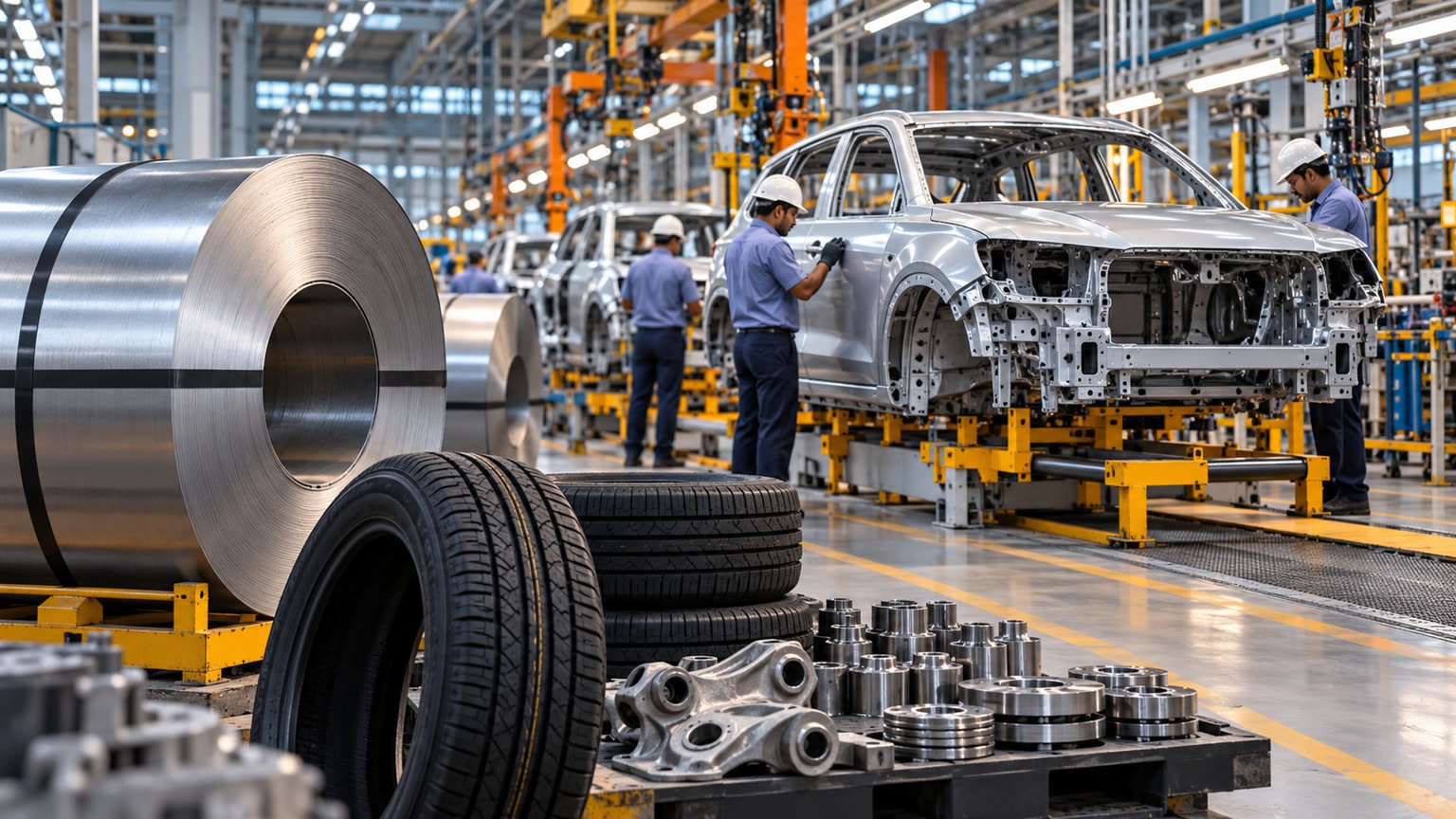
Motilal Oswal Financial Services expects Indian auto-sector margins to improve gradually after Q2 FY27 as manufacturer price hikes cushion higher commodity costs. For drivers and vehicle buyers, the near-term message is not a promised price cut: cost pressure may be partly absorbed by automakers, while new-vehicle prices, freight-linked costs and demand remain exposed to West Asia and weather risks.
The view is a forecast from a brokerage report, not a confirmed change to any car or two-wheeler price list. The report also says growth rates may moderate as the low comparison base created by last year’s GST rate changes fades.
Key takeaways
- Motilal Oswal expects auto margins to recover beyond Q2 FY27, helped by price increases taken by manufacturers.
- The report links the outlook to higher commodity costs, a favourable comparison base and festive-season dispatches.
- In its Q2 FY27 coverage, the report put passenger-vehicle growth at 31.2% year on year, commercial-vehicle growth at about 29% and internal-combustion-engine two-wheeler growth at 10.4%.
- El Niño and a renewed escalation of the West Asia crisis are identified as risks that could keep demand or input costs under pressure.
- For buyers, margin recovery does not mean lower on-road prices; the useful check is a dated quote plus the vehicle’s fuel, charging, insurance and maintenance costs.
What the Motilal Oswal report says
In the report published on 25 Oct 2026, Motilal Oswal said auto companies and component makers were still facing commodity-cost pressure. Its assessment was that much of the impact had already appeared in first-quarter results, while price hikes taken by original-equipment manufacturers could provide some relief from Q2 onward.
That distinction matters. A margin recovery means the gap between a company’s selling price and its costs may improve; it does not mean the selling price will fall. If an automaker raises the ex-showroom price to pass through part of a cost increase, the company can protect margins while the buyer pays more.
| Segment and period | Growth reported | Source and date |
|---|---|---|
| Passenger vehicles, Q2 FY27 (Jul–Sep 2026) | 31.2% YoY | Motilal Oswal report, 25 Oct 2026 |
| Commercial vehicles, Q2 FY27 (Jul–Sep 2026) | About 29% YoY | Motilal Oswal report, 25 Oct 2026 |
| ICE two-wheelers, Q2 FY27 (Jul–Sep 2026) | 10.4% YoY | Motilal Oswal report, 25 Oct 2026 |
The Society of Indian Automobile Manufacturers’ official Q2 release, dated 15 Oct 2026, reported a broader industry picture: passenger-vehicle sales grew 30.7%, two-wheeler sales 15.2% and commercial-vehicle sales 28.7% year on year. The two-wheeler figures are not contradictory: Motilal Oswal’s 10.4% figure is for ICE two-wheelers, while SIAM’s 15.2% figure covers the wider two-wheeler segment and its reported sales scope. These figures should not be merged into a single estimate.
Why this matters to vehicle buyers
Price increases are one of the clearest ways for a manufacturer to protect margins when materials, energy or logistics become more expensive. The report does not give a uniform increase for every brand or model, so it cannot be used to predict the price of a particular car, bike or commercial vehicle.
A buyer comparing options should therefore separate the market outlook from the personal cost calculation. Use the fuel-cost calculator with the vehicle’s real-world mileage and expected monthly kilometres, then check the dated rate on the live fuel-prices page. For an EV, charging access and route availability can change the practical cost just as much as the vehicle’s sticker price; the state-wise EV charging directory is a useful follow-up check.
This is also why a reported margin recovery should not be read as a promise of discounts. Dealer incentives, registration charges, insurance, financing terms, delivery timing and city-level taxes can change the final on-road amount even when the manufacturer’s list price is unchanged.
What could keep pressure on costs
Commodity and energy exposure
Motilal Oswal’s central argument is that price hikes may cushion commodity inflation, not that the underlying pressure has disappeared. If key inputs remain expensive, manufacturers may continue balancing volume, discounts and list-price changes. Component suppliers can face a similar squeeze when they cannot immediately pass higher costs through to customers.
West Asia and weather risks
The report lists a renewed escalation of the West Asia crisis as a monitorable. A prolonged shock could add volatility to energy, freight and imported-input costs, although the report does not quantify a direct impact on pump prices or any individual vehicle. Our earlier India crude-basket report explains why international crude movements do not automatically translate one-for-one into domestic fuel prices.
El Niño is another risk named in the report, particularly because weaker rural conditions can affect demand for two-wheelers, tractors and other mobility products. This is a risk to watch, not a confirmed forecast of weaker sales.
What to watch next
The next useful signals will be actual price-list changes, quarterly margin disclosures, commodity-cost trends and retail registrations after the main festive buying window. SIAM’s 15 Oct 2026 outlook still expected positive growth in the second half of FY2026–27, but it also warned that reported growth rates could moderate against a higher base and that inflation and geopolitical developments needed watching.
For a household or fleet operator, the practical takeaway is to compare a dated on-road quote with the complete operating cost rather than relying on an industry margin forecast. A margin recovery may support the financial health of manufacturers, but it does not by itself lower the rupees spent on buying, fuelling, charging or maintaining a vehicle.
Sources
- The Economic Times — Auto sector margins may improve from third quarter but El Nino, West Asia crisis key risks: Report — 26 Oct 2026.
- Motilal Oswal Financial Services report — Automobiles Sector Report: Strong pre-festive season demand across segments — 25 Oct 2026.
- Society of Indian Automobile Manufacturers — Auto Industry Sales Performance of Q2: FY2027 (July–September 2026) — 15 Oct 2026.
- WebIndia123/ANI — Auto sector margins may improve from third quarter but El Nino, West Asia crisis key risks: Report — 26 Oct 2026.