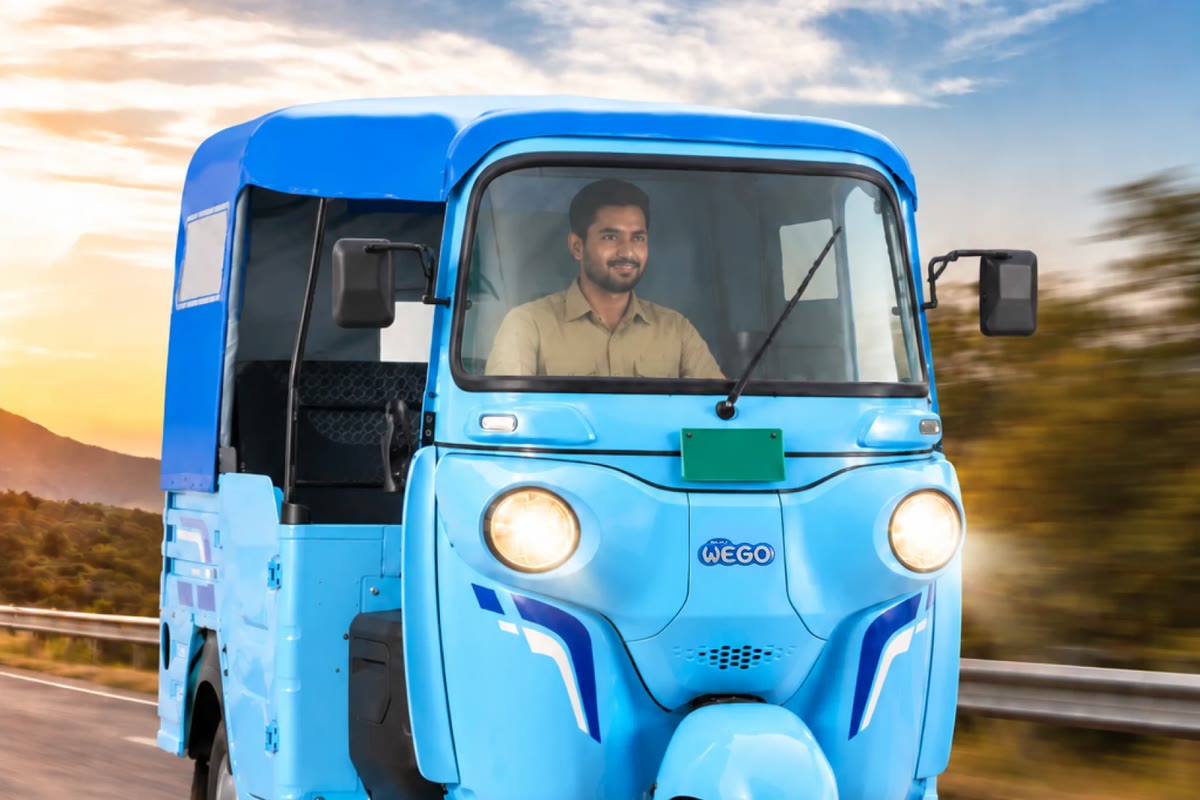
Bajaj Auto said on 26 Nov 2026, in an exchange filing, that its WEGO electric three-wheeler covered 394.2 km on a single charge and completed a 4,023-km journey from Kashmir to Kanyakumari. The figures matter to commercial EV operators, but they are company-announced record results, not a promise of the same distance on every loaded daily route.
Key takeaways
- Bajaj says WEGO covered 394.2 km between Namakkal and Tirunelveli in Tamil Nadu on one charge, with the result recognised by the India Book of Records and Asia Book of Records on the company's 26 Nov 2026 announcement.
- The vehicle also completed a 4,023-km Kashmir-to-Kanyakumari journey over nine days, according to Bajaj's filing and independent coverage from CMV360.
- Bajaj's official P9018 specification lists a 296-km certified range and a 17.7 kWh battery; RushLane reported the same product figures on 26 Nov 2026.
- The record release does not disclose the payload, average speed, charging procedure or other operating conditions, so operators should not use 394.2 km as their routine trip-planning number.
What Bajaj announced
The 394.2-km run took place between Namakkal and Tirunelveli in Tamil Nadu. Bajaj described it as the longest distance covered by an electric three-wheeler on a single charge and said the achievement was recognised by the India Book of Records and Asia Book of Records. The filing says the two organisations will jointly issue certificates, so the announcement is best read as a recognised record claim with the certification process still to be completed.
The separate endurance run began at Lal Chowk in Srinagar on 27 Oct 2026 and ended in Kanyakumari on 5 Nov 2026. Bajaj said the WEGO covered 4,023 km across the nine-day journey. CMV360's report on 26 Nov 2026 also recorded the route, dates and the involvement of adjudicators from both record organisations. The news is therefore about the public announcement on 26 Nov, not a journey that took place in the last two days.
Why 394.2 km is not the certified range
Bajaj's official P9018 product information lists a certified range of 296 km and a 17.7 kWh battery. Its 9 Feb 2026 launch release quoted an ex-showroom pan-India price of ₹4,41,247, while RushLane's 26 Nov report carried the same range, battery and price figures. The price is historical for comparison; an operator needs the latest local quotation, registration charges, insurance and taxes before calculating the full cost of ownership.
A certified range and a record run answer different questions. The certified figure is the product's published benchmark, while the record is a specific demonstration under conditions that the announcement does not fully describe. RushLane said the payload, average speed, charging procedure and other operating conditions were not provided. A passenger or cargo vehicle running in traffic, on slopes or with a heavier load can therefore deliver a different usable distance.
That distinction is important for a commercial vehicle because range is only one part of daily utilisation. The operator also needs to account for how much time the vehicle is available, where it can charge, whether the next charging point is compatible and how the route changes with passenger demand. A record can show engineering capability without becoming a guaranteed operating result.
What the cross-country journey demonstrates
The Kashmir-to-Kanyakumari run shows that the WEGO platform was used for a long, multi-day route across varied Indian roads. It does not mean the vehicle covered 4,023 km on one charge. The single-charge result and the cross-country result are two different achievements, and the filing does not state the number of charging stops or the total time spent charging during the longer journey.
For an operator assessing an inter-city or semi-urban route, route planning is as important as the battery specification. The road-trip planner can help map distance and breaks, while the EV charging station directory can be checked for charging access along the intended corridor. Those tools help with planning; they do not replace a loaded vehicle trial on the actual route.
What it means for three-wheeler operators
Bajaj is positioning the two achievements around fewer charging interruptions and longer daily running. That is relevant to passenger and last-mile operators because time spent charging is time the vehicle is not carrying passengers or goods. The financial outcome is not automatic, however. It depends on local electricity tariffs, charging losses, route length, load, maintenance, financing and the number of paid trips available.
For a comparison with a petrol or CNG three-wheeler, the fuel-cost calculator can estimate the combustion-fuel side of a route. An EV comparison still needs the operator's local electricity rate, charging schedule and any public-charger fee added separately. This avoids treating the record distance as a direct saving estimate.
Checks before using the record as a benchmark
- Start with the P9018's published 296-km certified range, and treat the 394.2-km result as a record demonstration rather than the normal operating figure.
- Confirm the current ex-showroom price and all local on-road charges instead of relying on the ₹4,41,247 price announced on 9 Feb 2026.
- Match the vehicle's expected passenger or cargo load, speed and terrain to the route being evaluated.
- Check charging access and downtime for the actual workday; the record announcement does not provide a complete charging log for the cross-country journey.
What to watch next
The most useful follow-up would be a fuller record log showing payload, average speed, state of charge, charging stops and total charging time. Those details would let operators compare the demonstration with their own duty cycles more fairly. Until then, the announcement is a notable range and endurance signal for India's electric three-wheeler market, while the published certified specification remains the safer starting point for route and cost planning.
Sources
- Bajaj Auto (NSE filing): Bajaj WEGO sets a record of 394.2 km on a single charge and completes the Kashmir-to-Kanyakumari journey — 26 Nov 2026.
- RushLane: Bajaj Wego Electric 3W Covers 394 Km On Single Charge - Completes Kashmir To Kanyakumari Run — 26 Nov 2026.
- CMV360: Bajaj WEGO Sets Record with 394.2 km Range on a Single Charge, Completes Kashmir to Kanyakumari Journey — 26 Nov 2026.
- Bajaj Auto: Bajaj WEGO P9018 product specifications — accessed 26 Nov 2026.
- Bajaj Auto: WEGO P9018 launch release with 296-km range, 17.7 kWh battery and price — 9 Feb 2026.