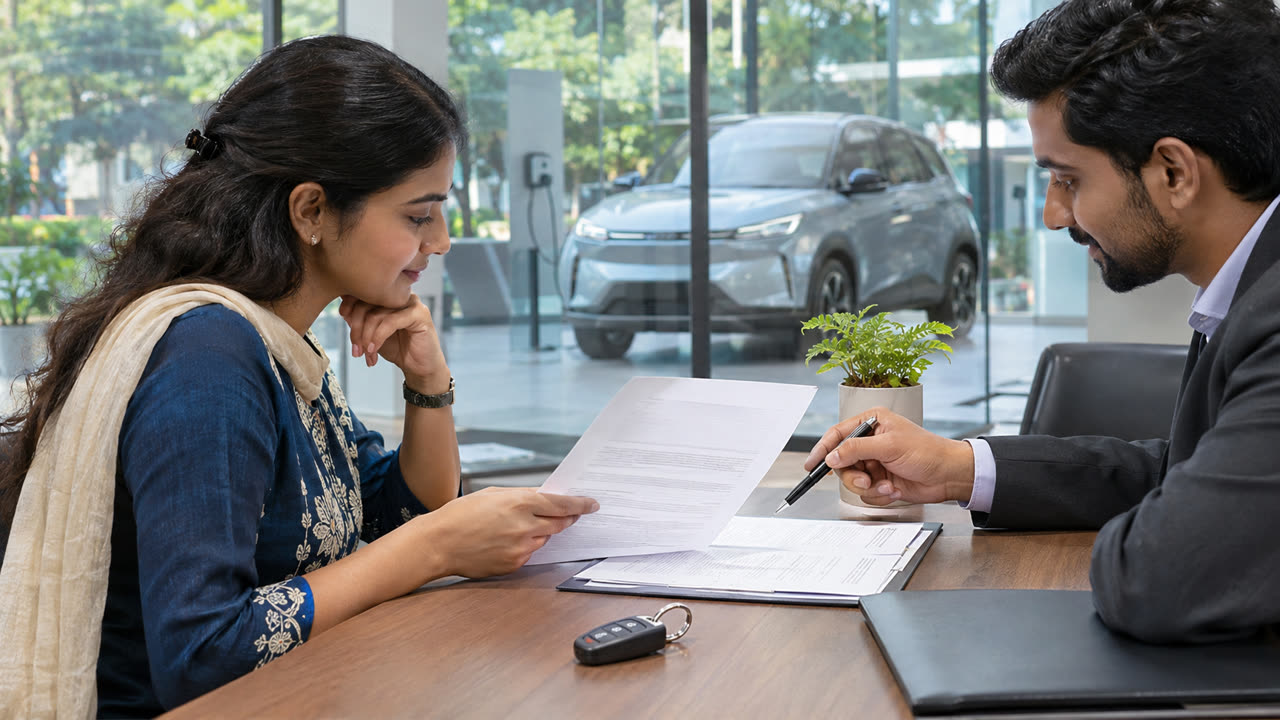
Bank of India is offering a 100% waiver of applicable processing charges on eligible new four-wheeler loans until 31 March 2027. For a buyer comparing finance this month, the offer can reduce the upfront cost of arranging a loan, but it does not by itself guarantee approval, a lower interest rate or a lower EMI.
The bank’s October investor presentation carries a nil-processing-charge offer through 31 March 2027. Moneycontrol’s report published on 16 Nov 2026 and Business Today’s report published on 2 Nov 2026 say the offer is effective from 1 October 2026 to 31 March 2027 and set out the eligibility conditions.
Key takeaways
- The offer covers applicable processing charges on eligible new four-wheeler loans; the reported validity ends on 31 March 2027.
- Individual borrowers generally need a CIBIL personal score of 725 or above for the eligible new-vehicle offer.
- Eligible non-individual borrowers can qualify with an external credit rating of BBB or above, or a CMR rating of 3 or better.
- Loans for eligible electric four-wheelers are reported to receive the processing-charge waiver irrespective of the applicant’s CIBIL score, subject to the bank’s other terms.
- The waiver is about processing charges. Interest, tenure, down payment, insurance, registration and other costs still need to be checked separately.
What Bank of India has changed
Processing charges are a one-time cost associated with arranging a loan. Bank of India’s official investor presentation shows a vehicle-loan offer with nil processing charges until 31 March 2027. The independent reports describe the same offer as a 100% waiver of applicable charges on eligible home and four-wheeler loans.
For vehicle buyers, the useful distinction is between the headline waiver and the word eligible. The published terms do not say that every car purchase or every applicant automatically receives the benefit. They refer to eligible new four-wheelers and to the bank’s applicable loan terms and conditions.
Who the vehicle-loan offer covers
Individual buyers
According to the reports by Moneycontrol and Business Today, an individual applicant with a CIBIL personal score of 725 or above can receive a 100% waiver of applicable processing charges on an eligible new four-wheeler loan. The score condition is an eligibility threshold for the offer, not a promise that the loan will be sanctioned.
Businesses and fleet operators
The reported terms also cover eligible non-individual borrowers. They need an external credit rating of BBB or above, or a CMR rating of 3 or better, subject to the bank’s assessment and documentation requirements. This is relevant to a business financing a new car or a small fleet, but it should not be read as a blanket waiver for every commercial-vehicle loan.
Electric four-wheelers
The offer has a separate provision for loans to purchase electric four-wheelers. The CIBIL threshold does not apply to this provision, according to the two independent reports, but the applicant must still meet the bank’s other loan criteria. In other words, the waiver removes one stated score condition; it does not remove the need for credit assessment, documents or repayment capacity.
What the waiver changes—and what it does not
The immediate benefit is lower upfront borrowing cost where the applicable processing charge is waived. The reports do not publish one fixed rupee saving for every applicant because the amount can depend on the loan product, sanctioned amount and applicable charge schedule.
The published offer is limited to processing charges. It should not be treated as a change to the interest rate, loan tenure or EMI unless those terms are separately stated in the sanction letter. Vehicle buyers also need to account for the down payment, road tax, registration, insurance, documentation, hypothecation and any prepayment or foreclosure charges that may apply under the written loan agreement.
This matters because a zero upfront processing charge can be smaller than the difference between two lenders’ interest rates over the full repayment period. A lower advertised fee is therefore only one part of the total cost comparison.
How to compare the real cost
Start with the same vehicle price, down payment and repayment period when comparing offers. Then record the interest rate, EMI, total repayment, processing charge, documentation charges and any conditions attached to an electric-vehicle or high-score concession. Ask for the applicable charges in writing rather than assuming that a festive offer covers every fee collected during disbursal.
Ownership costs also continue after the loan is sanctioned. For a petrol or diesel vehicle, the regular commute can be checked with the FuelPrice fuel cost calculator. An EV buyer can use the EV charging directory to check charging availability before comparing the financing benefit with day-to-day charging needs.
If the vehicle will be used for inter-city travel, the road-trip planner can help separate the finance decision from the fuel, charging and route costs. The paperwork needed when a loan is fully repaid is also worth keeping in view; the car-loan closure checklist explains the NOC and RC-update follow-through.
What to check before signing
- Confirm that the vehicle is a new four-wheeler covered by the offer and that the offer is still valid on the application and sanction dates.
- Check whether the waiver is recorded as 100% of applicable processing charges and whether GST or another documented charge remains payable.
- Verify the CIBIL, external-rating or EV-specific eligibility condition that applies to the borrower.
- Compare the written interest rate, tenure, EMI and total repayment with other available offers; the fee waiver alone does not establish the lowest total cost.
- Read the sanction letter for down payment, insurance, documentation, hypothecation, late-payment, prepayment and foreclosure terms.
What to watch until March 2027
The reported offer runs through 31 March 2027, subject to Bank of India’s prescribed eligibility criteria and applicable terms and conditions. The bank may update product schedules or eligibility details before that date, so the latest written terms should be checked at the point of application. The key takeaway for buyers is straightforward: treat the waiver as a reduction in one upfront charge, then compare the complete cost of the loan and the vehicle’s running costs.
Sources
- Bank of India, Investor Presentation — 26 Oct 2026
- Moneycontrol, Bank of India waives 100% processing charges on home, four-wheeler loans till March 2027 — 16 Nov 2026
- Business Today, Bank of India waives processing fees on home, car loans till March 2027; check eligibility — 2 Nov 2026
This article is for general information only and is not financial, insurance or legal advice.