Union minister Suresh Gopi said on 16 Nov 2026 that petrol and diesel prices cannot be reduced immediately, citing ₹42,000 crore in losses incurred by oil companies and disruption in petroleum-product supplies. For drivers, the practical message is that the statement offers no immediate nationwide pump-price relief; any change will need a fresh pricing or tax decision.
The remarks were reported after Gopi spoke to reporters at Chennai’s Meenambakkam airport. Drivers can check the latest city-wise rates on our live fuel-price page before filling up.
Key takeaways
- No immediate nationwide petrol or diesel price cut was announced with the minister’s remarks.
- Gopi gave a ₹42,000 crore loss figure for oil companies, but the reports did not specify the period or split it by company or fuel.
- The minister linked the pressure to the West Asia conflict and what he described as disruption in petroleum-product supplies.
- State governments remain able to reduce their own petrol taxes, but no common state-level cut was announced.
What Suresh Gopi said on 16 Nov
Gopi’s position was about timing and the financial condition of oil companies. He said a price reduction could not happen immediately because oil companies first needed to account for losses already incurred. He also said that supply-side problems were being addressed.
Mint, Moneycontrol and The Economic Times reported the same core remarks on 16 Nov. Moneycontrol and The Economic Times attributed their reports to ANI, while Mint also reported the airport comments. The ₹42,000 crore figure is therefore presented here as the minister’s stated estimate, not as a separately published financial statement from an oil company or the petroleum ministry.
This distinction matters: the report is not a notification changing petrol or diesel rates. It is a ministerial explanation for why consumers should not expect an immediate broad reduction at the pump.
Why the statement matters for drivers
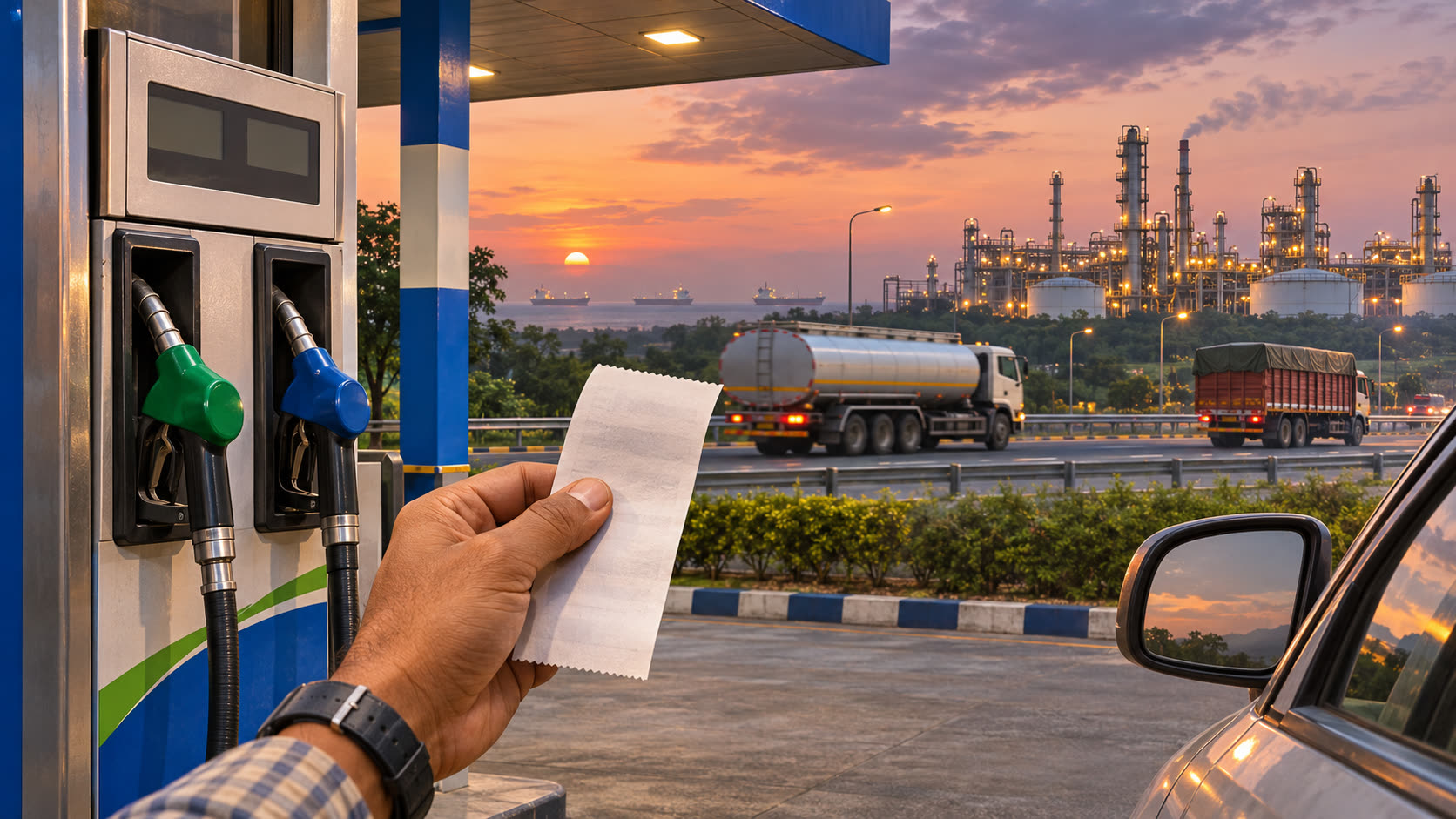
When retail fuel prices stay unchanged while the cost of buying, moving or refining fuel is under pressure, drivers do not receive relief simply because international conditions begin to improve. Oil companies may first need to rebuild margins or recover losses before a lower cost can be passed through to retail prices. That is the logic behind the minister’s comment, not a forecast of where prices will move next.
A simple monthly-cost illustration
For a driver who uses 40 litres of petrol or diesel in a month, every ₹1 per litre change alters the monthly fuel bill by ₹40. A ₹2 per litre change would alter it by ₹80. These are illustrative calculations based on fuel volume, not current prices or a prediction. Your actual impact depends on vehicle efficiency, kilometres driven, fuel type and the rate in your city.
For a longer journey, route length and expected fuel use matter as much as the pump rate. A fuel cost calculator can separate those two effects so a driver does not treat a possible price cut as guaranteed savings.
Who is affected
Private car and two-wheeler owners feel the effect at each refill, but the exposure is wider. Truck operators, bus companies, delivery fleets, taxis and farm users have fuel as a direct operating cost. If pump prices do not fall, their immediate cost base remains unchanged; if prices rise, the effect can appear in freight, delivery and travel budgets.
For households, the useful takeaway is not to assume that a fall in global crude automatically means a fall at the local pump. Retail prices also reflect taxes, exchange rates, product costs, freight and the decisions of fuel retailers. The minister’s statement adds the accumulated-loss issue to that list.
State taxes are a separate lever
Gopi said individual states can reduce the taxes they levy on petrol. That is different from a nationwide reduction by oil companies or the Centre. It means the final price can move differently between states even when the underlying fuel market is the same. The remarks mentioned price increases in Kerala and Karnataka, while giving no state-wise price table.
What changes now
There is no confirmed nationwide price cut to apply today based on the reports reviewed for this article. Drivers planning a commute or road journey can use the current rate shown on the fuel-price hub and then estimate the route cost with their own vehicle’s consumption. For multi-stop journeys, the road-trip planner can help put fuel, distance and timing in one view.
Fleet operators may also want to keep two numbers separate in their budgets: the pump rate actually paid and the volume consumed. That makes it easier to see whether a future price change, a change in route, or lower utilisation is driving the monthly total.
What to watch next
The next meaningful signal would be an official change in retail prices, a state tax decision, a compensation measure for oil companies, or clearer information that petroleum-product supply disruptions have eased. Until one of those developments is confirmed, the minister’s remarks point to a period in which drivers should not assume quick price relief.
For now, the most accurate reading is limited but important: petrol and diesel prices have not been cut nationally because of this statement, and no immediate cut was promised. Consumers can track their local rate, calculate the fuel needed for a trip and treat any future reduction as a confirmed change only when the relevant authority or retailer publishes it.
Sources
- Mint — “Not technically possible’: Suresh Gopi rules out immediate fuel price cut, cites ₹42,000 crore loss” — 16 Nov 2026
- Moneycontrol — “Petrol, diesel prices won’t come down immediately, says Suresh Gopi; here’s why” — 16 Nov 2026
- The Economic Times — “Petrol, diesel price cut not possible immediately, oil companies face ₹42,000 crore losses: Union Minister Suresh Gopi” — 16 Nov 2026