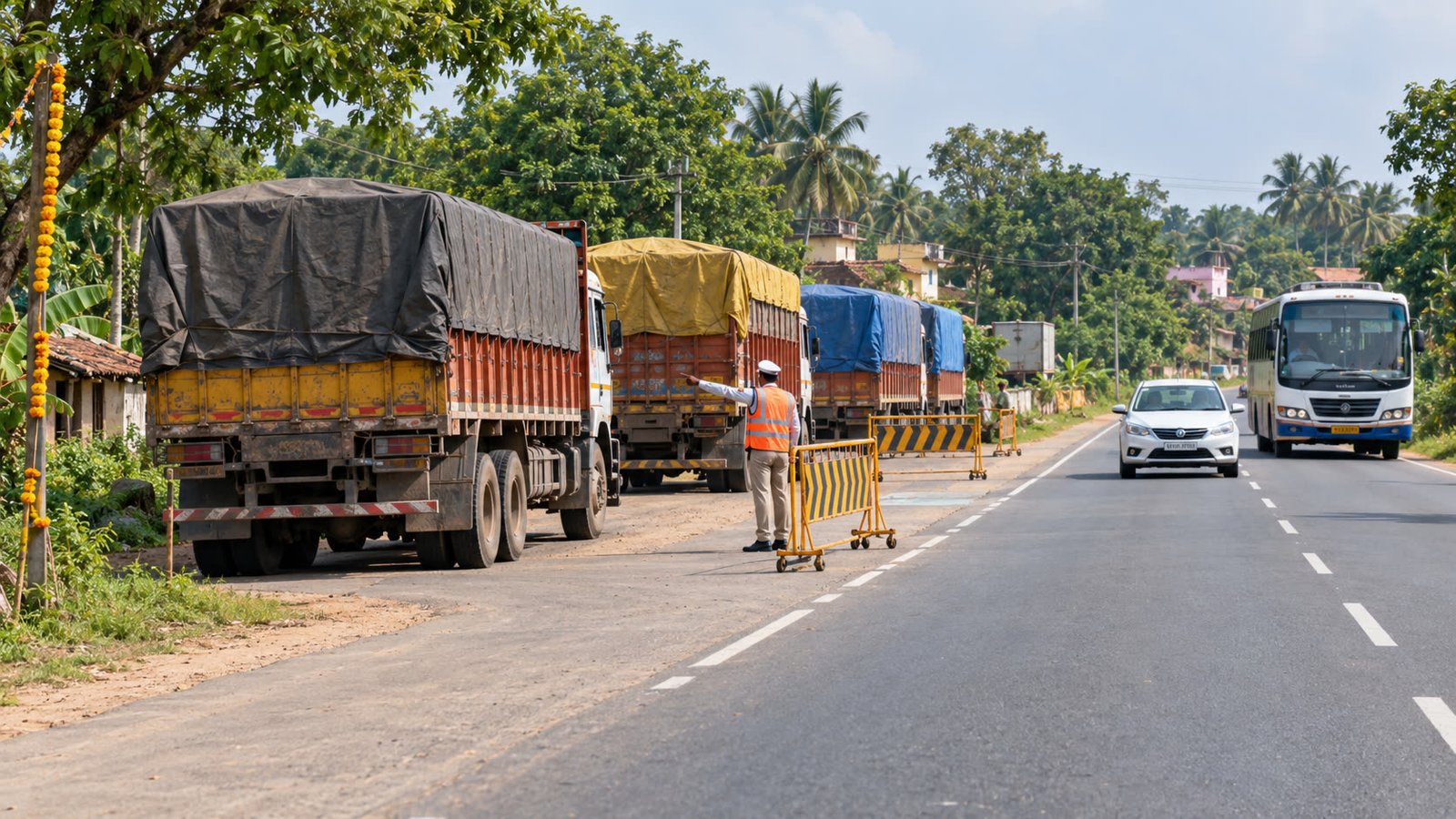
Cuttack district administration has ordered a temporary restriction on heavy vehicles along the Khuntuni–Narsinghpur stretch of State Highway-65 from 17 October to 27 October 2026, from 6:00 am to midnight every day. The order covers both directions under Athagarh police limits, so freight and construction operators need to check the time window before dispatching vehicles during the Durga Puja period.
Key takeaways
- The reported restriction runs from 17 October to 27 October 2026, every day from 6:00 am to 12:00 midnight.
- It applies to both directions on the Khuntuni–Narsinghpur stretch of State Highway-65 under Athagarh police limits.
- Trucks, tippers, dumpers, hyvas, trailers and transit mixers are covered, including loaded and unloaded vehicles.
- Ambulances, buses, fire-service and police vehicles, plus vehicles carrying LPG, fuel, milk, medicines and PDS supplies, are exempted according to the reports.
- The order is a temporary local traffic control; it is not a new toll rule or a nationwide heavy-vehicle ban.
What the Cuttack order changes
Prameya News and Argus News English report that the order was issued by Cuttack Collector and District Magistrate, and Regional Transport Authority chairman, Dattatraya Bhausaheb Shinde. The restriction covers the Khuntuni–Narsinghpur section of SH-65 in both directions, where puja mandaps are located along the highway under Athagarh police limits.
The stated purpose is crowd management and safer movement during Durga Puja. That distinction matters for drivers: the measure is tied to a defined festival period and a defined vehicle class. It should not be read as a permanent change to the road, a change in vehicle registration rules or a revision of toll charges.
Daily hours and vehicle classes
Heavy-vehicle movement is prohibited from 6:00 am until midnight each day between 17 October and 27 October 2026. The reports say the restriction applies to trucks, tippers, dumpers, hyvas, trailers and transit mixers carrying stone chips, concrete and other construction material. Both loaded and empty vehicles are covered, which means an empty return trip may still fall within the order.
Operators moving construction material or aggregate should therefore check the vehicle category and the planned crossing time, rather than assuming that a vehicle can pass because it is not carrying a load. The reports do not publish a single alternative route for all affected vehicles, so the correct diversion may depend on the vehicle, destination and directions issued at the control point.
Who is affected on the road
Freight and construction operators
The most direct effect is on truck and construction movement through the restricted stretch. A vehicle that normally crosses during the daytime window may have to wait, use a locally designated diversion or change its dispatch time. Since no universal alternate route is specified in the reports, fleet managers should confirm the on-ground arrangement with local enforcement and allow for loading, waiting and detour time.
A diversion can change both distance and running cost. Operators can use the fuel-cost calculator to test the effect of additional kilometres using the vehicle's own efficiency. If the replacement route uses a tolled road, compare the likely charge in the toll-charge calculator before finalising the trip estimate. These are planning checks, not a claim that every affected vehicle will pay an additional toll.
Private cars, two-wheelers and buses
The reported order targets the listed heavy-vehicle classes and does not describe a blanket closure for private cars or two-wheelers. However, motorists can still encounter slower movement near pandals, barricades, police checks and vehicles being turned around. Buses are listed among the exempted vehicles, but exemption from the restriction does not guarantee a delay-free journey during the festival rush.
People travelling through the corridor can review the departure time and route assumptions in the road-trip planner before leaving. The practical check is to keep the itinerary flexible around the 6:00 am to midnight control period and follow the traffic personnel's directions rather than relying only on an older map route.
Essential and emergency services
The reported exemptions include ambulances, buses, fire tenders and police vehicles. Vehicles carrying LPG cylinders, fuel, milk, medicines and Public Distribution System supplies are also listed as exempted so that emergency response and essential deliveries can continue. These vehicles remain subject to lawful road-safety directions and any separate local control applied at the time of travel.
What drivers should check before travelling
- Confirm the vehicle class: Check whether the vehicle is a truck, tipper, dumper, hyva, trailer or transit mixer covered by the order. Do not assume that an empty vehicle is outside the restriction.
- Check the clock: The reported daily restriction is in force from 6:00 am to midnight through 27 October 2026. A route plan that works after midnight may not work during the day.
- Confirm the local diversion: The two reports describe the restriction but do not publish one universal alternate route. Drivers should follow the signs and directions provided at the control point.
- Rework the trip estimate: If the route changes, recalculate distance, fuel and any toll exposure before dispatch. Congestion-related idling can also affect the final fuel requirement.
- Expect festival traffic: Private vehicles are not described as banned by the order, but extra time may be needed near puja locations and temporary barricades.
What to watch next
The present order is reported to end on 27 October 2026. Authorities may issue a fresh advisory if crowd conditions, road safety or local events require a change, so operators should check for an updated notice before a later trip. Until then, the important distinction is between the temporary heavy-vehicle control and a permanent road or toll change: the reports describe only the former.
Reader takeaway
For most private-car and two-wheeler users, SH-65 is not reported as fully closed, but the Khuntuni–Narsinghpur corridor can be slower during the festival period. Freight and construction operators face the clearest restriction and should verify the vehicle class, crossing time and locally directed route before sending a truck through Athagarh.