Electric passenger-vehicle registrations in India rose 93.6% year on year to about 97,000 during the second quarter of FY2027, covering July to September 2026, according to Deloitte’s sixth Wheelwatch tracker. The same report says electric two-wheelers crossed 10% penetration for the first time, a sign that battery-powered mobility is moving beyond an early-adopter niche and into a larger commuter market.
Key takeaways
- Electric passenger-vehicle registrations reached about 97,000 in Q2 FY2027, up 93.6% from the same quarter a year earlier.
- Electric passenger vehicles accounted for 6.7% of registrations in the quarter, up from 6% in the previous quarter.
- Electric two-wheelers crossed 10% of the two-wheeler market for the first time, according to the tracker.
- Passenger-vehicle wholesale sales rose 30.7% year on year to about 14 lakh units in the quarter, giving EV growth a wider market backdrop.
- Dealer passenger-vehicle inventory was reported at about 43–45 days by the end of September, so strong registrations do not guarantee that every model or variant is immediately available.
What Deloitte measured in Q2 FY2027
The July–September period was the second quarter of financial year 2026–27. Deloitte’s tracker combines industry sales data with vehicle-registration trends, so the metrics do not all describe the same stage of the buying process: passenger-vehicle growth is reported as wholesale sales, while the EV figures are registrations recorded after vehicles reach buyers.
| Measure | Q2 FY2027 result | Comparison |
|---|---|---|
| Electric passenger vehicles | About 97,000 registrations | +93.6% year on year |
| Electric passenger-vehicle share | 6.7% | 6% in Q1 FY2027 |
| Electric two-wheelers | More than 10% penetration | First time above that mark |
| Passenger vehicles, all powertrains | About 14 lakh wholesale units | +30.7% year on year |
The headline EV growth is therefore meaningful, but it should not be read as a claim that electric cars have replaced petrol or diesel vehicles. A 6.7% electric share still leaves most passenger-vehicle registrations with other powertrains. The useful signal is the direction of travel: EVs are taking a larger place in the set of vehicles available to compare, while the two-wheeler market is reaching a threshold that matters for everyday commuting.
Why the two-wheeler milestone matters
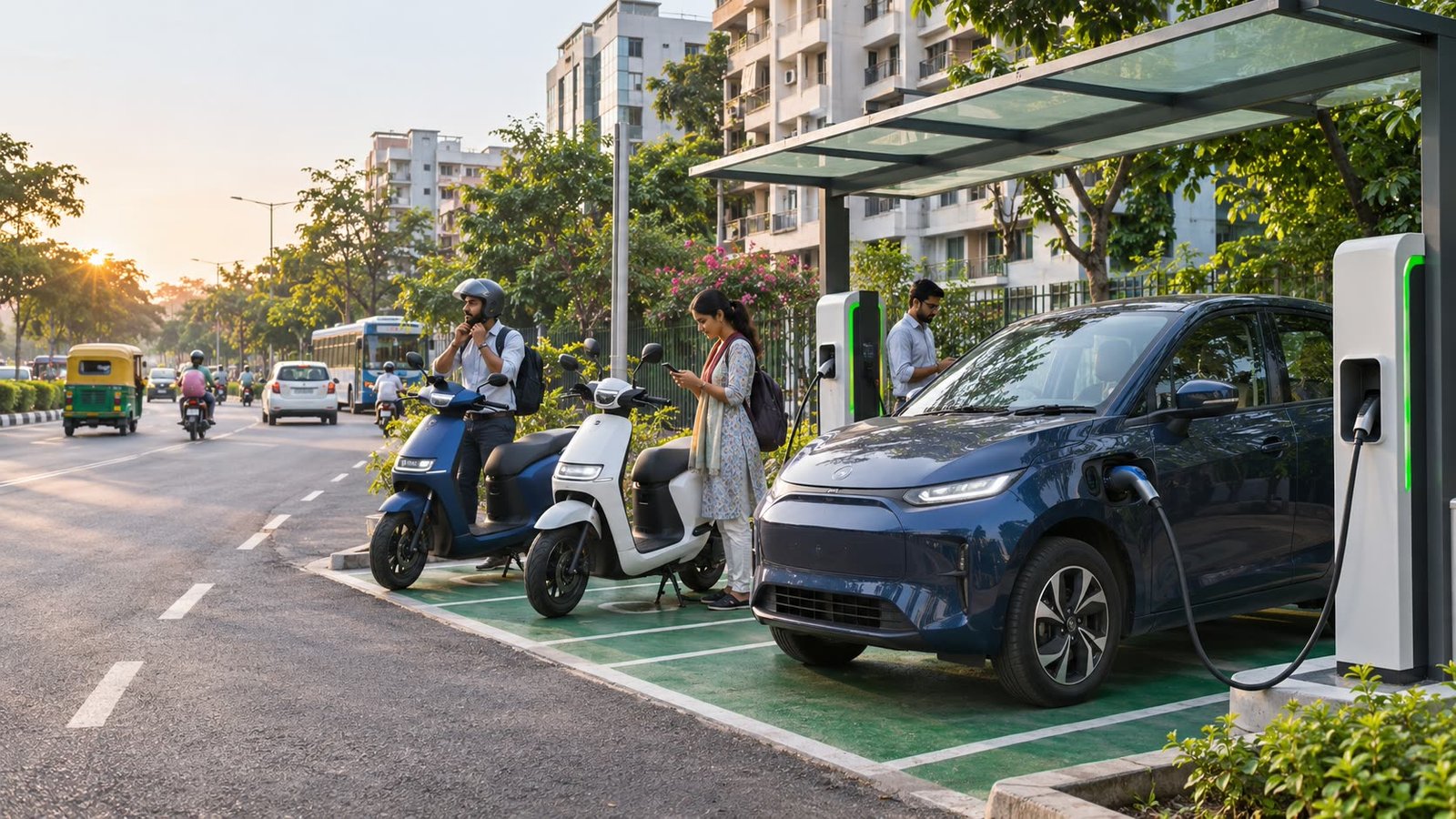
Two-wheelers are a high-volume part of Indian mobility, and many daily trips are shorter and more predictable than inter-city car journeys. Crossing 10% penetration does not mean every city or buyer has the same experience, but it suggests that electric scooters and motorcycles are becoming a mainstream option in more parts of the market.
For a commuter, the practical question is less about the national percentage than about whether the vehicle fits a routine. Home or workplace charging, the length of the daily trip, battery warranty terms, service coverage and the availability of a backup charging point can matter more than a national sales ranking. The state-wise EV charging directory can help map public charging options before a route or vehicle is compared.
What the passenger-EV figure means for buyers
Nearly doubling registrations in one quarter shows stronger acceptance, but the number also reflects the vehicles that manufacturers and dealers could supply during the period. Deloitte’s tracker, as summarised in reports dated 7 Nov 2026, also points to higher dealer inventory by September. Inventory can improve choice, but it is not a promise of a discount, a particular trim or a shorter delivery time.
Buyers comparing a battery-electric car with a petrol, diesel, CNG or hybrid alternative need to separate the purchase decision from the running-cost calculation. The relevant inputs include the quoted efficiency or consumption, electricity tariff, charging losses, fuel price, insurance, service schedule and the route being driven. Current fuel rates can be checked on the live fuel prices page, while a route-based estimate can be run through the fuel cost calculator. These tools provide a planning baseline; the final comparison still depends on the vehicle, tariff and usage pattern.
Charging access is part of the ownership equation
The Q2 data makes the supply side harder to ignore. More registrations can encourage manufacturers to add models and expand service capacity, but a buyer’s experience depends on whether charging is available where the vehicle is parked and along the routes that matter. Public chargers are useful for top-ups and longer journeys, but they do not remove the need to understand charging time, connector compatibility and access rules at the chosen location.
For occasional highway travel, a route comparison should include charging stops alongside distance, time and tolls. The road-trip planner can help structure that check. It is also worth treating the report’s national figures as a market signal rather than a guarantee that charging density, service support or resale conditions are uniform across India.
What to watch next
The next useful test will be whether electric passenger-vehicle share remains near the 6.7% Q2 level after the festive period, whether electric two-wheelers stay above the 10% threshold, and whether dealer inventory moves closer to normal as supply and registrations balance. Fresh product launches may lift choice, but component availability, charging expansion and vehicle-specific pricing will determine how much of that growth reaches buyers outside the largest cities.
For drivers and operators, the takeaway is specific: India’s EV market is growing quickly enough to affect the vehicles being offered and the infrastructure being built, but national growth is not a substitute for a personal cost and route check. Compare the vehicle’s real use case, charging access and total running inputs with the alternatives before treating the headline percentage as a purchase signal.
Sources
- Deloitte India, “Wheelwatch edition 6”, Q2 FY2027 tracker, accessed 9 Nov 2026
- NamasteCar, “India’s Automobile Market Gains Momentum as Passenger Vehicle Sales Rise 30.7% and EV Demand Surges”, 7 Nov 2026
- CARC, “India’s Car Market Accelerates: Passenger Sales Up 30.7% as EV Registrations Nearly Double”, 7 Nov 2026