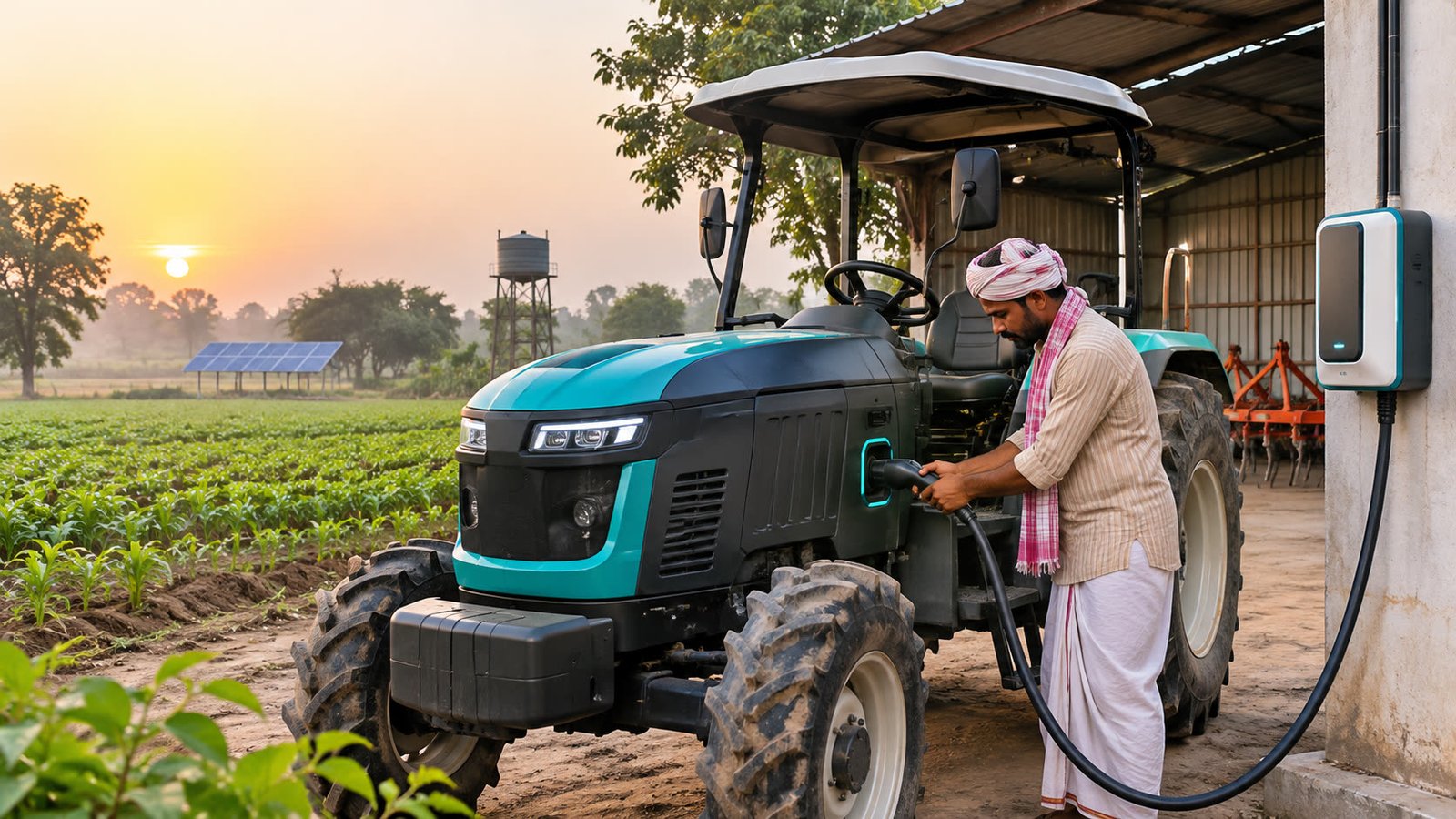
India’s electric tractor segment is moving beyond isolated pilots into an early commercial phase. A Business Standard report published on 8 Nov 2026, using VAHAN data and industry inputs, said 248 electric tractors were registered between 1 Jan and 31 Oct 2026, while manufacturers had created 35,000–40,000 units of annual capacity. For farmers and industrial operators, the practical question is whether lower energy use can justify a higher purchase price and new charging requirements.
Key takeaways
- VAHAN-based registrations reached 248 electric tractors from 1 Jan to 31 Oct 2026, compared with 219 in calendar year 2025, according to the reported data.
- The emerging industry has stated combined annual capacity of 35,000–40,000 units, well ahead of current registrations.
- AutoNxt told Business Standard that a 3-acre rotavation task can use electricity costing about ₹300–400, against ₹1,500–2,000 of diesel for a comparable operation.
- The lower operating-cost case is strongest for high-utilisation farm, sugar-mill, construction and other industrial work; the upfront price and charging setup still matter.
- Manufacturers are seeking permission for commercial registration on highways, so an agricultural electric tractor should not automatically be treated as cleared for every road-going use.
What the latest registration data shows
The 248-unit figure is small beside India’s overall tractor market, but it marks a rise from the 219 electric-tractor registrations reported for 2025. It also shows why the sector is better described as early-stage than mass-market: factories and product programmes are being prepared before demand has reached their stated capacity.
The registration number should be read as vehicle registrations, not factory dispatches or enquiries. VAHAN data can also be revised as records are digitised and updated. The government’s public VAHAN dashboard is therefore the right reference point for checking the latest count, while the current report provides the January–October 2026 snapshot.
AutoNxt, TI Clean Mobility’s Montra Electric business and Moonrider Electric Tractors are among the companies identified in the report. Established diesel tractor makers have so far taken a more cautious approach, which leaves the segment dependent on specialist manufacturers, state support and buyers with a high enough utilisation rate.
Where the diesel-cost advantage appears
Business Standard quoted AutoNxt’s comparison for rotavation, or soil-breaking work, across 3 acres. The company said a diesel tractor may consume 15–20 litres of diesel, costing ₹1,500–2,000, while its electric tractor could do the same task using electricity worth about ₹300–400 at a tariff of ₹10 per unit. On those stated assumptions, the indicative energy-cost difference is ₹1,100–1,700 for that task.
That is a company estimate, not a guaranteed saving or a national benchmark. Soil condition, implement size, payload, operator technique, battery state, charging losses and the local electricity tariff can materially change the result. Operators comparing the diesel baseline can check current fuel prices, then calculate the vehicle’s own duty cycle rather than applying a headline saving to every farm.
Upfront price changes the break-even question
The same report put AutoNxt’s 45 HP electric tractor at ₹15.5–16 lakh, compared with ₹7–8 lakh for a comparable diesel tractor. AutoNxt’s own product information describes its X45H2 as a commercially available 45 HP-equivalent electric tractor for agricultural and industrial work, but the purchase price, finance terms, warranty package and delivery conditions still need to be confirmed in an actual quotation.
The gap means that low annual utilisation can weaken the case even when electricity is cheaper per task. In contrast, equipment working long shifts or in industrial operations may use its battery and charging investment more intensively. AutoNxt told the newspaper that the additional investment could be recovered within 12 months in high-utilisation industrial applications; that is the company’s estimate, not an outcome that applies to every owner.
For a road-going fleet or haulage use case, a fuel-cost calculation can make the diesel baseline clearer, but it cannot replace checks on charging downtime, battery replacement, service access or financing cost.
Policy support is available, but it is not uniform
The Agriculture Ministry’s DBT portal lists the Sub-Mission on Agricultural Mechanisation for 2026–27. The ministry’s SMAM guidelines allow states to add machines under appropriate categories and set assistance within state-approved price and subsidy limits. That structure supports local implementation, but it does not create one identical electric-tractor subsidy for every buyer in India.
Business Standard also reported state-level incentives and quoted industry participants on their effect on purchase cost. Any such support should be checked against the relevant state agriculture notification, the approved machine list, the buyer category, registration requirements and the date of application. A reported incentive is not the same as an automatic entitlement.
Checks before an operator compares models
- Match the job, not just the horsepower: verify PTO output, implement compatibility, payload, terrain and the number of working hours required each day.
- Price the charging system: include sanctioned electrical load, charger installation, wiring, backup arrangements and the time when the tractor can be taken off duty.
- Confirm the support package: ask for the battery warranty, service response, software support, replacement terms and the cost of consumables in writing.
- Check eligibility: state subsidies, testing, registration and agricultural-equipment rules may differ by location and use. Do not infer eligibility from a manufacturer’s general statement.
- Separate field and highway use: manufacturers seeking commercial registration permission indicates that road-going operation may involve a different compliance path. For public charging options beyond a private farm connection, the state-wise EV charging directory is a useful starting point, but availability and connector compatibility must be verified locally.
What to watch next
The next meaningful test is not factory capacity alone; it is repeat demand from farms and industrial fleets that can use the vehicle often enough to recover its higher upfront cost. Registrations, state-approved equipment lists, charging deployments and clearer rules for commercial road use will show whether the segment can move from a small specialist market into a broader vehicle category.
For now, the electric-tractor case is strongest where fuel use is high, work is predictable and charging can be planned. For lower-use buyers, the total-cost comparison should include the full purchase, energy, maintenance, downtime and compliance picture rather than relying on the electricity-versus-diesel difference alone.
Sources
- Business Standard — “From farms to factories, electric tractors prepare for a growth spurt” — 8 Nov 2026
- Ministry of Road Transport and Highways, Parivahan — VAHAN Public Dashboard — accessed 9 Nov 2026
- Department of Agriculture and Farmers Welfare — DBT Agriculture Machinery portal, SMAM 2026–27 — accessed 9 Nov 2026
- Department of Agriculture and Farmers Welfare — Sub-Mission on Agricultural Mechanisation guidelines — 2024
- AutoNxt Automation — X45H2 45 HP electric tractor product information — accessed 9 Nov 2026