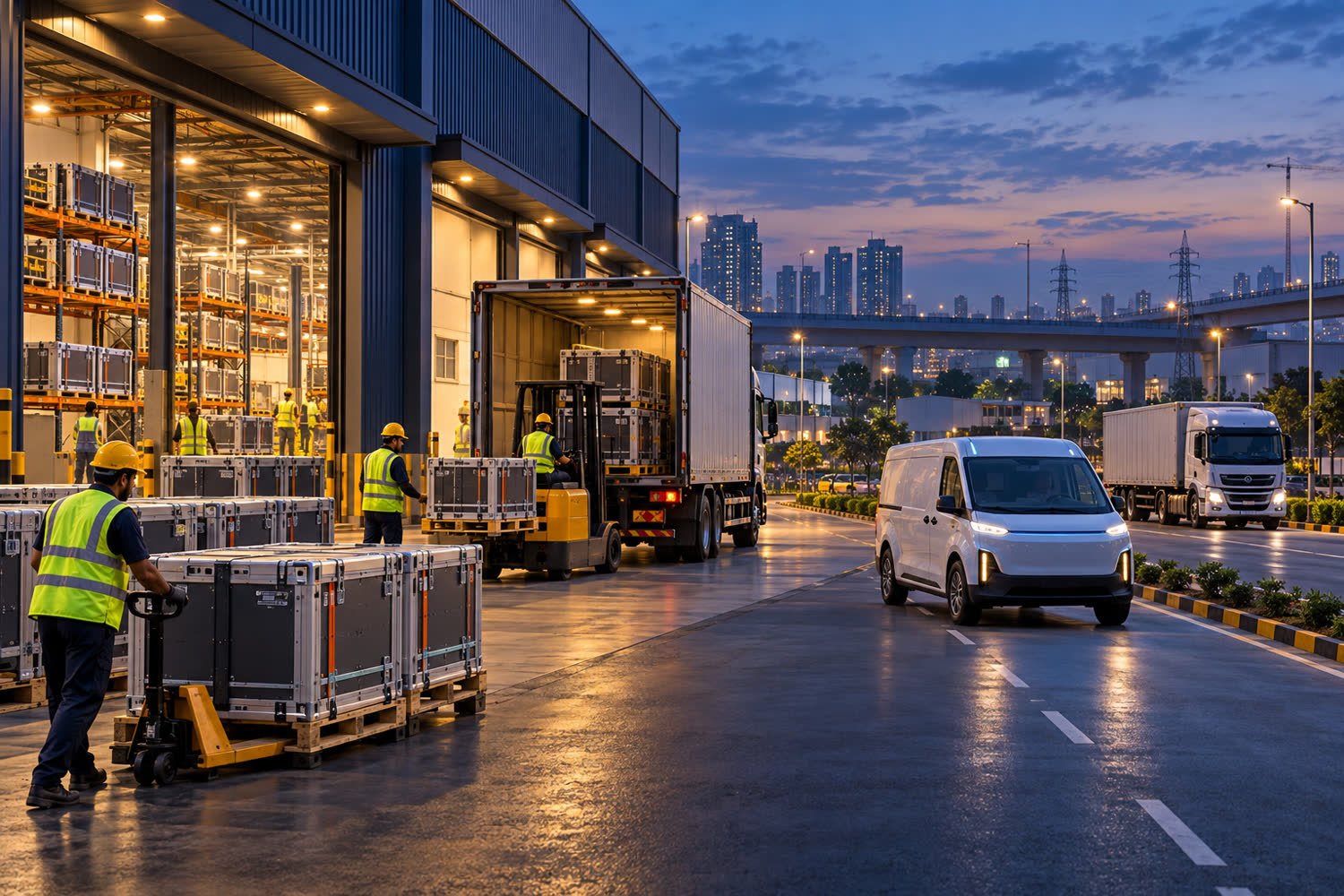
DHL is prioritising organic expansion in India rather than acquisitions, according to a 23 Oct 2026 Business Standard interview with DHL Global Forwarding chief executive Oscar de Bok. The update matters to Indian freight and auto-sector readers because the company says its India programme is expanding logistics capacity for EV batteries, semiconductors, pharmaceuticals and finished vehicles, with EV-battery logistics centres planned in Chennai and Mumbai.
Key takeaways
- DHL’s latest India update is a growth and network strategy statement, not a new fuel-price, toll or freight-rate announcement.
- The company’s existing India programme is worth about €1 billion through 2030 across its businesses; DHL announced that commitment in November 2025.
- The planned network includes an EV and battery logistics focus in Chennai and Mumbai, alongside a healthcare logistics hub in Bhiwandi.
- DHL’s Trade Atlas forecasts India will account for 6% of additional global trade between 2024 and 2029, but that is a forecast rather than a guaranteed outcome.
What DHL said in the latest India update
In the interview published on 23 Oct 2026, DHL Global Forwarding’s de Bok said the group was willing to take higher investment risks in India because it views the country as a growth engine. The company’s immediate preference is organic expansion: adding facilities, air capacity, physical infrastructure and technology within its existing network rather than buying scale for its own sake.
That distinction matters for fleet operators and vehicle suppliers. An organic expansion plan usually becomes visible through new hubs, warehouse capacity, transport connections and specialised services over time. It does not by itself mean that every shipper will get a lower quote, that delivery times will fall on every route, or that the company will disclose a new nationwide capacity figure.
What the €1 billion India programme covers
DHL announced its around-€1 billion India investment programme on 13 Nov 2025, with spending planned through 2030 across its business units. The official announcement listed a healthcare logistics hub in Bhiwandi, an automated sorting centre for DHL Express in Delhi, a low-emission Blue Dart facility in Bijwasan and an EV and Battery Logistics Centre of Excellence in Chennai and Mumbai.
The €1 billion figure should therefore be read as an existing multi-year commitment, not as a fresh amount announced on 23 Oct 2026. The newer development is the company’s stated willingness to keep building in India through organic growth and to align capacity with sectors such as pharmaceuticals, EVs, semiconductors and automotive components.
Why EV and vehicle logistics are important
EV growth changes the logistics task as well as the vehicle itself. Battery packs, cells, modules, power electronics and other high-value components require specialised packaging, handling, documentation and routing. Finished vehicles and replacement parts also move through different combinations of factories, ports, warehouses, dealerships and service networks.
DHL told Business Standard that it is seeing demand for EV batteries, components and finished vehicles in automotive logistics. Its India plans also include a temperature-controlled air-freight corridor from Bengaluru to international destinations, which shows how the network is being built for multiple cargo categories rather than only conventional road freight.
For a vehicle manufacturer or parts supplier, more specialised logistics capacity can reduce the need to arrange every stage independently. For a road transport operator, however, the immediate effect is more likely to be a change in the mix of freight and service requirements than a guaranteed fall in diesel costs or toll bills. The commercial impact will depend on the corridor, cargo type, loading requirements and contract terms.
India’s trade outlook and the road-freight link
DHL’s Trade Atlas 2025 forecasts that India will generate 6% of the absolute increase in global trade between 2024 and 2029, behind China at 12% and the United States at 10%. The forecast helps explain why logistics companies are adding capacity, but it should not be treated as a promise that every Indian freight segment will grow at the same pace.
For operators planning a vehicle or parts movement, the practical question is where time and cost are actually spent. A warehouse location can change the last-mile distance, while tolls, fuel use, loading delays and empty return legs can change the economics of a route. FuelPrice’s road-trip planner can help map a route before a longer movement is priced, and the toll charge calculator can be used to check the toll component separately.
What fleet operators and EV users can watch
Three signals will show whether this expansion becomes useful beyond the headline. First, watch for confirmed opening dates, handling capacity and service coverage at the Chennai, Mumbai and Bhiwandi facilities. Second, check whether a quoted service covers only line-haul movement or also warehousing, customs handling, last-mile delivery and return logistics. Third, compare the full route cost rather than looking only at the freight quote: fuel, tolls, waiting time, insurance requirements and cargo-handling conditions can all affect the final figure.
EV users planning longer trips will not see a new charging rule or a guaranteed improvement in public charging from this announcement. Charging access remains a separate question, so the state-wise EV charging directory is the more relevant follow-up when planning a road journey. DHL’s expansion is a supply-chain signal; it is not a substitute for checking the actual route, charger availability or service terms.
What changes now
Nothing in the latest update changes India’s fuel prices, toll rates, vehicle prices or consumer delivery promises. The near-term watch is execution: whether DHL opens or expands the announced facilities, how much capacity is allocated to EV and automotive cargo, and whether other logistics companies respond with competing networks. For transporters and auto suppliers, the useful takeaway is to track capacity and corridor-level costs rather than assume that a large investment headline automatically lowers operating expenses.
Sources
- Business Standard, “DHL bets on India’s growth, favours organic expansion over acquisitions” — 23 Oct 2026
- DHL Group, “DHL Group to invest around EUR 1 billion in India by 2030” — 13 Nov 2025
- DHL Group and NYU Stern, “DHL Trade Atlas 2025: Mapping the shifting landscape of global trade” — 12 Mar 2025