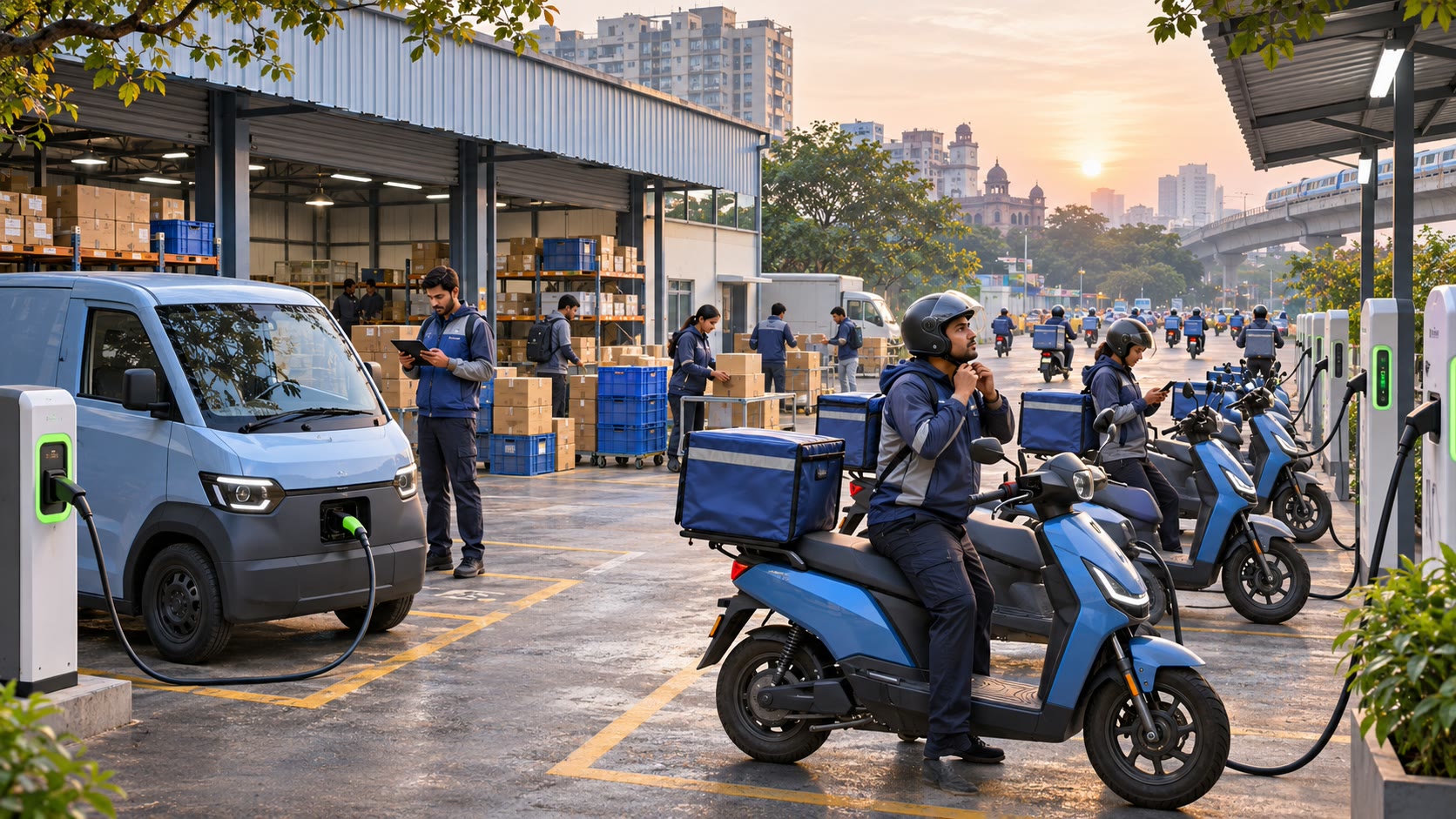
Eternal is reviewing its target to facilitate 100% electric delivery operations by 2030 after the Zomato and Blinkit parent’s monthly active rider base grew to 12 lakh. The company remains committed to electrification, but says a revised timeline must account for EV availability, charging access, policy rollout and the wider group’s commercial vehicles.
Key takeaways
- The 2030 electrification target is under review; a possible 2035 date has been discussed but is not confirmed.
- Eternal’s monthly active rider base across Zomato and Blinkit has grown from about 1.5 lakh when the original target was set to 12 lakh, according to reports based on a 15 Nov 2026 interview.
- The company says EV use among its delivery partners was about 12–13%, compared with an estimated 6–7% market penetration in its previous assessment.
- The revised plan may cover Hyperpure’s trucks and smaller commercial vehicles as well as two-wheelers used for food and quick-commerce deliveries.
What Eternal has said
Economic Times, Moneycontrol and Business Standard reported on 15 Nov 2026 that Eternal Chief Sustainability Officer Anjalli Ravi Kumar told PTI the company was reassessing the 2030 deadline. The reports describe a revised timeline as work in progress, not as an announced change or cancellation of the target.
The scale of the business has changed since the original commitment. Kumar said the network had about 1.5 lakh monthly active riders when the target was set and about 12 lakh across Zomato and Blinkit by 15 Nov 2026. She also said Eternal needs to onboard about 30 lakh people a year to maintain its rider base, making reliable access to vehicles across roughly 900 cities a practical constraint.
A possible 2035 deadline was mentioned in the interview, but it remains under consideration. The official Eternal sustainability page continues to describe a goal of facilitating 100% EV-based food deliveries by 2030. That distinction matters: there is no confirmed replacement date on the company’s public page, and the latest reporting should be read as a review of the plan rather than a formal policy update.
Why the target is harder at today’s scale
Electrifying a small share of a growing fleet is different from making the entire network electric. A higher EV percentage can still leave a large petrol-powered base if the number of riders and delivery routes is expanding quickly. For Eternal, the challenge is not limited to the number of electric scooters available for existing partners.
The group now wants its long-term target to reflect more than food-delivery two-wheelers. Hyperpure uses four-wheelers, including trucks and smaller commercial vehicles, so the replacement plan has to consider payload, route length, charging downtime and service support. A small electric cargo vehicle suited to short city runs cannot automatically replace a larger vehicle on a heavier or longer route.
Availability also varies by location. The company says it cannot guarantee that every new delivery partner joining across about 900 cities will be able to access a suitable and reliable EV. That puts charging coverage, battery-swapping options, vehicle rental supply and local repair networks alongside purchase price as part of the transition question.
What it means for delivery partners and fleet operators
No new government requirement for private vehicle owners or delivery partners follows from this announcement. It is a company-level review of an electrification goal. The reports say Eternal is encouraging adoption through financial incentives, rental access and its EV Bazaar rather than mandating one vehicle choice for every partner.
For a delivery partner, the relevant comparison is the full operating cycle: daily distance, energy cost, charging or swapping time, battery warranty, maintenance access and the ability to keep working if the primary vehicle is unavailable. Lower energy use can support an EV case, but the result depends on the route and how the vehicle is financed or rented. The EV station directory can help locate public charging options when planning coverage, while the fuel-cost calculator can estimate the petrol or diesel side of a route comparison.
Fleet operators should also separate a vehicle’s running cost from its total cost of ownership. A vehicle that is economical on a sub-200-km urban route may not fit a high-payload route with limited charging windows. Before changing procurement plans, operators can map route length, payload, charging availability, vehicle uptime, financing terms and resale or replacement assumptions. These are operating checks, not a guarantee of savings.
What to watch next
- Eternal’s formal revised date, once the company publishes one.
- Whether the target remains limited to food deliveries or expands to the group’s commercial vehicles.
- How quickly charging and battery-swapping networks reach smaller cities where delivery partners work.
- Whether lenders, rental providers and manufacturers offer workable access for partners who cannot purchase an EV upfront.
For now, the announcement does not change the fuel, registration or insurance obligations of Indian vehicle owners. It does show why large fleet targets are being measured against vehicle access and infrastructure, not only against a headline percentage. EV buyers and operators can use the road-trip planner to test route patterns and identify where charging time may affect a working day.
Sources
- The Economic Times — “Zomato, Blinkit parent Eternal may push back 100% EV delivery fleet target” — 15 Nov 2026
- Moneycontrol — “‘Doesn’t look feasible’: Zomato, Blinkit parent Eternal rethinks 2030 all-electric fleet target” — 15 Nov 2026
- Business Standard — “Zomato-parent Eternal reworks 2030 EV delivery target amid fleet expansion” — 15 Nov 2026
- Eternal — “Climate conscious deliveries” — accessed 16 Nov 2026