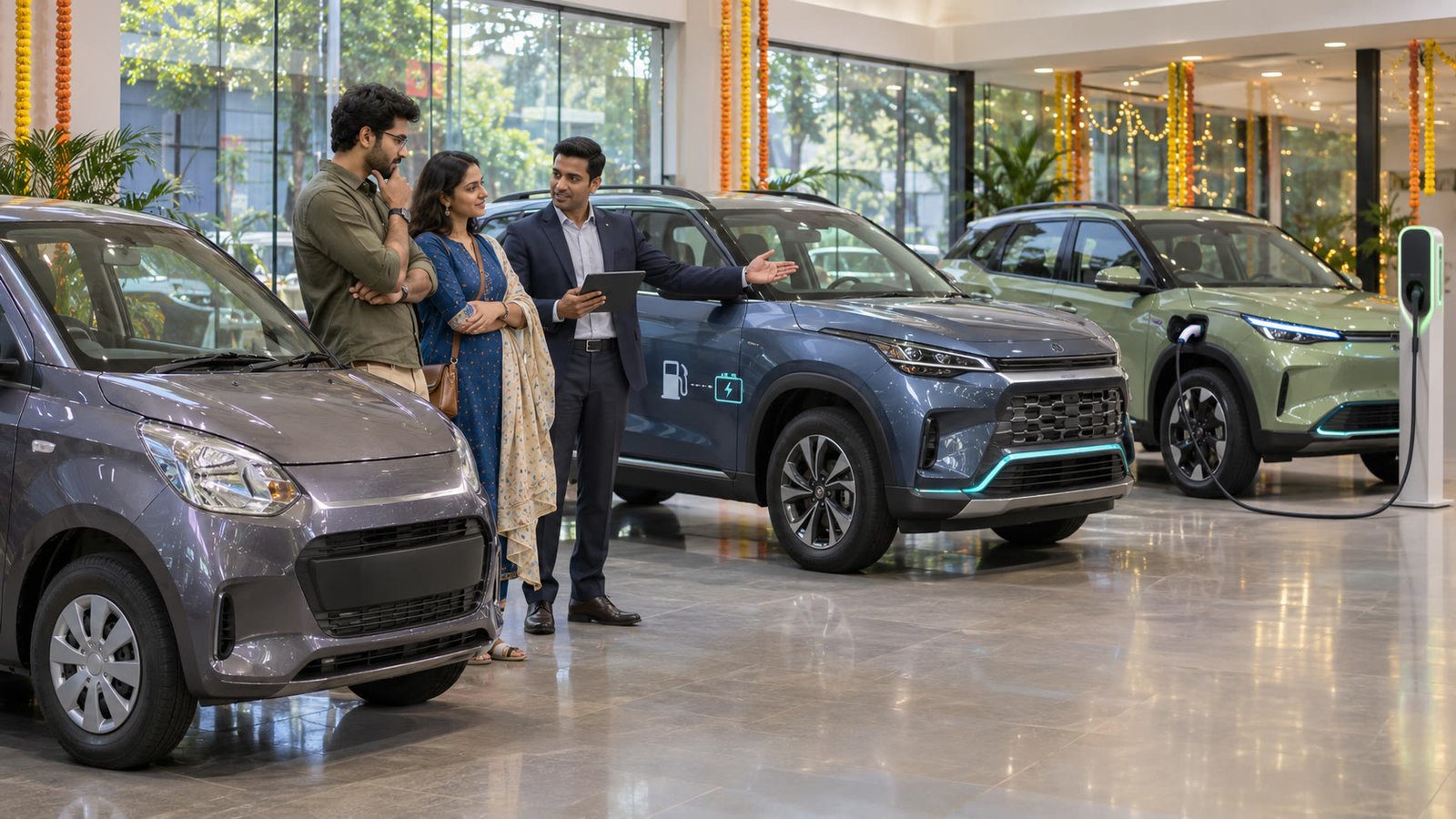
Grant Thornton Bharat's Festive Passenger Vehicle Pulse 2026 survey finds that 32.9% of prospective Indian car buyers are still comparing options, even though 24.9% describe themselves as likely or definite festive-season buyers. For readers, the finding matters because it shows that a lower sticker price alone may not settle the decision: safety, fuel efficiency and the ownership trade-off between hybrid, electric and petrol vehicles are increasingly part of the comparison.
Key takeaways
The survey, released for the 2026 festive buying period and reported by Business Standard on 5 Nov 2026, covered more than 1,300 consumers and over 500 dealers across India.
- 32.9% are still evaluating: A sizeable group remains in the consideration stage rather than having committed to a purchase.
- Hybrids lead powertrain preference: Hybrid vehicles were preferred by 37% of respondents, ahead of electric vehicles at 22.8%.
- Safety comes first: Safety was cited by 57% of respondents, followed by fuel efficiency at 51.6% and price at 47.2%.
- Fuel-transition awareness is uneven: 40.9% expressed concerns about E20-compatible vehicles, while 32.6% said they were aware of upcoming CAFE Phase III norms.
Why many festive buyers are still comparing
The 4 Nov 2026 Grant Thornton Bharat report says 24.9% of respondents were likely or definite buyers, while 32.9% were still exploring options and 42.2% were unlikely to purchase in the festive season. The sample was not a count of vehicle registrations; it was a survey of consumers and dealers. That distinction is important because the percentages describe purchase intent and preferences, not market share.
For manufacturers and dealers, the report points to a conversion challenge. Interest is present, but buyers are spending more time comparing ownership economics, safety, technology and powertrain confidence before they commit. The finding also helps explain why a showroom enquiry does not always turn into a booking during the festive window.
Powertrain choice is becoming an ownership-cost question
Hybrid vehicles were the preferred powertrain for 37% of respondents, compared with 22.8% for electric vehicles, 31.3% for petrol and 8.8% for diesel, according to the report and its 5 Nov 2026 coverage in Business Standard. The result does not establish that one technology is cheaper or better for every driver. It shows that buyers are weighing lower running costs and emissions against charging access, refuelling convenience, maintenance confidence and resale expectations.
For a petrol or hybrid comparison, the relevant question is the vehicle's expected monthly fuel bill at the driver's actual distance and city price, not only the advertised efficiency figure. FuelPrice's fuel cost calculator can help turn a claimed mileage figure into a trip or monthly running-cost estimate. For an EV, the comparison should also account for where charging is available on regular routes; the state-wise EV charging directory provides a practical starting point for that check.
Safety and efficiency outrank the headline price
Safety was the leading purchase consideration in the survey at 57%, followed by fuel efficiency at 51.6% and price at 47.2%. This ordering is useful for buyers because the purchase price is only one part of the ownership decision. Insurance, scheduled maintenance, tyres, energy or fuel, financing and likely resale value can change the total cost over the period the vehicle is kept.
A financing quote should therefore be read alongside the on-road price and running-cost estimate. FuelPrice's earlier guide on checks before signing a car loan explains the charges and disclosures that can sit beside the advertised interest rate. Actual loan offers vary by borrower profile, lender, tenure and product terms.
E20 and CAFE Phase III awareness gap
The report found that 40.9% of respondents were concerned about engine performance and maintenance implications for E20-compatible vehicles. Separately, only 32.6% said they were aware of the upcoming Corporate Average Fuel Efficiency, or CAFE, Phase III regulations. These are survey responses, not a finding that E20-compatible vehicles are unsuitable or that a new rule has already changed a buyer's obligations.
The practical implication is an information check: buyers comparing petrol, hybrid and EV models need the manufacturer's compatibility statement, warranty terms, service requirements and expected energy or fuel use for the exact variant. A general powertrain label is not enough to establish the cost or suitability of a particular vehicle.
What buyers can compare before booking
- On-road cost: compare the same price basis, including registration, insurance, accessories and any confirmed discount.
- Energy cost: use a realistic monthly distance and current local fuel or charging assumptions rather than a laboratory figure alone.
- Usable convenience: check charging or refuelling access on the routes that matter, and assess whether the vehicle's range or tank size fits those trips.
- Ownership support: read the warranty, service intervals, battery or hybrid-system coverage, insurance options and resale assumptions before comparing the final cost.
For buyers comparing several routes or usage patterns, FuelPrice's road-trip planner can also help place fuel, toll and travel time in the same trip context. The aim is not to rank one powertrain for every household, but to make the trade-offs visible before a booking decision.
What the industry will watch next
The survey suggests the festive market has demand but a more selective buyer. Automakers and dealers will be watching whether the undecided group converts into registrations, which body styles win those decisions and whether clearer explanations of powertrain costs reduce hesitation. The report's findings also point to a wider need for transparent information on E20 compatibility, charging readiness, safety equipment and long-term ownership.
Reader takeaway: The 2026 festive survey is a snapshot of what buyers are considering, not a sales ranking. Use it as a reminder to compare total ownership cost, safety and everyday convenience together, and to verify model-specific claims before treating a powertrain preference as a financial conclusion.