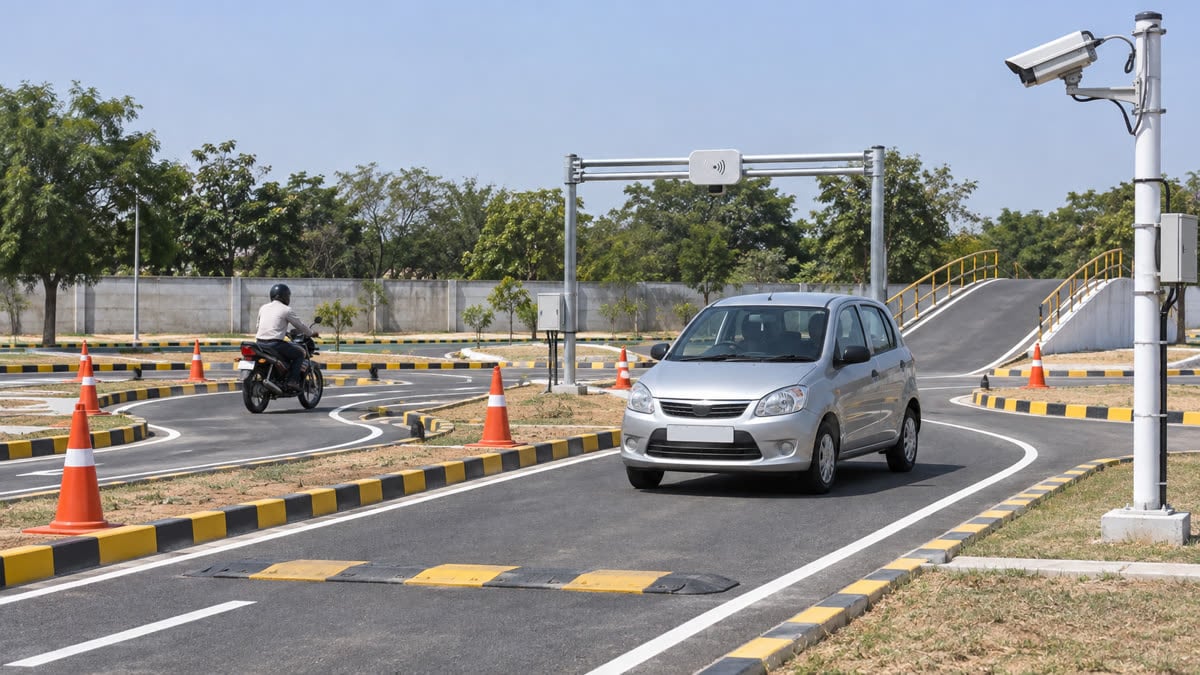
Telangana's Transport Department and Maruti Suzuki India signed a Memorandum of Agreement (MoA) on 5 Nov 2026 to set up 12 automated driving-licence test tracks across six locations. The project is designed to make licence tests more consistent and traceable, but the reports do not give a commissioning date, so applicants should continue following the existing RTO process until a location-specific notice is issued.
Key takeaways
The two reports reviewed agree on the following confirmed details:
- 12 automated driving test tracks are planned at Ibrahimpatnam, Kondapur, Uppal, Medchal, Nagole and Karimnagar.
- Two-wheeler and light motor vehicle (LMV) licence tests are planned at all six locations; heavy motor vehicle (HMV) testing is planned at Nagole and Karimnagar.
- High-definition cameras, RFID sensors, real-time analytics and integrated IT systems will support computerised, rule-based testing under the Central Motor Vehicle Rules (CMVR).
- The MoA does not announce a new licence category, fee revision or operational date; those details must come from Telangana Transport Department or RTO notices.
What Telangana and Maruti have agreed
The agreement announced on 5 Nov 2026 is a road-safety and licensing-infrastructure project under Maruti Suzuki's corporate social responsibility programme. The Economic Times, citing PTI and a company statement, and Telangana Today both reported that the facilities will be established at six locations: Ibrahimpatnam and Kondapur in Ranga Reddy district; Uppal, Medchal and Nagole in Medchal district; and Karimnagar.
The agreement is important for applicants because it identifies where the new testing capacity is intended to be built. It is not, however, an announcement that all 12 tracks are already open. The reports reviewed do not specify a construction or commissioning timetable, an appointment process, or any change to the fee charged for a driving-licence test.
Planned test coverage
| Location | District | Reported test coverage |
|---|---|---|
| Ibrahimpatnam | Ranga Reddy | Two-wheeler and LMV |
| Kondapur | Ranga Reddy | Two-wheeler and LMV |
| Uppal | Medchal | Two-wheeler and LMV |
| Medchal | Medchal | Two-wheeler and LMV |
| Nagole | Medchal | Two-wheeler, LMV and HMV |
| Karimnagar | Karimnagar | Two-wheeler, LMV and HMV |
The heavy-vehicle detail matters for applicants and fleet operators. An HMV applicant should not assume that every new location will accept that category simply because the project covers six locations.
How the automated tests are expected to work
The planned tracks will use high-definition cameras, RFID sensors, real-time analytics and an integrated IT system. The reported design is for a computerised, rule-based evaluation aligned with the CMVR. In practical terms, the technology is intended to capture driving performance against predefined test conditions and reduce the scope for inconsistent manual assessment.
That technology does not replace the legal requirements for a driving licence. It also does not create a new licence class or guarantee a pass. Applicants will still have to meet the existing eligibility and document requirements and follow the instructions issued by the RTO handling the application. The exact manoeuvres, scoring rules, data-retention period and process for raising a dispute have not been set out in the reports about this MoA.
Who is affected now
The immediate group affected is people applying for a two-wheeler or LMV licence at the listed Telangana locations once the tracks become operational. HMV applicants are affected only where the facility is authorised for that class. Applicants elsewhere in Telangana are not automatically covered by this agreement until their local transport office issues a separate update.
For existing drivers, the MoA does not change a current licence, renewal requirement or traffic rule. For other road users, a more consistent assessment of new drivers could support road safety over time, but a new testing facility is an infrastructure measure rather than a guarantee that accident levels will fall.
What applicants should check next
- Wait for the facility notice. Check the Telangana Transport Department, the relevant RTO and the official Parivahan process for the commissioning date, appointment instructions and accepted documents.
- Match the vehicle class to the location. The reported plan covers two-wheelers and LMVs at all six locations, while HMV testing is limited to Nagole and Karimnagar in the announced arrangement.
- Continue with the current process. No change to application documents, test fees or eligibility has been announced with the MoA. Do not treat the agreement itself as permission to skip an existing step.
- Prepare for standard driving skills. The detailed track layout has not been published in the reports reviewed. Applicants can practise smooth starts and stops, turns, reversing, signalling, observation and lane discipline, while relying on official instructions for the actual test.
Plan the trip to the test location
Applicants who need to travel to a designated facility can use the road-trip planner to compare route distance and travel time before a slot is confirmed.
For practice visits or the return journey, the fuel-cost calculator can help estimate the trip's fuel spend using the vehicle's actual mileage. The result is an estimate, not a promise of the final expense.
What to watch next
The next meaningful update will be a facility-wise commissioning notice. Applicants will need to know when each track opens, how slots are booked, which documents are required, whether a test vehicle is provided, and how results or technical disputes are handled. Until those details are published, the signed MoA should be read as a planned infrastructure rollout, not an immediate nationwide change to driving-licence rules.
For Telangana drivers, the practical takeaway is simple: keep using the existing application and test process, track official RTO updates, and confirm the vehicle class accepted at the selected location before travelling.