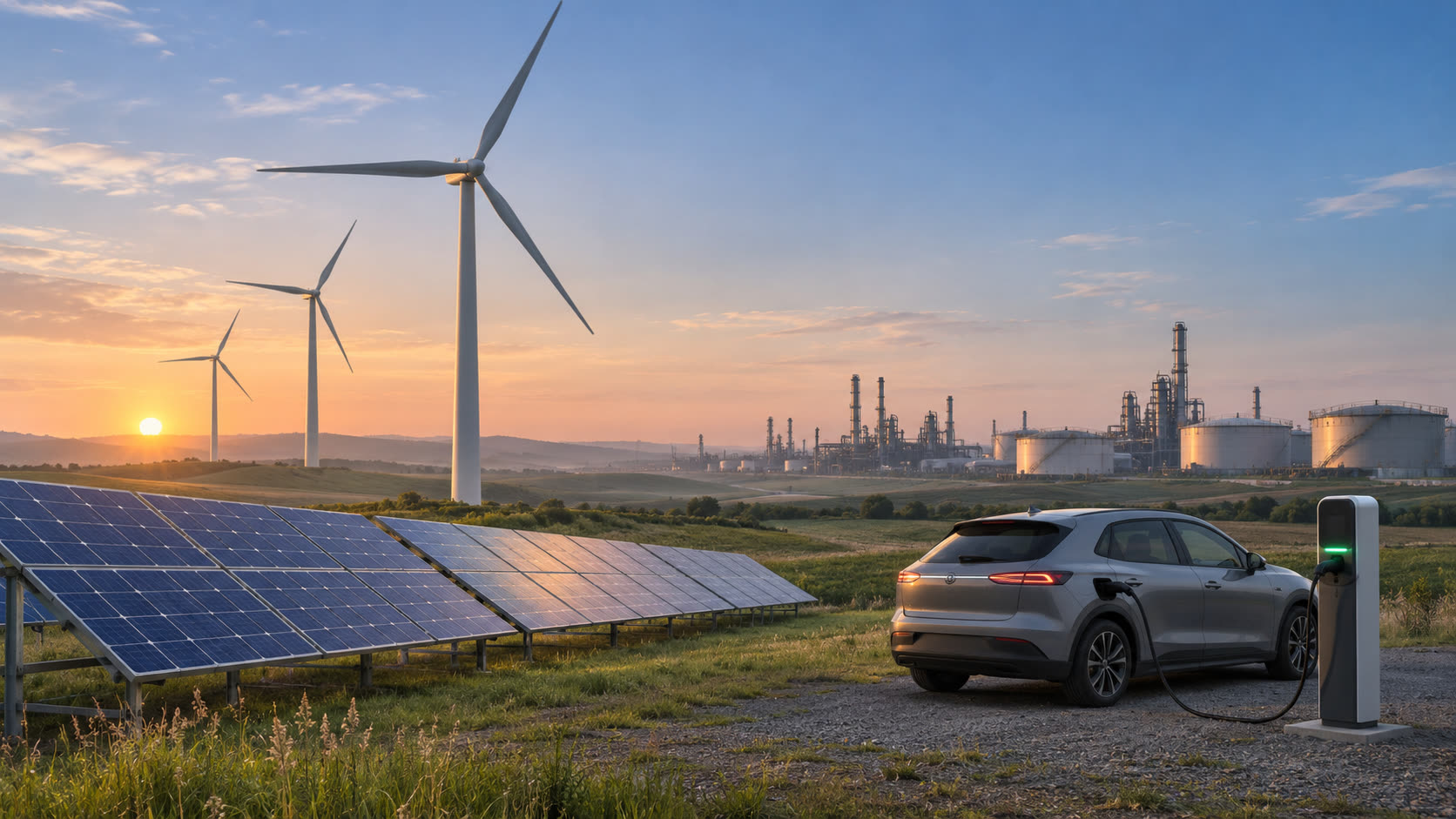
Global fossil-fuel CO2 emissions are projected to fall 0.4% in 2026, to 38.2 billion tonnes, according to the Global Carbon Project's annual budget released on 10 November 2026. For drivers and transport operators, the signal is mixed: solar, wind and electric vehicles are beginning to offset new energy demand, but the sharpest near-term reduction is tied to an oil shock that could reverse if supplies and prices normalise.
Key takeaways
- Fossil-fuel CO2 emissions are projected at 38.2 billion tonnes in 2026, down 0.4% from the previous year.
- Oil-related emissions are projected to fall 1.9%, while natural-gas emissions fall 0.3% and coal emissions rise 0.6%.
- The Global Carbon Project says solar, wind and electric vehicles are meeting two-thirds of the increase in global energy demand.
- The decline is not yet proof that global emissions have reached a durable peak; the report links part of the change to the Iran-related energy shock.
What the 2026 carbon budget says
The 2026 Global Carbon Budget is the latest annual estimate from an international research team of more than 140 scientists. The Global Carbon Project released the findings on 10 November 2026, as the COP31 climate conference took place in Antalya, Türkiye. The report is published as a preprint in Earth System Science Data and is due to undergo peer review.
The headline result is a small projected fall in emissions from fossil fuels: 38.2 billion tonnes of CO2 in 2026, down 0.4% from the previous year. Le Monde described the result as the first slight fossil-fuel emissions decline since the pandemic-era fall in 2020, while the Associated Press noted that the change would still be small against the scale of global energy use.
That distinction matters. The report also projects total CO2 emissions, including land-use change such as deforestation, at 43.3 billion tonnes in 2026. In other words, a modest decline in the emissions tied to coal, oil and gas does not mean the overall amount of CO2 entering the atmosphere is falling.
Why oil use is falling fastest
Oil is the largest part of the projected fossil-fuel decline. The Global Carbon Project puts the fall in oil-related emissions at 1.9%. The Associated Press reported a similar result as a decline of nearly 2%, and linked the timing and composition of the change to the energy shock created by the Iran conflict and disruption around the Strait of Hormuz.
The same report projects natural-gas emissions to fall 0.3% while coal emissions rise 0.6%. That mix is important for transport: an oil shock can reduce driving, flying, freight activity and other oil use quickly, but it does not automatically represent a permanent switch to cleaner systems. Higher fuel costs can also push households and businesses to change behaviour before the underlying vehicle fleet or industrial equipment changes.
This is why the result should not be read as a global fuel-price bulletin. Retail petrol and diesel prices depend on local taxes, refining margins, currency movements, distribution costs and the timing of wholesale changes. Readers tracking current rates can use the live fuel prices hub, but the carbon report itself does not forecast what a driver will pay at a particular station.
Clean energy is offsetting new demand
The more durable part of the report is its estimate that solar, wind power and electric vehicles are meeting two-thirds of the increase in global energy demand. That does not mean fossil fuels have disappeared from the system. It means clean technologies are supplying a growing share of new electricity and transport demand, limiting the amount of additional coal, oil and gas needed.
Transport remains a slower-moving part of the transition because cars, vans and trucks stay on the road for years. An EV can reduce direct oil use, but its wider emissions effect depends on the electricity used for charging and on how quickly new vehicles replace older ones. For readers planning charging stops or comparing electric travel with a fuel trip, the EV charging directory is a practical follow-up to the global trend.
The report's message is therefore two-sided. Clean-energy growth is already large enough to offset much of rising demand, yet the researchers say it is not expanding fast enough to lock in a lasting peak in fossil CO2 emissions. A single annual decline can be caused by an economic or geopolitical shock; a durable peak requires repeated reductions while economies and mobility services continue to function.
What it means for drivers, fleets and vehicle buyers
For a household, the immediate implication is uncertainty rather than a guaranteed saving. If oil supply constraints ease and prices fall, some of the oil-related emissions reduction could unwind as travel and freight activity recover. If clean power, charging networks and EV sales keep expanding, the structural effect could be more persistent, but it will arrive through vehicle replacement, infrastructure investment and electricity-system changes rather than one annual carbon number.
Fleet operators face the same split. Fuel use can respond quickly to route planning, load factors and operating conditions, while replacement decisions take longer and depend on vehicle cost, range, charging access and duty cycle. A trip-level estimate is more useful for a specific journey than a global emissions average, so operators can compare scenarios with the fuel-cost calculator.
What to watch next
The next test is whether the projected decline survives a return to more normal oil and gas flows. The Global Carbon Project says the remaining carbon budget for limiting warming to 1.5°C is now 150 billion tonnes, equivalent to less than four years of emissions at the current rate. Le Monde reported the same estimate while warning that a rebound could follow if the Strait of Hormuz crisis eases and hydrocarbons become cheaper.
For the global fuel and auto market, the useful signals are the combination of repeated clean-power growth, faster electrification of transport and sustained declines in fossil-fuel demand. The 2026 result is encouraging, but it is best understood as a warning: the world may be close to a turning point, yet this year's drop is not enough to confirm that the turn has happened.
This article is for general information only and is not financial, insurance or legal advice.
Sources
- Global Carbon Budget, “Fossil CO2 emissions decrease in 2026,” 10 November 2026
- The Associated Press, “Heat-trapping carbon pollution drops, but scientists cite the Iran war rather than energy progress,” 10 November 2026
- Le Monde, “Fossil fuel-related CO2 emissions show slight global drop, an encouraging but insufficient sign,” 10 November 2026