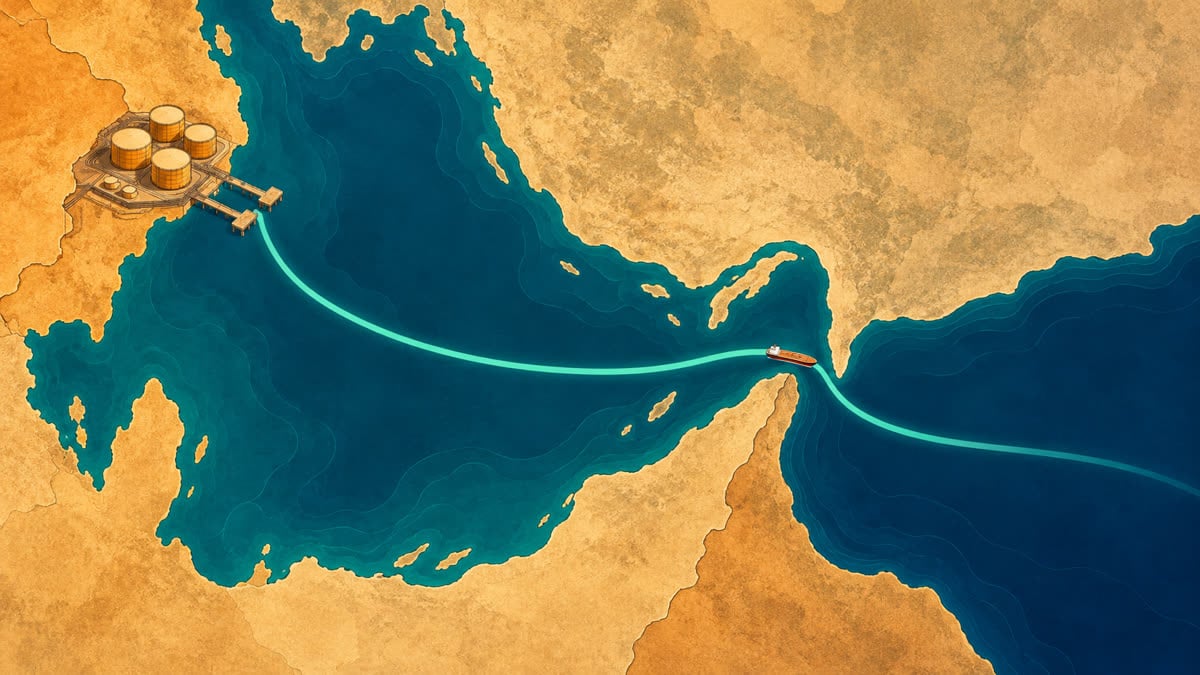
Iraq’s Foreign Minister Fuad Hussein says Baghdad has reached understandings with Washington and Tehran that have allowed Iraqi oil exports to resume through the Strait of Hormuz using a shipping lane near Oman. The statement is not a general reopening of the chokepoint, but it is a fresh signal for global crude flows, tanker risk and fuel-price expectations.
Key takeaways
- Hussein says Iraqi exports have resumed after understandings with the United States and Iran.
- Reuters reported that the arrangement uses a shipping lane near Oman; the reports do not describe unrestricted access for all vessels.
- Hussein estimated Iraq’s losses from the disruption at about US$60 billion, a ministerial estimate rather than an independently audited figure.
- The International Energy Agency says nearly 20 million barrels per day of oil crossed Hormuz in 2025, making even a limited change in access relevant to global markets.
- Repeatable tanker movements, maritime guidance and insurance costs will show whether the arrangement becomes a durable supply channel.
What Iraq says has changed
In an interview reported by Al Jazeera on 7 November 2026, Hussein said Iraq had resumed oil exports through Hormuz after reaching understandings with Washington and Tehran. He also said the interruption had cost Iraq about US$60 billion. Reuters reported the following day that the United States had reached understandings with Iraq to permit exports through a shipping lane near Oman.
Dawn separately reported that Iraqi oil exports had resumed after understandings with both Washington and Tehran. The agreement is therefore best described as reported and limited: the sources attribute the information to Hussein’s interview, but do not provide a published text setting out the route’s operating rules, duration, cargo limits or security guarantees.
That distinction matters. A lane that allows Iraqi cargoes to move is not the same as a return to normal commercial navigation across the strait. It also does not establish that other exporters, buyers or tanker operators can use the same arrangement on identical terms.
Why the Hormuz route matters to global oil markets
Hormuz is a major supply chokepoint because producers on the Persian Gulf side have few practical alternatives for moving crude and refined products to overseas buyers. The IEA’s February 2026 factsheet estimates that nearly 20 million barrels per day of oil passed through the strait in 2025. For comparison, the US Energy Information Administration estimated 20.9 million barrels per day in 2023, or about one-fifth of global petroleum-liquids consumption. The different reference years point to the same market reality: the route carries a very large share of internationally traded energy.
The IEA identifies Iraq among the producers that rely on Hormuz for the vast majority of oil exports, while noting that Saudi Arabia and the United Arab Emirates have some pipeline routes that bypass the strait. That makes a controlled route near Oman especially important for Baghdad. It can restore an export option without claiming that the broader maritime security problem has disappeared.
The global effect is larger than Iraq’s own cargoes. If ships can move more reliably, traders may reduce part of the risk premium built into crude, diesel and tanker freight. If attacks, delays or insurance restrictions continue, the same market can reverse quickly. The arrangement is therefore a signal to monitor, not a guaranteed supply reset.
What it means for drivers, freight and fuel costs
For drivers, the first impact may appear in market expectations rather than at the pump. Crude is an important input, but retail petrol and diesel prices also reflect refining margins, freight, marine insurance, taxes, currency movements and local pricing policy. A safer route can reduce one part of the cost stack without producing an immediate fall in the price paid by consumers.
Readers comparing what a fuel-market shock means for a real journey can use the fuel cost calculator. For local retail rates, the live fuel prices hub is the more direct check; it is separate from the wholesale crude market and can move on a different timetable.
Transport operators have a wider exposure. Diesel availability, bunker fuel, freight rates and delivery schedules are linked to the reliability of shipping lanes and refineries, so a partial reopening can help logistics before it is visible in household fuel prices. Airlines and manufacturers can also remain exposed to jet-fuel and petroleum-product costs even if crude headlines turn calmer.
What changes now—and what does not
What changes is that Iraq says it has a route for oil exports through a period when Hormuz access has been disrupted. That could improve Baghdad’s ability to sell crude and give buyers another indication that some Gulf flows remain possible.
What does not change is the lack of evidence that the entire strait has reopened for normal traffic. The reports reviewed here do not say that all ships have been cleared, that the route is permanent, or that insurance and security conditions have returned to pre-crisis levels. It would be premature to translate the announcement directly into lower global fuel prices.
What to watch next
The next useful evidence will be operational rather than rhetorical. Market participants and fuel users will be looking for repeatable sailings, confirmed cargo loadings and guidance from the relevant maritime authorities. They will also watch whether tanker owners and insurers treat the Oman-side lane as a usable commercial corridor or as a tightly controlled exception.
- Whether Iraqi shipments continue beyond an initial sailing window.
- Whether the United States, Iran or Iraq publish additional terms for the route.
- How tanker insurance, freight rates and diesel benchmarks respond as cargoes move.
- Whether other Gulf exporters seek comparable access or continue using separate workarounds.
Reader takeaway
Iraq’s announcement is a potentially meaningful development for global oil flows, but the confirmed fact is narrower than a headline about Hormuz reopening. Until actual vessel movements and operating rules become clearer, the practical reading for motorists and transporters is to follow local pump prices and trip costs rather than assume that a diplomatic understanding will immediately change what they pay.
Further developments can be followed in FuelPrice’s worldwide fuel news coverage.
This article is for general information only and is not financial, insurance or legal advice.
Sources
- Al Jazeera, “Iraq’s FM says external parties using Iraqi soil to attack neighbours” — 7 Nov 2026
- Reuters, “Iraq has reached understandings with US to allow oil exports through Hormuz, minister says” — 8 Nov 2026
- Dawn, “Current circumstances suggest potential for renewed war in Middle East: Iraqi FM” — 7 Nov 2026
- International Energy Agency, “Strait of Hormuz 2026 Factsheet” — Feb 2026
- US Energy Information Administration, “World Oil Transit Chokepoints” — Jun 2024