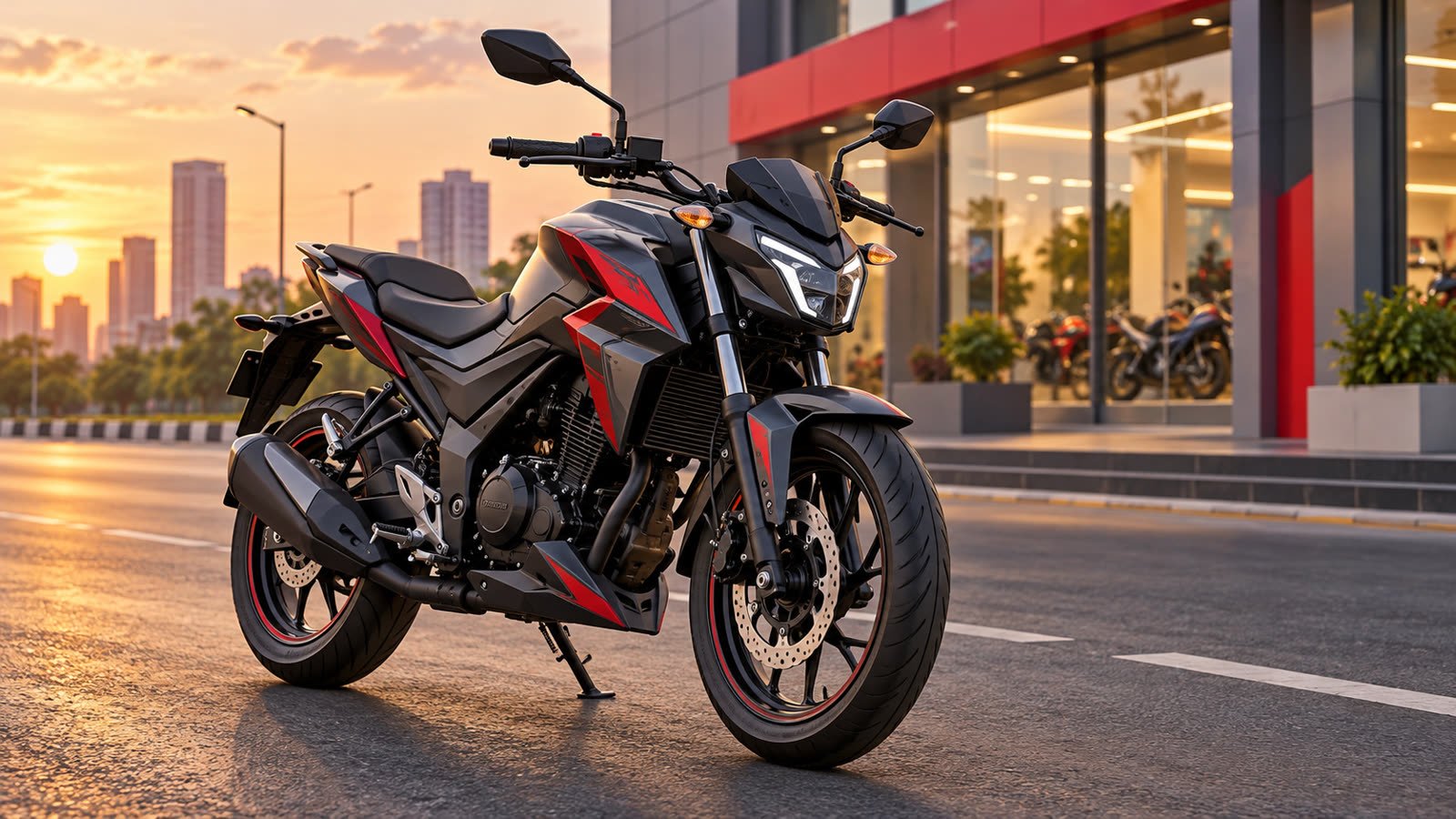
Key takeaways
- The Standard, Pro and Carbon variants are priced at ₹1,27,000, ₹1,37,000 and ₹1,41,000 respectively, all ex-showroom Delhi.
- Autocar Professional reports bookings opening on 17 Oct 2026 and customer deliveries beginning on 1 Nov 2026; NDTV gives a variant-level timeline in which Pro and Carbon start then while Standard is expected from January 2027.
- Hero's BSE-filed release describes a 163cc oil-cooled four-valve engine producing 17.1 PS and 14.6 Nm.
- The Pro and Carbon add ride-by-wire, Rain/Road/Sport modes, cruise control and a 37mm KYB upside-down front fork; Carbon adds a 4.2-inch TFT console.
- The prices are introductory ex-showroom figures, so registration, insurance, accessories and other on-road costs are extra.
Price and variant structure
All three prices are introductory ex-showroom Delhi figures reported by Autocar India and HT Auto. The move from Standard to Pro is ₹10,000, while Pro to Carbon adds ₹4,000, before registration, insurance, accessories and other on-road charges.
| Variant | Price | Main equipment reported |
|---|---|---|
| Standard | ₹1,27,000 | LCD console, conventional telescopic fork and single-channel ABS |
| Pro | ₹1,37,000 | Ride-by-wire, three riding modes, cruise control, 37mm KYB USD fork and dual-channel ABS |
| Carbon | ₹1,41,000 | Pro equipment plus a 4.2-inch TFT console and connected functions |
The table is a buyer's first comparison, not an on-road quote. State registration charges, insurance premiums and optional equipment can change the final amount materially, so the dealer's written breakup should be checked against the applicable city and state.
Bookings, deliveries and the important timing difference
Autocar Professional, reporting on the company launch, says bookings open on 17 Oct 2026 and customer deliveries begin on 1 Nov 2026. NDTV's variant-specific report says Pro and Carbon deliveries start on 1 Nov, while the Standard is expected from January 2027. Because the reports give different levels of detail, buyers should confirm the exact variant's delivery date in the booking confirmation rather than assume that every version arrives together.
Engine and feature changes
Hero's BSE-filed press release describes the updated motorcycle with a 163cc, four-valve, oil-cooled engine. It lists 17.1 PS at 8,750 rpm, 14.6 Nm at 6,500 rpm and a claimed 0–60 km/h time of 4.4 seconds. The displacement is not presented identically across the coverage: NDTV reports 164.32cc, while the company release uses 163cc. Both sources report the same headline power and torque figures; the registration document and final brochure should be treated as the reference for a buyer's specific motorcycle.
The useful distinction is between the variants. The Pro brings electronic throttle control, Rain, Road and Sport modes, cruise control, a 37mm KYB USD front fork and dual-channel ABS. The Carbon carries that equipment and adds a 4.2-inch TFT display with Bluetooth-connected call, message, music and navigation functions. The company release also lists a Type-C charger and Panic Brake Alert among the updated equipment.
What the launch means for buyers
The ₹14,000 spread from Standard to Carbon is relatively small compared with the total purchase price, but the equipment is not identical. A buyer focused on basic commuting may compare the Standard's lower entry price with the Pro's added braking and electronic equipment. A rider who regularly uses open roads may value cruise control and the TFT display, but those features do not replace active attention or safe riding.
The price headline should also not be confused with ownership cost. The fuel bill depends on local petrol prices, traffic, riding style and the mileage achieved by the delivered motorcycle. To estimate a likely trip or monthly fuel spend, use the fuel cost calculator with a realistic mileage assumption rather than the introductory purchase price.
For the fuel input, check live petrol prices for the relevant city. If the motorcycle will be used for inter-city travel, the road-trip planner can help estimate distance and fuel before comparing the variants. These calculations still exclude insurance, maintenance, financing and registration costs.
What to check before booking
- Confirm whether the quoted price is the introductory ex-showroom Delhi price or a city-specific revised quote.
- Ask for the complete on-road breakup, including registration, insurance, accessories and any handling or documentation charges.
- Get the variant, colour, expected delivery date and booking conditions in writing, especially because the reported timelines differ by variant.
- Check which display, ABS system, fork and riding-mode equipment is included in the selected version rather than assuming every feature is standard.
- Review the warranty, service schedule and connected-feature requirements before treating the higher variant's equipment as part of the ownership value.
What to watch next
The next useful update will be city-wise availability and on-road pricing after bookings open. Buyers should also watch Hero MotoCorp's final brochure and dealer paperwork for the confirmed displacement, equipment split and Standard-variant delivery schedule. Until those details are settled for a particular city, the ₹1.27 lakh–₹1.41 lakh figures are best read as launch prices, not final purchase cheques.
Sources
- BSE filing / Hero MotoCorp — “Premiumisation journey: all-new Xtreme 160R 4V and refreshed Xtreme 250R” — 16 Oct 2026
- Autocar Professional — “Hero MotoCorp launches updated Xtreme 160R 4V and Xtreme 250R” — 16 Oct 2026
- Autocar India — “Updated Hero Xtreme 160R 4V launched from Rs 1.27 lakh” — 16 Oct 2026
- NDTV Auto — “2026 Hero Xtreme 160R 4V Launched In India; Rs 1.27 Lakh, Gets New Design, Features” — 16 Oct 2026
- HT Auto — “Hero Xtreme 160R launched in India with ride-by-wire, cruise control; prices start at ₹1.27 lakh” — 16 Oct 2026