Varroc Engineering and France-based Forsee Power announced on 16 Oct 2026 that they plan to form an India joint venture for electric-vehicle battery packs. The proposed venture will begin with electric three-wheelers and later target two-wheelers, light commercial vehicles, buses, trucks and other industrial applications. For Indian EV users, this is a battery-supply-chain development—not a new vehicle launch, a confirmed price cut or an immediate change to an existing scooter or three-wheeler.
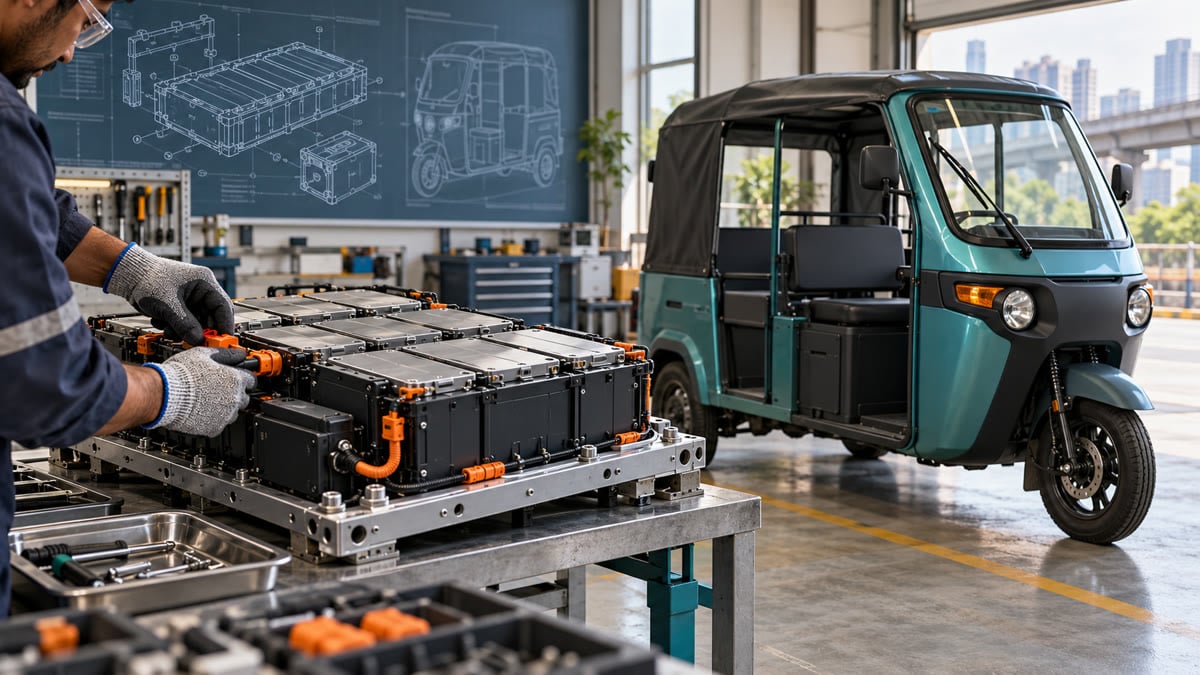
Illustration: a battery-pack engineering workshop and electric three-wheeler; representative visual, not a photograph of the Varroc–Forsee transaction.
Key takeaways
- Varroc plans to acquire a 45% equity stake in Forsee Power India and take management and operational control, according to the companies’ announcement.
- The proposed joint venture will initially focus on battery packs for electric three-wheelers.
- The stated roadmap includes two-wheelers, light commercial vehicles, buses, trucks, off-highway vehicles and industrial vehicles.
- The arrangement remains subject to applicable regulatory and corporate approvals, so the announcement does not mean the transaction is complete.
- No vehicle price, battery capacity, range, consumer booking date or immediate subsidy has been announced for this partnership.
What Varroc and Forsee Power announced
In its 16 Oct 2026 release, Forsee Power said Varroc would acquire a 45% equity stake in Forsee Power India, its Indian subsidiary focused on battery-pack systems, and would exercise management and operational control over the entity. The companies described the arrangement as a proposed joint venture to combine Forsee Power’s battery-system expertise with Varroc’s automotive engineering, manufacturing and customer relationships.
ETAauto separately reported the same transaction and its initial three-wheeler focus on 16 Oct. That independent report also said the partnership is intended to expand into other vehicle segments over time. The wording matters because the announcement confirms a corporate plan and the intended scope of the business; it does not confirm that a battery pack is already available for a particular vehicle sold in India.
The release says the proposed joint venture is subject to applicable regulatory and corporate approvals. Until those steps are completed, the 45% stake and operational-control plan should be treated as an announced transaction in progress rather than a completed ownership change.
Why three-wheelers come first
The first application named by the companies is electric three-wheelers. Forsee Power and Varroc said the business would develop battery-pack solutions that can be adapted to different vehicle architectures and operating conditions. The commercial-vehicle starting point is relevant to India’s last-mile passenger and goods mobility, where vehicle uptime, usable battery capacity, service access and replacement cost matter alongside the sticker price.
That does not mean every electric three-wheeler on Indian roads will use a Forsee Power or Varroc battery. It also does not establish a new range or charging standard. The practical reading is narrower: if the venture is completed and develops customer programmes, it could add another India-based supplier option for vehicle makers and fleet integrators. Any effect on prices, service coverage or running costs would depend on future contracts, production scale and the specifications of individual packs.
What this means for EV owners, buyers and fleets
Current three-wheeler and scooter owners
Nothing changes for current owners because of this announcement alone. There is no instruction to replace a battery, change a charger or alter a vehicle’s maintenance schedule. The companies have not announced a retrofit programme, a replacement-pack catalogue or a service network for retail owners.
Prospective buyers and fleet operators
The roadmap may eventually be relevant to electric two-wheelers and light commercial vehicles, but it is not a product launch. A buyer cannot yet use the announcement to compare a particular model’s range, warranty or cost per kilometre. The release does not provide a vehicle name, battery capacity, chemistry, charging time, pack price or customer-delivery date.
For a running-cost comparison, the fuel cost calculator can be used alongside verified electricity tariffs and vehicle-efficiency data; the joint-venture announcement does not supply those inputs. Public charging access can be checked through the EV charging directory, but a future commercial battery pack may have different charging and service requirements. If an incentive is part of the ownership calculation, the EV subsidy eligibility and status guide is a useful starting point for checking the current rule position rather than assuming this corporate announcement creates a new benefit.
Confirmed now, still pending
| Confirmed in the 16 Oct announcement | Not confirmed yet |
|---|---|
| Varroc’s planned 45% stake and management and operational control | Completion of the transaction and any remaining approvals |
| Battery packs for electric three-wheelers as the initial focus | Named vehicle-maker customers, pack specifications and production timing |
| A roadmap covering two-wheelers and commercial and industrial vehicles | Vehicle prices, range, warranty, charging support and retail availability |
What to watch next
The next meaningful updates are likely to be completion of the transaction, details of the operating structure and the first customer or vehicle applications. For EV users, the useful information will be more specific than the ownership announcement: where packs will be made and serviced, how safety and battery-management systems are validated, what warranty and replacement terms apply, and whether packs are designed for the duty cycles of passenger, cargo or industrial vehicles.
It will also be important to separate a battery supplier’s capability from a vehicle maker’s final product. A new local pack programme can support more supply choices, but range, charging time, durability and running cost are determined by the complete vehicle system and the way it is used.
Reader takeaway
For now, the Varroc–Forsee announcement is best understood as an industrial EV-battery partnership aimed first at three-wheelers. It may strengthen India’s pool of battery-pack engineering and manufacturing capability if completed, but the sources do not promise lower vehicle prices, longer range or an immediate benefit for existing owners. Those questions can be answered only when the venture discloses specific vehicle programmes, pack specifications and customer-facing support.
Sources
- Forsee Power, “Varroc and Forsee Power to form joint venture to scale EV battery solutions in India” (16 Oct 2026)
- ETAuto, “Varroc to acquire 45% stake in Forsee Power India for EV battery joint venture” (16 Oct 2026)
- Autocar Professional, “Varroc To Take Control Of Forsee Power India In EV Battery JV” (16 Oct 2026)