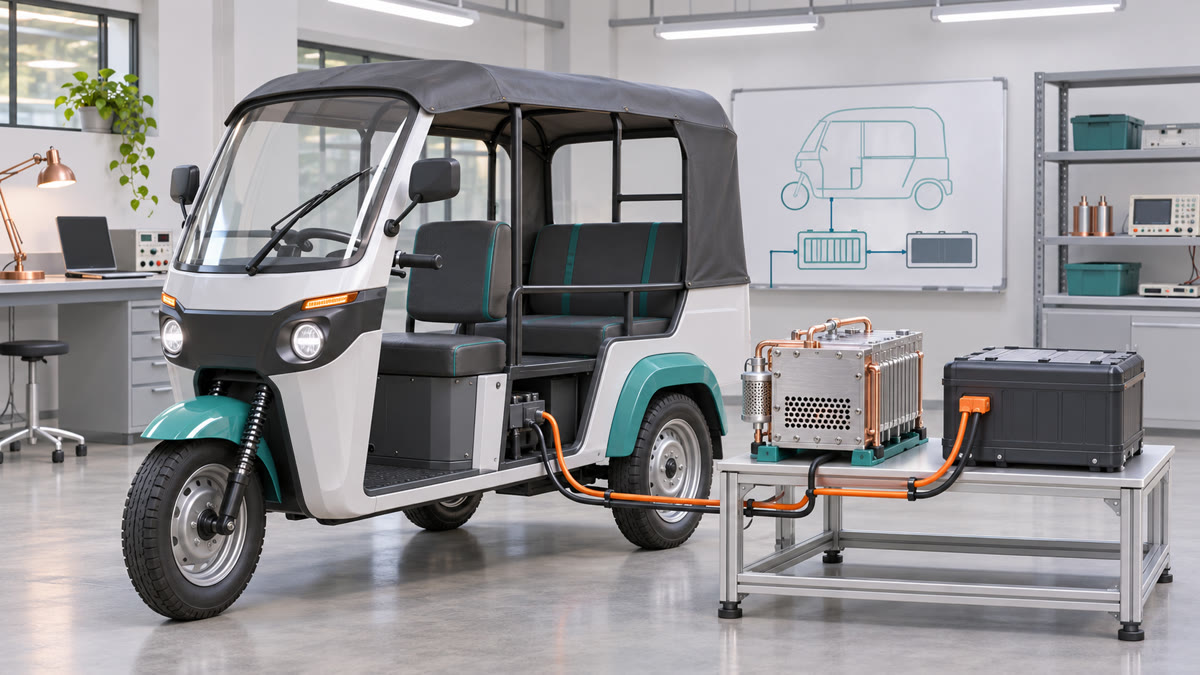
Hindustan Zinc and the Indian Institute of Technology Madras have unveiled an electric three-wheeler research prototype that combines a conventional lithium-ion battery with an approximately 1 kWh zinc-air battery used as a range extender. The 26 Nov 2026 announcement is a vehicle-level demonstration, not a commercial launch, price reveal or promise of a new electric auto going on sale.
Key takeaways
- The zinc-air unit contributes nearly 10% of the prototype's total energy requirement, according to the official release and independent reports.
- The lithium-ion battery handles acceleration and peak-power demand, while the zinc-air unit supplies a steadier flow of energy during operation.
- The Hindustan Zinc-IIT Madras collaboration began in 2024 and has now moved from laboratory research to a vehicle-level demonstration.
- No production timeline, driving-range claim, price or consumer charging change has been announced.
What Hindustan Zinc and IIT Madras unveiled
The official IIT Madras release dated 26 Nov 2026 describes an electric three-wheeler fitted with an approximately 1 kWh zinc-air battery. A PTI report carried by ThePrint and a Business Standard report published the same day confirm the same broad specifications: the vehicle uses a dual-battery configuration, with the zinc-air unit contributing nearly 10% of the vehicle's total energy requirements.
That split is important. The existing lithium-ion battery remains responsible for acceleration and other high-demand operations. The zinc-air battery is intended to provide a steady supply of energy while the vehicle is running. In other words, the prototype demonstrates a supplementary battery architecture; it does not replace the lithium-ion pack with a zinc-air unit.
| System | Role in the prototype | What it means today |
|---|---|---|
| Lithium-ion battery | Acceleration and peak-power demand | Remains the main high-output battery described in the reports. |
| Zinc-air battery | Steady energy supply and range-extender support | Supplements the existing pack in a research demonstration. |
Why zinc-air battery research matters
Zinc-air batteries generate electricity by using zinc and oxygen from the surrounding air. The official release says the prototype uses a non-flammable, water-based electrolyte and points to zinc's availability and recyclability as potential advantages for future energy-storage applications. Those are potential technology benefits, not a verified claim that this prototype is cheaper, safer in every use case or ready for mass production.
For India, the research also connects vehicle technology with local materials. Hindustan Zinc and IIT Madras said the work is intended to advance indigenous zinc-based energy-storage capability. Business Standard reported that alternative battery chemistries could help diversify supply chains, while lithium-ion batteries are expected to remain central to electric mobility for the foreseeable future.
The practical value of that diversification is long term. A successful alternative chemistry could give manufacturers another option when they balance cost, safety, weight, energy capacity, raw-material availability and recycling. The current announcement does not quantify any of those outcomes for a production vehicle.
What the prototype means for electric-auto users
For an electric three-wheeler owner or buyer, there is no immediate product change to act on. The companies have not announced a retail model, a price, a certified range, a battery warranty, a launch date or a change to public charging access. The prototype should therefore be read as research progress rather than a new buying option.
For fleet operators, the questions to watch are more specific: how much additional usable range the zinc-air unit delivers in real duty cycles, how its performance changes with temperature and load, how long the battery lasts, how it is charged or replenished, and what maintenance the dual-battery system requires. None of those operating details was provided in the 26 Nov announcement.
An e-three-wheeler operator planning a route can still use the road-trip planner to examine stops and distance. For current charging locations, the EV station directory remains the relevant starting point; the new prototype does not yet create a new public charging network or a different connector standard.
Why the three-wheeler demonstration is relevant
The choice of a three-wheeler puts the technology in a vehicle format where battery weight, usable energy and uptime are closely connected to daily operating economics. That does not prove the system is commercially suitable, but it gives the research a practical test bed beyond a laboratory cell.
The official release says the collaboration, initiated in 2024, has progressed from laboratory-scale research to vehicle-level demonstration. The next stage will determine whether the chemistry can move from a working prototype to repeatable, durable and economically viable use. A demonstration alone cannot establish a production range or a saving for drivers.
What happens next
The announcement leaves several milestones open. The research partners would need to publish more information on cycle life, energy delivered over a complete route, safety testing, charging or mechanical-recharge arrangements, packaging, service requirements and the cost of scaling the battery. They would also need to show how the zinc-air unit behaves alongside the lithium-ion battery during acceleration, gradients and stop-start commercial use.
Until those details are available, readers should avoid treating the approximately 1 kWh figure or the nearly 10% energy contribution as a certified range increase. The figures describe this prototype's battery configuration and energy contribution as reported on 26 Nov 2026; they do not state how many extra kilometres a production three-wheeler would travel.
Readers comparing an electric commercial route with a petrol or diesel alternative can use the fuel-cost calculator for the fuel portion of the comparison, but charging time, electricity access, vehicle load and battery availability also need to be included in the operating picture.
Reader takeaway
The Hindustan Zinc-IIT Madras prototype is a credible research milestone because it demonstrates a zinc-air battery working alongside lithium-ion storage in an electric three-wheeler. Its immediate significance is for battery research and future commercial-vehicle development, not for today's showroom prices or certified range claims. The next useful update will be evidence on durability, real-world energy delivery and scale-up economics. Until then, the announcement shows one possible route to diversify EV battery technology without presenting an untested prototype as a finished product.
Sources
- IIT Madras — “Hindustan Zinc, IIT Madras advance zinc-air battery technology for Next-Generation electric mobility” — 26 Nov 2026
- Hindustan Zinc exchange filing — “Hindustan Zinc, IIT Madras advance zinc-air battery technology for Next-Generation electric mobility” — 26 Nov 2026
- ThePrint/PTI — “Hindustan Zinc, IIT-M develop zinc-air battery for electric 3-wheelers” — 26 Nov 2026
- Business Standard — “HZL, IIT Madras develop zinc-air battery tech for electric mobility” — 26 Nov 2026