Honda has confirmed that it plans to introduce India-focused models in the under-four-metre and mid-size categories from 2028. Separately, Autocar Professional reported on 26 Sep 2026 that Honda Cars India is in talks to source a 1.2-litre engine family from Horse Powertrain for a future compact SUV, with petrol, hybrid and CNG applications under consideration.
The engine arrangement, model name, price and specifications are not confirmed by Honda. For Indian buyers, this is a product-development update rather than a launch, booking or mileage announcement.
Key takeaways
- Honda’s official 2026 business briefing confirms India-focused models in the under-four-metre and mid-size categories from 2028.
- Autocar Professional and TV9 Hindi report that a 1.2-litre engine from Horse Powertrain is being considered for the compact SUV programme.
- Petrol, petrol-electric hybrid and CNG applications are reported possibilities, not confirmed variants.
- Honda has not announced the SUV’s name, price, booking date, engine output, mileage or India launch schedule.
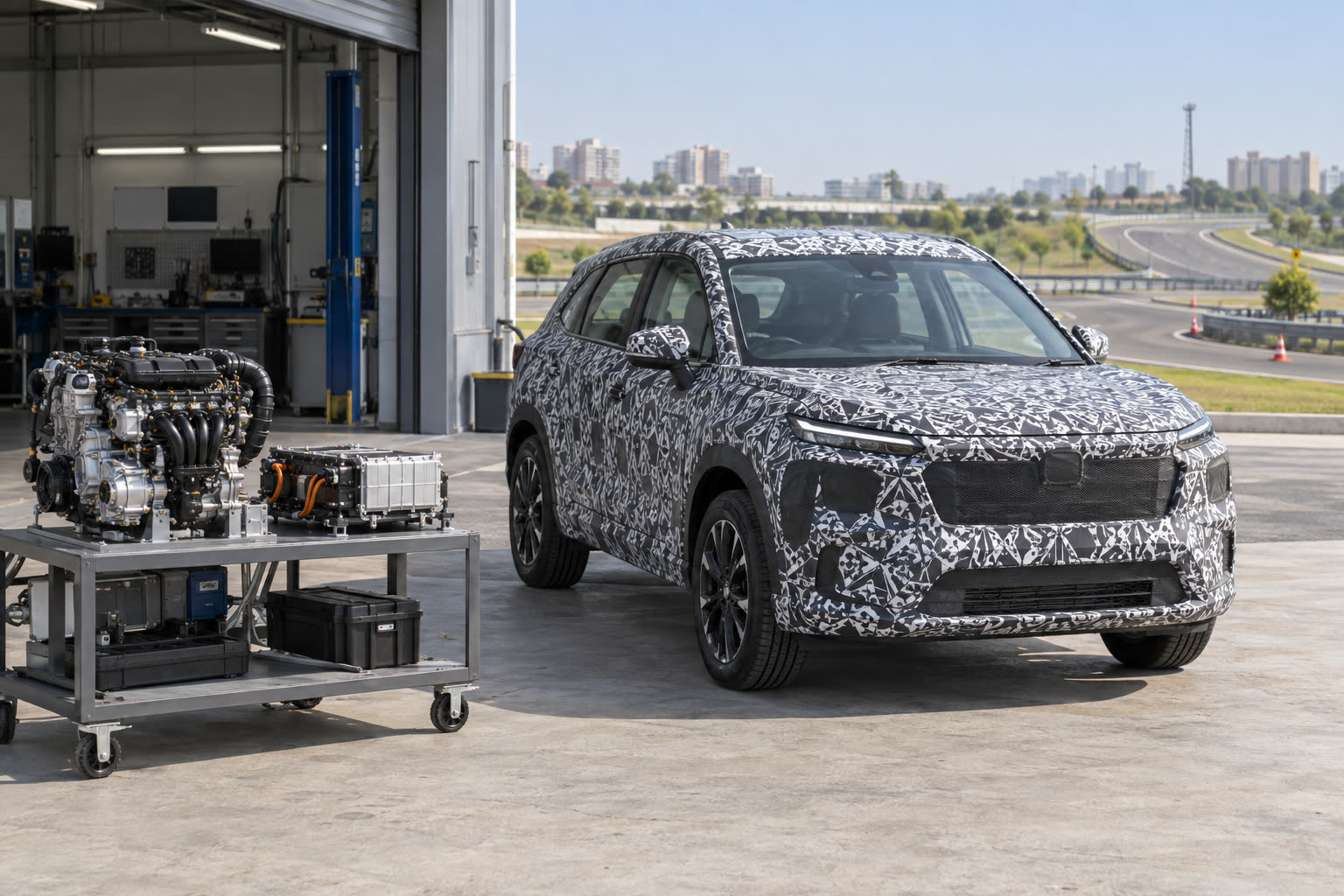
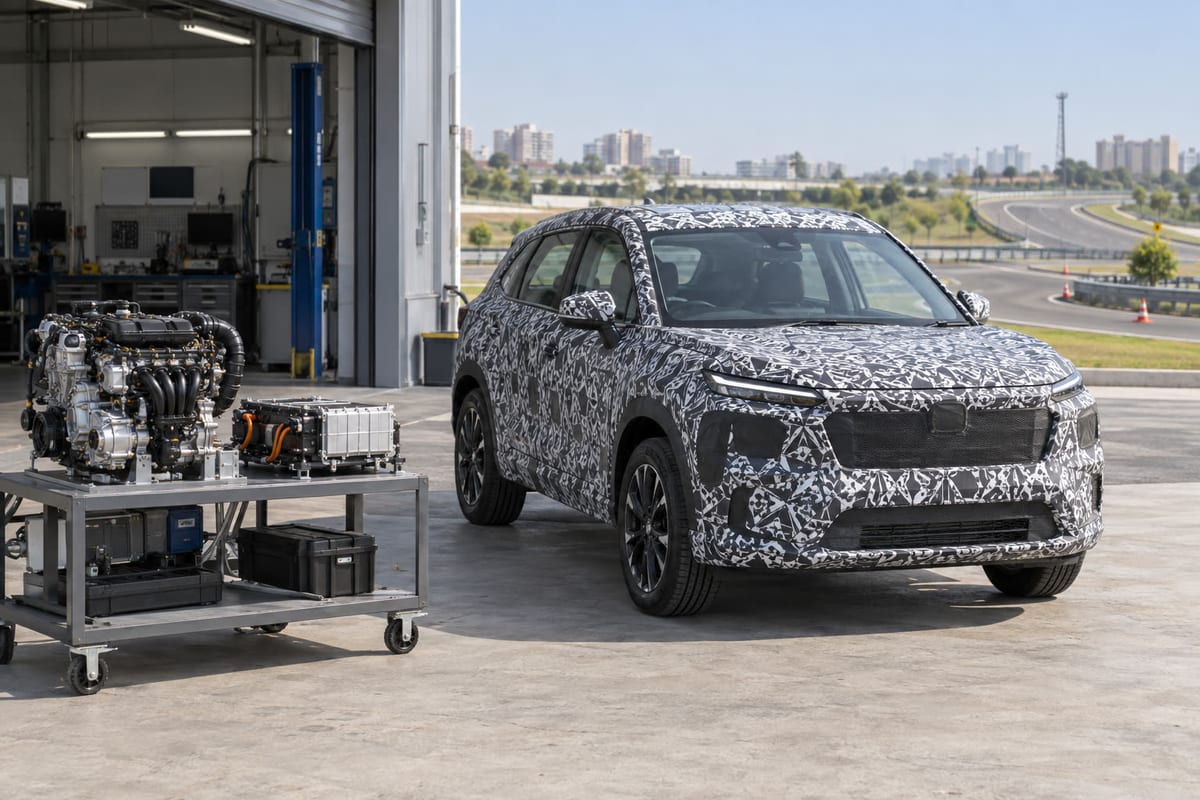 Illustrative editorial image generated for FuelPrice; Honda has not released an official image of this SUV or engine programme.
What Honda has confirmed
Honda’s global “Summary of 2026 Honda Business Briefing”, published on 14 May 2026, says the company will begin introducing strategic models tailored for India from 2028. It identifies two broad categories: vehicles under four metres in length and mid-size vehicles. Honda says the products will be developed around Indian customer needs and will use local development resources more actively.
That official roadmap confirms the timing and broad market direction, but it does not name a compact SUV, an engine supplier or a powertrain. Autocar India also reported Honda’s confirmed plan for a new sub-four-metre model in 2028, while noting that the company had not released product specifications. The exact body style, launch sequence and production plan should therefore be treated separately from the confirmed category-level roadmap.
What is being reported about the engine
Autocar Professional reported on 26 Sep 2026 that Honda Cars India is discussing a possible 1.2-litre engine supply arrangement with Horse Powertrain. The report said the engine family could support petrol, petrol-electric hybrid and CNG applications for an upcoming compact SUV. TV9 Hindi separately reported the same possibility on 27 Sep 2026, while also making clear that the supplier and programme were not officially confirmed.
Horse Powertrain is a powertrain company associated with Renault Group and Geely, with Saudi Aramco as a shareholder, according to both reports. The company’s relevance to this story is its focus on combustion and hybrid systems that can be adapted for different applications. A sourced engine could help Honda address several fuel types without developing every version entirely in-house, but that is an industry rationale—not a confirmed Honda business decision.
Honda told Autocar Professional that it works with a broad ecosystem of technology, engineering and supplier partners, but does not comment on specific partners, sourcing discussions or future powertrain programmes. That response is why the reported Horse Powertrain arrangement should remain labelled as a possibility until Honda or the supplier makes a formal announcement.
Why a multi-fuel strategy matters to Indian drivers
A compact SUV offered with different fuel choices could serve very different driving patterns. A petrol version may suit buyers who want simpler refuelling access, a CNG version may appeal to high-mileage urban users who have a convenient gas station, and a hybrid could target drivers who want lower fuel use in stop-and-go traffic. None of those benefits can be quantified yet because Honda has not confirmed the engine calibration, certified efficiency, battery size or CNG tank layout.
For a future buyer, the useful comparison will be running cost rather than the fuel label alone. Once official efficiency and prices are available, the fuel cost calculator can help compare a typical commute or monthly distance across powertrains. The calculation should use the relevant city rate and the buyer’s real distance, not a headline efficiency figure by itself.
Fuel prices vary across India and can change independently of a vehicle launch. Readers tracking the ownership case can check live fuel prices across Indian cities separately from the vehicle’s ex-showroom price. For longer-distance use, route length, traffic, tolls and access to CNG or charging infrastructure can matter as much as the advertised engine specification; the road-trip planner can help frame that wider trip-cost question when the final vehicle details are known.
What is still unconfirmed
- Model identity: Honda has not announced a name, design, dimensions or variant list for the under-four-metre vehicle.
- Engine agreement: the reported discussion with Horse Powertrain is not a confirmed supply contract or launch commitment.
- Technical details: power, torque, transmission, certified fuel efficiency, hybrid battery capacity and CNG tank size are unknown.
- Price and timing: Honda has not announced an ex-showroom price, booking window, delivery start or exact India launch date.
- Ownership support: service intervals, warranty terms, parts availability and the network for any new powertrain will need to be disclosed before buyers can compare ownership risk.
What prospective buyers should watch
The next meaningful update would be an official Honda announcement naming the model or confirming the powertrain programme. Buyers should then look for the certified fuel-efficiency figure, not an early estimate; the transmission paired with each fuel option; and the amount of standard safety and driver-assistance equipment included at the expected price.
For the CNG version, boot-space impact, tank placement, warranty coverage and the availability of authorised service will be important. For a hybrid, buyers will need the battery warranty, operating conditions behind the efficiency claim and the cost of scheduled maintenance. For the petrol version, the comparison should include the final engine output, transmission and on-road price rather than only the displacement.
Honda’s use of external engineering or powertrain resources would not by itself determine whether the vehicle is a good or poor fit. The practical test will be how the finished SUV is calibrated for Indian roads, how consistently it is supported after sale and whether the price reflects the equipment and running costs. Those are questions that cannot be answered from the current report.
What happens next
The confirmed part of the story is Honda’s India-focused product roadmap beginning in 2028. The reported part is the possible use of a 1.2-litre Horse Powertrain engine family with petrol, hybrid and CNG applications. Until Honda publishes a model announcement or a formal technical specification, there is no confirmed price, booking process or buyer action linked to this report.
Bottom line: Honda appears to be preparing a broader India strategy for the high-volume under-four-metre segment, but the reported engine sourcing should be read as an early development signal. The final vehicle, fuel options and ownership cost will become meaningful only after the company confirms them.
Sources
- Honda, “Summary of 2026 Honda Business Briefing” — 14 May 2026
- Autocar Professional, “Exclusive: Honda to Source Horse 1.2-litre Engine for New Compact SUV” — 26 Sep 2026
- TV9 Hindi, “Honda की नई SUV में नहीं मिलेगा कंपनी का अपना इंजन! Powertrain will come from outside, know why” — 27 Sep 2026
- Autocar India, “Honda announces new sub-4m SUV for India” — 14 May 2026