Hyundai Motor India has confirmed that it is preparing a dedicated mass-market electric vehicle for India in Q4 FY27, which falls between January and March 2027. The update matters to buyers because it points to a new, more accessible Hyundai EV, while the model’s production name, price, battery and certified range are still not official.
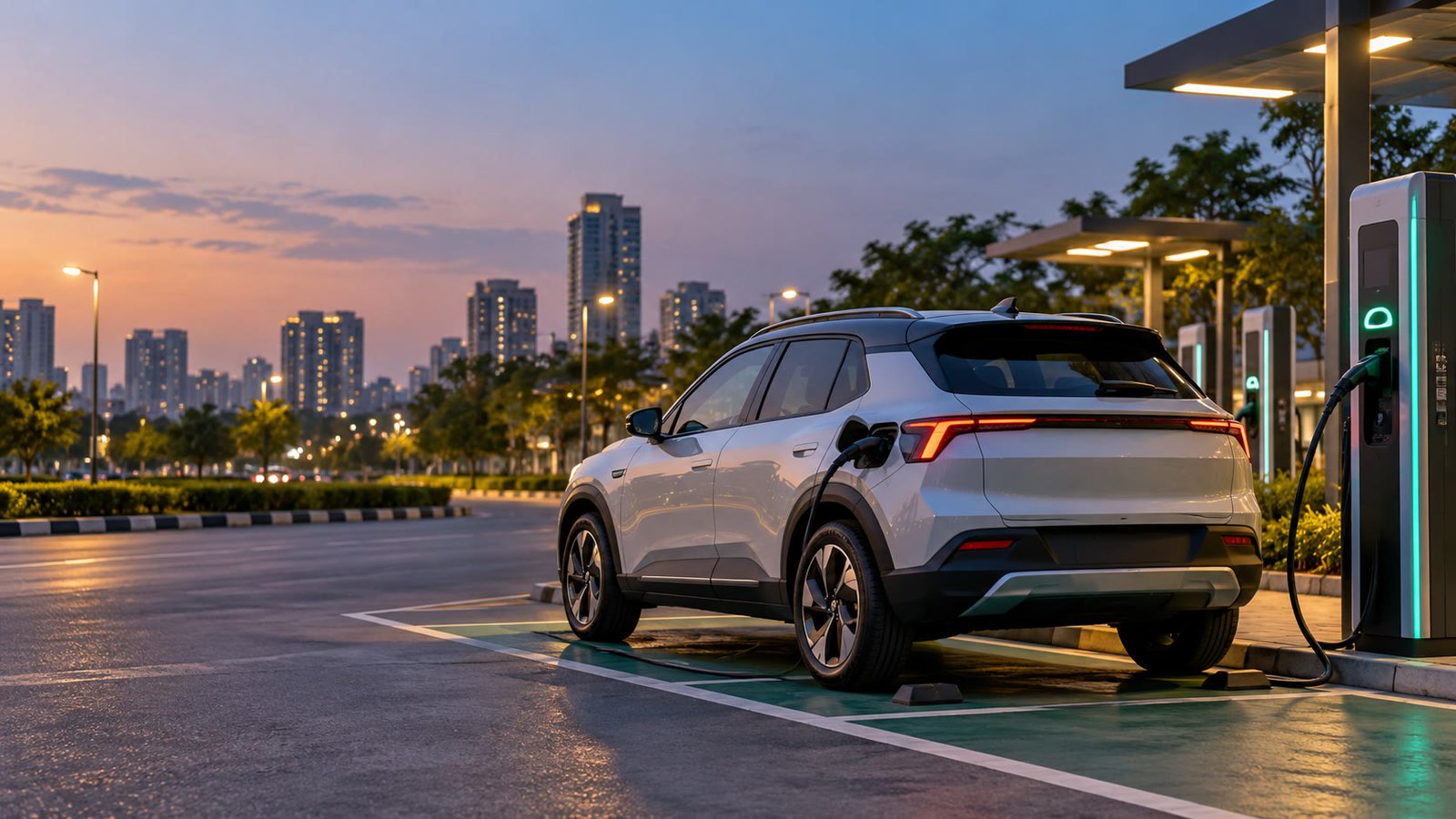
Image note: this is an illustrative public-charging scene, not a photograph of Hyundai’s unreleased model.
Key takeaways
- Hyundai Motor India’s 28 Oct 2026 results release places the planned mass-market EV in Q4 FY27.
- Hyundai Motor’s global roadmap describes an A-segment SUV EV that will be localised and designed for India.
- Next-generation infotainment and Level 2 assisted-driving technology have been stated as planned features.
- “Ioniq P” is a reported name, not a name Hyundai has formally confirmed in its India release.
- Price, battery size, certified range, booking date and final launch date have not been announced.
What Hyundai confirmed on 28 October
In its Q2 FY27 financial-results release dated 28 October 2026, Hyundai Motor India said it was “fully geared up” for the launch of a dedicated mass-market EV in Q4 FY27. Hyundai’s financial year runs from April to March, so that window means January to March 2027.
This is an official launch window, but it is not the same as a fixed launch day. The release does not announce bookings, a price list, a battery specification or a certified driving-range figure. Independent reports from CarWale and DynoBHP also interpret the company’s latest update as a January–March 2027 launch plan.
There is an earlier timing difference worth noting. Autocar India reported in September that Hyundai Motor India’s managing director and CEO had indicated an end-2026 debut, while the company’s later 28 October results release places the planned launch in Q4 FY27. Until Hyundai publishes a firm date, the later official company window is the most current reference; the earlier report remains relevant background rather than a confirmed delivery date.
What is known about the vehicle
Hyundai Motor’s 26 August 2026 CEO Investor Day roadmap described an all-new A-segment SUV EV for India. The company said the new electric SUV would be localised and designed for India, and would receive a next-generation infotainment system and Level 2 assisted-driving technology.
Those statements establish the direction of the product, not its final specification. The official material does not identify the model name, battery chemistry, usable battery capacity, charging speed, boot volume or ARAI-certified range. Autocar India has separately reported development and battery-sourcing details for Hyundai’s compact EV programme, but those reported details should not be read as a final India-market specification until the company publishes them.
Is the “Ioniq P” name confirmed?
CarWale reported on 29 October that Hyundai referred to the small EV as “Ioniq P” during its global quarterly earnings call. The same report used conditional wording—“if it is going to be called that”—and Hyundai’s India results release did not name the vehicle.
That distinction matters for searchers looking for an “Ioniq P price” or “Ioniq P range”. The name is a useful reported identifier for the story, but it should not be treated as a confirmed product title. The same caution applies to online expected-price cards, battery figures and range estimates that are not accompanied by a Hyundai specification or homologation document.
Why this matters to Indian EV buyers
Hyundai’s India website currently lists the IONIQ 5 and Creta Electric among its electric cars. A smaller India-focused model could broaden the company’s EV choice for households that want a compact SUV format, but that is an inference about market positioning, not a promise of a particular price band or sales outcome.
The practical question for buyers will be whether the new vehicle’s complete ownership cost matches its use case. Ex-showroom price alone will not answer that. Buyers will eventually need the on-road price in their state, any applicable state support, insurance, home-charger cost, charging tariff, service plan and battery warranty alongside the official range.
What to compare when details arrive
- Battery and warranty: check usable capacity, warranty duration, mileage conditions and what is covered if battery performance declines.
- Charging: compare the included home-charging equipment, installation requirements, AC charging time and DC fast-charging capability.
- Access: use the state-wise EV charging directory to see how public charging availability fits the routes you actually drive.
- Running cost: benchmark a current petrol or diesel route with the fuel-cost calculator, then compare it with the EV’s electricity assumptions once Hyundai publishes them.
- Long trips: use the road-trip planner to think through distance, stops and charging time rather than comparing brochure range alone.
For a live baseline on conventional fuel costs while waiting for the Hyundai EV’s official numbers, readers can check current petrol and diesel prices. The comparison should use the same route, driving pattern and time period; a headline efficiency number can otherwise make two powertrains look more alike than they are in daily use.
What changes now
For now, the announcement changes Hyundai’s product roadmap, not the terms of a showroom purchase. There is no official order page, final model name, launch-day schedule or price list for this EV in the company material cited here. Existing Hyundai EVs remain the currently documented options, while this vehicle is still a future launch.
The next useful update will be the release of the production name and core specifications. After that, buyers can make a meaningful comparison using on-road pricing, charging support, warranty terms and route-specific running costs. Until then, reported names and estimates are best treated as watch items rather than purchase figures.
What to watch next
- Hyundai’s formal announcement of the production name and booking timeline.
- Battery capacity, certified range, charging hardware and safety equipment.
- Ex-showroom and on-road pricing, including the variants offered in India.
- Details of local production, service coverage and public-charging support.
Reader takeaway
The firm news is Hyundai’s latest official target: a dedicated mass-market EV for India in Q4 FY27, backed by a stated India-focused SUV and technology direction. The “Ioniq P” name, price and range remain reported or unknown. Buyers can track the launch, but there is not yet enough official information to calculate the vehicle’s final purchase or trip cost.
Sources
- Hyundai Motor India Limited Q2 FY27 Financial Results — 28 Oct 2026
- Hyundai Motor Company Charts Profit-Driven Growth Roadmap at 2026 CEO Investor Day — 26 Aug 2026
- Hyundai Ioniq P To Be The Name of The Small EV for India? — 29 Oct 2026
- Hyundai compact EV to debut by end of 2026 — 3 Sep 2026
- Hyundai Confirms a Mass-Market EV for India by March 2027 — 29 Oct 2026