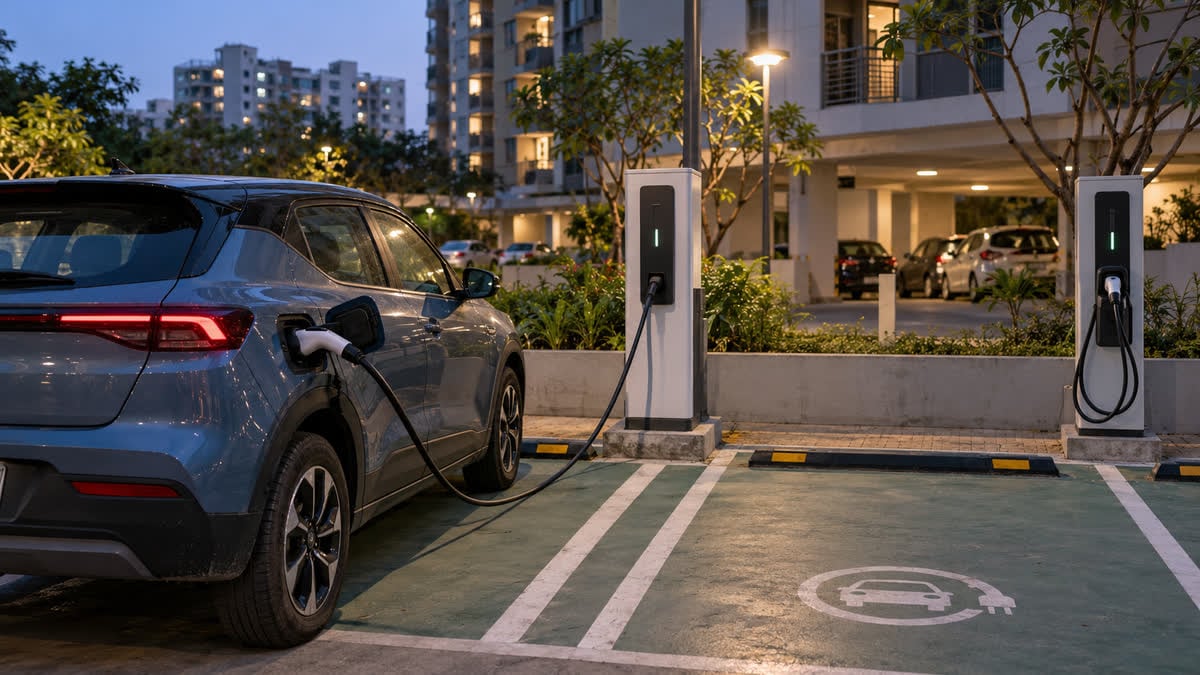
Bain & Company’s Global Automotive Consumer Survey 2026 finds battery reliability is the top barrier among Indian consumers sceptical of battery-electric vehicles (BEVs), with 52% citing it. The 21 Oct 2026 findings matter to prospective buyers because charging access and charging time ranked next, putting home-charging practicality alongside purchase price in the decision.
Key takeaways
- Battery reliability was cited by 52% of Indian BEV sceptics, ahead of insufficient charging infrastructure at 44% and long charging times at 43%.
- High vehicle price was cited by 32% of sceptical respondents, placing it behind battery and charging concerns in the survey.
- 57% of Indian consumers said they were open to buying a BEV, but Bain cautions that stated interest does not automatically become a purchase.
- About 71% of existing Indian BEV owners reported charging at home often or always, making parking and electricity access important ownership checks.
The findings are from Bain’s Global Auto Consumer Survey: Regional Trends in a Changing World — India Insights. Bain’s 21 Oct 2026 release says the wider study covered more than 12,000 automotive consumers across 11 markets; India-specific findings were also reported by TOI Auto and ANI/The Tribune on the same date. The survey is a measure of consumer views, not a battery-failure rate or a forecast of EV sales.
Battery confidence comes before price for many sceptics
The order of concerns gives the survey its practical value. For Indian respondents who were hesitant about BEVs, the first question was whether the battery would remain dependable, followed by whether a usable charger would be available and how long charging would take. Price still mattered, but it was not the leading barrier in the reported India results.
The difference matters because a lower sticker price does not remove the daily inconvenience of a charger that is occupied, unreliable or too far from a regular route. It also explains why a buyer comparing an EV with a petrol or diesel car needs to look beyond the purchase quote and examine the time and access required to keep the vehicle ready.
| Concern among Indian BEV sceptics | Share citing it | What it means for a buyer |
|---|---|---|
| Battery reliability | 52% | Check warranty scope, exclusions and battery-health terms. |
| Insufficient charging infrastructure | 44% | Map dependable chargers around home, work and regular routes. |
| Charging takes too long | 43% | Check AC/DC compatibility, charging power and typical waiting time. |
| High vehicle price | 32% | Compare total ownership cost, not only the ex-showroom price. |
Source context: Bain’s India Insights survey results, published 21 Oct 2026 and reported independently by TOI Auto and ANI/The Tribune. Multiple concerns could be relevant to the same respondent.
What the findings mean for Indian EV buyers
Home charging is an access question
About 71% of existing Indian BEV owners in the survey said they charge at home often or always. That does not mean every prospective owner has the same option. A buyer in a house with a dedicated parking socket may have a different routine from a resident who parks on a public road or in a shared apartment bay.
Before treating home charging as a given, check whether the parking space is assigned, whether the building permits a charger, whether the electrical load can support it and who pays for installation and electricity. For public top-ups, FuelPrice’s state-wise EV station directory can help with the first availability check; actual uptime, connector compatibility and payment requirements still need confirmation with the operator.
Battery warranty needs careful reading
The survey measures confidence, so a warranty cannot be treated as proof that a battery will never degrade. It is a contract that defines what happens if specified conditions are met. Compare the covered years and kilometres, the battery-health threshold if one is stated, transfer rules for a second owner, exclusions and the process for a claim. Keep those terms separate from a manufacturer’s general statement about battery life.
Test drives can reduce uncertainty, but do not guarantee a purchase
Bain’s India findings reported by TOI Auto and ANI/The Tribune say 82% of respondents who had test-driven a BEV would consider buying one, compared with 66% of those who had not. That is an association in survey responses, not proof that a test drive alone causes a purchase. It does show why buyers should use a test drive to examine seating, visibility, regenerative braking, charging information and the real-world route they expect to drive.
A practical pre-purchase checklist
- Write down the charging routine. Identify where the car will charge on ordinary weekdays and what the backup is when that point is unavailable.
- Match the car to the route. Check charger locations and connector types along regular intercity trips rather than relying only on the advertised range. The FuelPrice road-trip planner can help organise the route and stops.
- Separate energy cost from ownership cost. Include installation, maintenance, insurance, finance, tyres and the opportunity cost of charging time. For a like-for-like petrol comparison, the fuel-cost calculator provides a starting point for the conventional-car side of the calculation.
- Ask for written battery terms. Save the warranty document, service schedule and any battery-health reporting method before making a comparison.
Drivers planning longer journeys can also read FuelPrice’s earlier report on public EV charging station availability and highway reliability. The survey’s message is not that every EV buyer will face the same problem; it is that charging access and battery confidence deserve the same attention as price and range.
What to watch next
The next test for the EV market is conversion: turning interest into ownership without leaving buyers to solve battery and charging uncertainty on their own. More transparent warranty language, better information about charger uptime and easier access to test drives would address different parts of the concern identified by Bain. For buyers, the useful response is to compare those practical details model by model and route by route, rather than treating the survey as a verdict for or against electric vehicles.
Frequently asked questions
Does the 52% figure mean 52% of EV batteries fail?
No. It is the share of Indian consumers sceptical about BEVs who named battery reliability as a purchase barrier. It measures perceived risk, not observed failure frequency.
Is price no longer important for EV buyers?
No. The survey reported high vehicle price as a concern for 32% of Indian BEV sceptics. The finding is that battery reliability and charging concerns ranked higher in the reported India results.
What should apartment residents check first?
Check assigned parking, society permissions, electrical capacity, installation responsibility and a workable public-charging backup before comparing vehicle prices.
Sources
- Bain & Company — Global Auto Consumer Survey: Regional Trends in a Changing World — India Insights — 21 Oct 2026
- Bain & Company via PR Newswire — Price still dominates car buying in US and Europe, while China puts technology first — 21 Oct 2026
- TOI Auto — Indian EV Buyers Fear Battery Reliability More Than High Prices: Bain & Company Survey Finds — 21 Oct 2026
- The Tribune/ANI — Battery reliability concerns, charging gaps remain key barriers to EV adoption in India: Bain survey — 21 Oct 2026