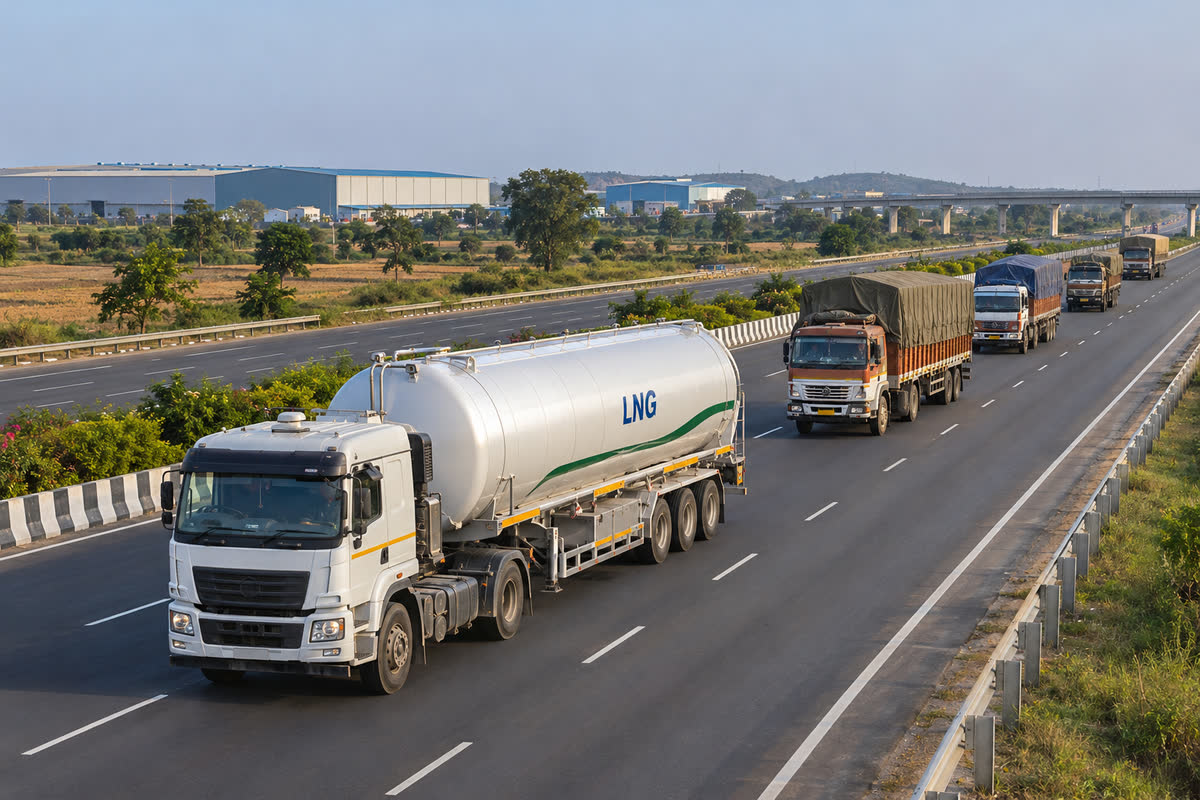
The International Gas Union (IGU) published a report on 28 Nov 2026 saying India’s LNG trucking opportunity will depend on refuelling corridors, vehicle finance, competitive fuel prices and secure supply. For Indian fleet operators and freight customers, the message is that LNG cannot compete with diesel on fuel price alone: the route, station network and total operating cost will decide whether a switch is workable.
Key takeaways
- The IGU report is an industry assessment, not a new Indian government mandate or a change to vehicle rules.
- It says India’s freight demand could nearly triple between 2019–20 and 2030–31, increasing the importance of long-haul fuel choices.
- Government research has separately identified LNG stations, price stability and financing as conditions for a viable heavy-truck ecosystem.
- Fleet operators need route-level evidence before treating LNG as cheaper or cleaner in every application.
What the new IGU report says
In its 28 Nov 2026 report, “From Pilots to Corridors”, the IGU examines where liquefied natural gas can compete with diesel in long-haul trucking and where it may reduce local pollutants. It says freight demand could nearly triple between 2019–20 and 2030–31, but presents that as a planning outlook rather than a guaranteed market outcome.
The report’s central point is that adoption will be corridor-led. A truck needs dependable access to LNG along the route, a fuel price that makes sense against diesel, a secure supply chain and financing that reflects the vehicle’s resale and operating risks. If one of those pieces is missing, a lower quoted fuel price may not translate into a lower cost per trip.
That distinction matters because the report does not announce a subsidy, a mandate or a nationwide retail price. It is a newly published assessment from an industry body. Any change in Indian vehicle policy, fuel taxation or station approvals would still need to come from the relevant government authority.
Why refuelling corridors matter first
LNG is intended mainly for heavy vehicles travelling long distances, rather than for every car or short urban delivery route. A corridor with too few compatible stations can force a fleet to carry operational buffers, detour for fuel or keep diesel vehicles available as a fallback. Those costs can offset the benefit of a lower LNG quote.
The practical starting point for a fleet is a diesel baseline for its actual work: route distance, payload, empty return legs, tolls, driver time, maintenance and refuelling stops. FuelPrice’s fuel-cost calculator can help structure the diesel portion of that comparison; an LNG case still needs a verified station plan and a supplier quote for the route.
Operators also need to distinguish a national station target from a usable corridor. A station announced on paper does not guarantee that it is open, compatible with the truck, supplied on the required day or positioned at the right interval. For long-haul transport, availability and reliability are part of the fuel cost.
Finance and delivered price remain bottlenecks
The IGU’s focus on vehicle finance reflects the higher uncertainty around a new fuel ecosystem. A fleet’s decision is not just the price of gas at the dispenser. It includes the truck’s upfront cost, financing terms, expected utilisation, payload, service support, replacement timing and the risk that a route or station network develops more slowly than expected.
A Petroleum and Natural Gas Regulatory Board case study published on 9 Apr 2025 likewise described LNG trucking in India as nascent and identified station expansion, price stability and easier financing as parts of the ecosystem needed for growth. Its scenarios projected 30,000 to 50,000 LNG trucks by 2030, depending on the scenario. That is a government research projection, not the current number of LNG trucks on Indian roads.
A NITI Aayog-hosted ICF study on LNG in medium- and heavy-commercial vehicles also treated infrastructure, fuel pricing and financing risk as connected issues. It noted that emissions results depend on the vehicle, route and the treatment of upstream leakage, so “lower-emission” should not be read as a blanket result for every truck or operating pattern.
What it means for drivers, fleets and freight costs
There is no immediate change to petrol, diesel or CNG prices for private motorists because of this report. The near-term relevance is to transporters, manufacturers, fuel suppliers and businesses that buy road freight. If LNG fleets grow on suitable corridors, operating costs and local pollution could change over time, but those effects would depend on actual fuel contracts, station uptime, vehicle utilisation and competition between technologies.
- Fleet operators: compare delivered fuel cost with the full route cost, including downtime, payload and backup-vehicle needs. Treat projections as scenarios, not promises of savings.
- Freight customers: ask whether a carrier’s claimed fuel benefit is based on a specific route and dated fuel price, rather than a national average or an unverified estimate.
- Private drivers: the story does not change today’s pump prices. Current petrol, diesel and CNG benchmarks can be checked on FuelPrice’s live fuel prices hub.
- Route planners: tolls remain part of a long-haul operating model. Use the toll charge calculator alongside fuel assumptions when comparing corridors.
What to watch next
The next useful signals will be operational rather than promotional: verified LNG station openings on major freight corridors, transparent delivered-price quotes, truck availability, service coverage and financing products that match commercial-vehicle cash flows. A route-by-route station map will be more useful to operators than a broad national headline.
There is also an early vehicle-supply signal. Maritime Gateway reported on 24 Nov 2026 that Ashok Leyland was preparing additional LNG trucks for long-haul operations, while noting that specifications and a confirmed launch date had not been announced. That is reported company activity, not proof that a nationwide LNG switch is imminent.
Bottom line
The IGU report is best read as a checklist for India’s freight transition. LNG may fit some high-utilisation, long-haul routes, but the business case depends on a connected refuelling corridor, stable and competitive delivered prices, suitable trucks and workable finance. For drivers and freight buyers, the important question is not whether LNG is automatically cheaper; it is whether the complete route can operate reliably at the quoted cost.
Sources
- International Gas Union, “The opportunity to scale LNG trucking in India Report” — 28 Nov 2026
- Petroleum and Natural Gas Regulatory Board, “Natural Gas consuming sectors” — 9 Apr 2025
- NITI Aayog and ICF, “LNG as a Transportation Fuel in Medium & Heavy Commercial Vehicle Segment” — 2024
- Maritime Gateway, “Ashok Leyland prepares new LNG trucks for long-haul freight operations” — 24 Nov 2026