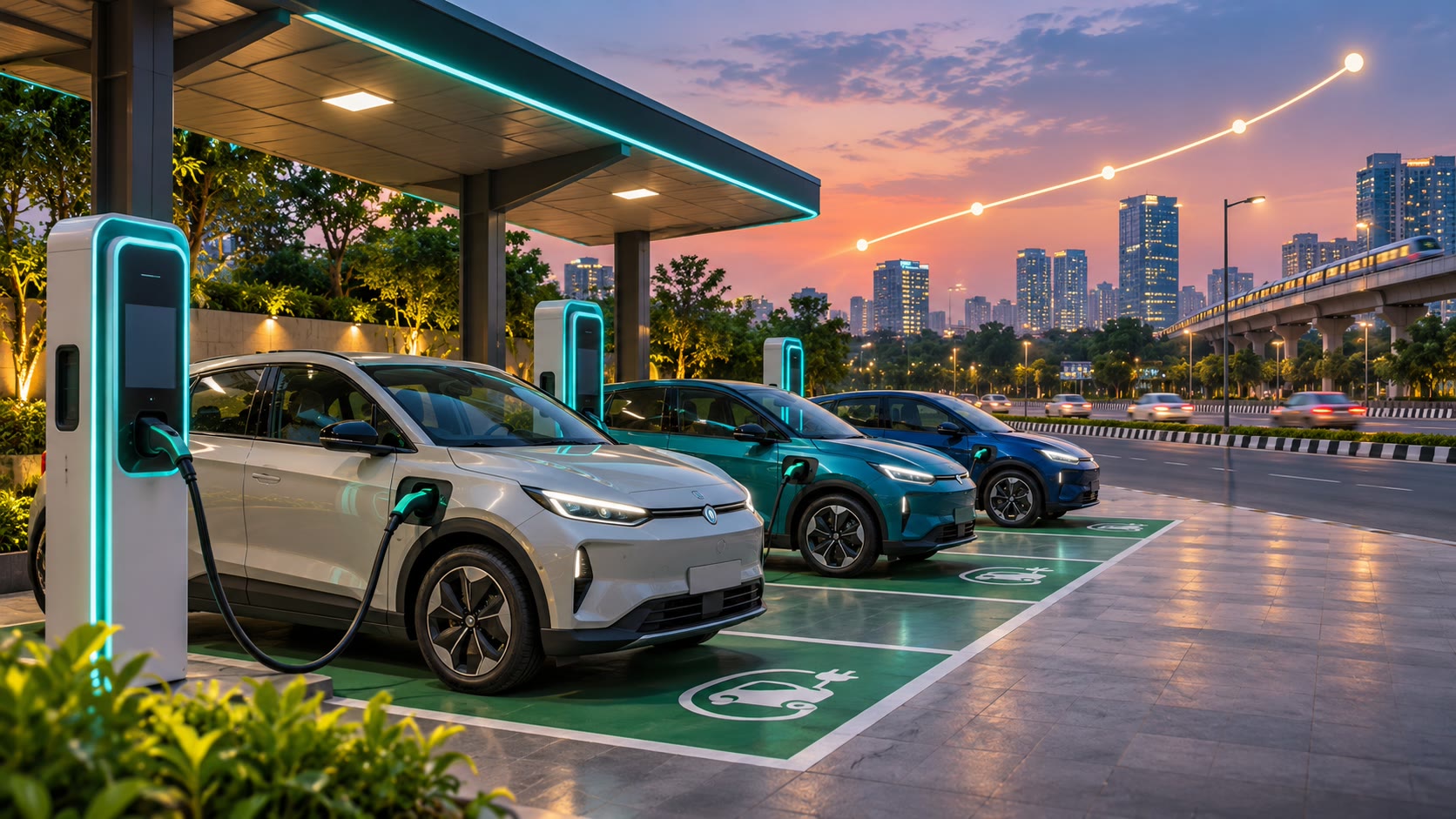
India’s electric passenger-vehicle (PV) registrations reached about 2.59 lakh by 25 Nov 2026, according to a report citing the Government’s Vahan data. That is above the 2.22 lakh recorded for the whole of FY26, giving buyers a clearer signal that battery-powered cars and utility vehicles are moving beyond a niche segment.
The latest figure covers the current financial year to date, not a completed annual result. It also describes registrations counted in Vahan-based reporting, so it should be read as a timely market indicator rather than a guarantee about any particular model’s price, range or resale value.
Key takeaways
- Electric PV registrations reached about 2.59 lakh by 25 Nov 2026, above the reported FY26 total of 2.22 lakh.
- Battery-powered cars and utility vehicles reached a 7.6% share of PV registrations in the latest snapshot, compared with 4.6% in the FY26 comparison used by the report.
- Tata remained the leading electric-PV maker, with Mahindra and JSW MG Motor among the other largest contributors.
- FADA’s separate October retail release put electric PV penetration at 7.30%, reinforcing the direction of travel while using a different reporting window.
- For a buyer, charging access, route pattern, warranty and total ownership cost still matter more than the national sales headline alone.
What the latest Vahan reading shows
The 2.59 lakh tally refers to electric cars and utility vehicles counted within the passenger-vehicle category. The figure was reported on 26 Nov 2026 using Vahan data available up to 25 Nov. Compared with the 2.22 lakh reported for all of FY26, the current tally is roughly 16.7% higher, calculated from the two published figures, even though the current year still has months left.
The brand mix shows that the market is not being driven by one new entrant alone. Tata remained in front, Mahindra held the next position, and JSW MG Motor continued to account for a substantial share of electric-PV registrations. The report also noted activity from VinFast, Maruti Suzuki and Kia, pointing to a broader set of choices than the market had a few years ago.
At 7.6%, the latest penetration rate means that roughly eight of every 100 new passenger vehicles in the snapshot were battery-powered. That is a share of new registrations, not the proportion of all vehicles already on Indian roads. Petrol, diesel, CNG and hybrid vehicles still make up the majority of new PV registrations.
Why the milestone matters for Indian drivers
The latest Vahan reading is useful because it connects product availability with actual registrations. A larger installed base can make it easier for owners to find model-specific service experience, compare charging options and assess how a vehicle fits a common commute. Those benefits are not automatic, but a larger market gives buyers more evidence to examine than a launch claim or a brochure range.
An independent cross-check points in the same direction. The Federation of Automobile Dealers Associations (FADA) reported a 7.30% electric share of passenger-vehicle retail in October 2026, while the later Vahan snapshot was 7.6%. The two figures cover different dates and reporting systems, but both are above FADA’s FY26 PV EV share of 4.25%. The gap between the datasets is a reminder to compare like-for-like numbers rather than treating every EV percentage as interchangeable.
What buyers should check before comparing EVs
Compare the route, not only the brochure
A national sales milestone does not tell an owner what a vehicle will cost on a particular commute. Compare the electricity tariff, charging losses, home-charging installation and likely public-charging use with the petrol or CNG cost for the same route. The fuel cost calculator can provide a conventional-fuel baseline for that comparison; the EV side still needs the vehicle’s usable battery size and the applicable charging rate.
Check charging access before a long trip
Daily home or workplace charging and occasional highway charging are different needs. Check whether the preferred model’s connector, charging speed and network availability suit the places the vehicle will actually visit. FuelPrice’s EV charging directory can help locate public charging points by state, while the road-trip planner is useful for thinking through stops and route length before treating a claimed range as a trip plan.
Separate market growth from model fit
Buyers still need to compare the exact vehicle’s on-road price, usable range, battery and vehicle warranty, service coverage, insurance cost, boot or cargo space and financing terms. A rising national share can show that the category is gaining acceptance, but it cannot establish that every model suits every driver or that a particular ownership cost will be lower.
How to read the data carefully
Vahan registration counts and FADA retail data are both valuable, but they are not identical datasets. They can differ in coverage, cut-off date, category definitions and the way updates arrive from registering authorities. That is why the current report’s FY26 comparison uses a 4.6% electric-PV share, while FADA’s own FY26 release reports 4.25% for its PV retail dataset. Neither figure should be silently substituted for the other.
The practical conclusion is still clear: electric PV registrations have grown quickly in FY27 and have already passed the prior full-year Vahan-based tally cited in the latest report. The next useful checks are whether the share holds through the rest of the financial year, whether supply keeps pace with enquiries, and whether charging access expands alongside vehicle sales.
Reader takeaway
India’s electric passenger-vehicle market is now large enough for registration data to influence a real purchase comparison. Use the 2.59 lakh milestone as evidence of momentum, then test any vehicle against the routes, charging access, warranty and total costs that apply to your own use.
Sources
- Vahan Public Report, Parivahan Analytics, Government of India — accessed 27 Nov 2026.
- Electric PV sales cross FY26 tally, penetration rises to 8%, The Times of India — 26 Nov 2026.
- FADA Releases Oct’26 Vehicle Retail Data, Federation of Automobile Dealers Associations — 6 Nov 2026.
- FADA Releases FY’26 and March’26 Vehicle Retail Data, Federation of Automobile Dealers Associations — 6 Apr 2026.